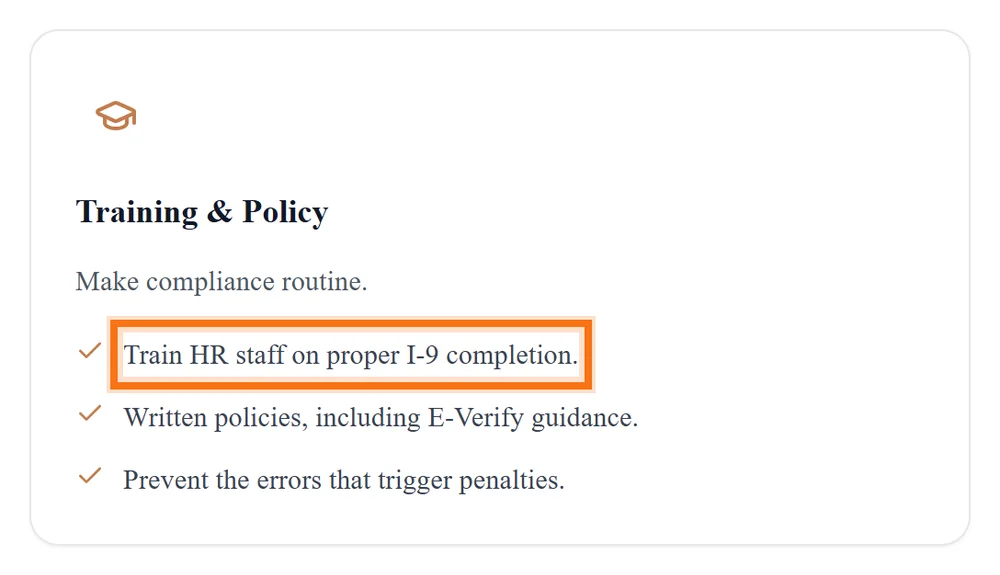
Texas HR managers can get I-9 training from two kinds of providers. The federal government runs free sessions: USCIS and E-Verify host live Form I-9 and E-Verify webinars, and the Justice Department’s Immigrant and Employee Rights Section (IER) runs free employer webinars on discrimination rules. An immigration law firm adds training built around your own forms, your own errors and written policies. In Dallas, Atlas Immigration Law trains HR staff on proper I-9 completion as part of its I-9 compliance work.
Key takeaways
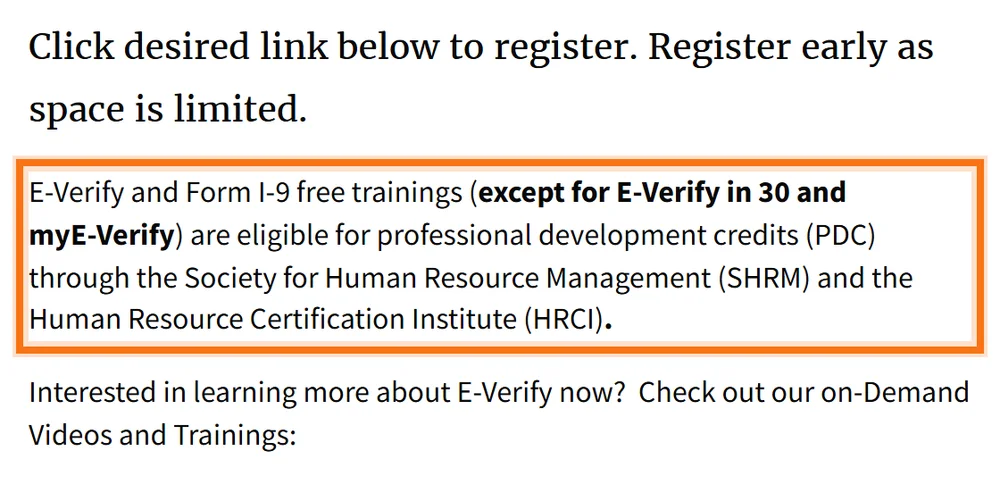
Train everyone who completes Section 2, not only the HR manager. The free E-Verify and Form I-9 webinars count toward SHRM and HRCI recertification credits (except E-Verify in 30 and myE-Verify). Every new E-Verify user must take a tutorial that includes fraudulent document awareness training. Training must cover what not to do as well: asking for specific documents or acting on an E-Verify mismatch too early creates liability of its own. Paperwork fines run $288 to $2,861 per form even when every worker is authorized.
Who on your team needs I-9 training
Federal law requires every employer that hires someone in the United States to complete Form I-9 for that person, citizens included. The form looks simple, but the mistakes that cost money happen at the desk where it is completed: a Section 2 finished on day four, a document title written wrong, a work permit that expired with nobody noticing. Training is how you stop those mistakes before they repeat across hundreds of forms.
- Anyone who completes or signs Section 2. In a Texas company with several locations, that is often a store manager, a site supervisor or an office administrator, not HR. Each of them signs under penalty of perjury.
- E-Verify users. New E-Verify users complete the E-Verify tutorial, and anyone who creates cases needs to know how to handle a mismatch.
- Recruiters and hiring managers. They do not touch the form, but they talk to candidates about work authorization, and the anti-discrimination rules apply from the first interview question.
- Payroll and HRIS staff. They own the dates that drive reverification and the retention schedule, and they are the ones who match payroll against I-9s in a self-audit.
- New HR leaders. If you just took over immigration compliance from a predecessor, training is the fastest way to learn which practices you inherited.
Free I-9 training from USCIS, E-Verify and the Justice Department
Before paying anyone, use the free federal sessions. They are taught by the agencies that write and enforce the rules, and they are a solid baseline for every new team member. The E-Verify training calendar lists live webinars every week, including Form I-9 Overview, Form I-9 Document Training, Employee Rights, E-Verify Overview and E-Verify for Existing Users. Registration is online, sessions run on Webex, and space is limited.
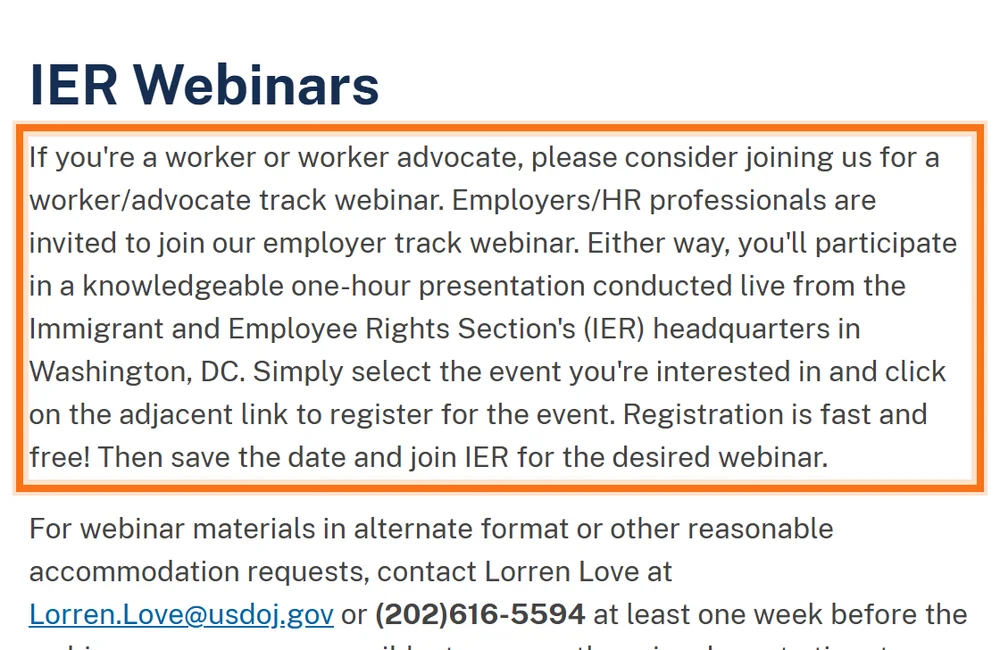
The Justice Department covers the other half of the job: how to verify without discriminating. IER runs free one-hour webinars with a separate track for employers and HR professionals, joint webinars with USCIS on employee rights, and an on-demand employer training video. Its Employer Hotline, 1-800-255-8155, answers anti-discrimination questions.
The reference every trainee should keep open is the USCIS M-274, Handbook for Employers, linked from I-9 Central. It is the agency’s own guidance on completing the form, and most training sessions follow it.
What I-9 training must cover: 8 topics for Texas HR teams
Whoever teaches it, a complete I-9 training covers the topics below. Use the table as a checklist for any session you buy or attend: if a topic is missing, your team will learn it later from an audit.
| Training topic | The rule staff must know | The mistake it prevents |
|---|---|---|
| Current form edition | Use the 01/20/25 edition, or the 08/01/23 edition with a 05/31/2027 expiration date (uscis.gov/i-9) | Forms on an expired version for every hire since the switch date |
| Deadlines | Section 1 by the first day of work; Section 2 within three business days of the start date (8 CFR 274a.2) | Late Section 2, a substantive violation that cannot be fixed later |
| Document examination | The employee chooses which acceptable documents to show; the reviewer checks that they reasonably appear genuine and relate to the person | Asking for a specific document or for more than the form requires (8 U.S.C. 1324b) |
| Remote examination | Only E-Verify employers in good standing may use the live video alternative procedure, applied consistently, with copies kept | Video checks by a company not enrolled in E-Verify for that site |
| E-Verify mismatches | Notify the employee, give the Further Action Notice, allow 10 federal government working days; no adverse action in the meantime | Firing, suspending or delaying training of a worker over a mismatch |
| Reverification | Recheck time-limited work permits by their expiration date, on Supplement B; never reverify U.S. citizens or green card holders | A worker on payroll with expired proof, or a discrimination claim |
| Corrections | Line through, correct, initial and date, attach a note; never backdate or use correction fluid | Hidden changes that ICE treats as fraud |
| Retention | Keep each form three years from hire or one year after employment ends, whichever is later | Forms purged too early, or kept long after the rule allows disposal |
How to read this table: the middle column is what each trainee should be able to say from memory, and the right column is what an auditor finds when they cannot. The first three rows apply to every hire; the E-Verify rows apply only if your company uses E-Verify, which Texas state agencies must do under Government Code section 673.002.
The document rules trainees get wrong most often
Most HR staff learn the deadlines quickly. The harder skill is the document review itself, because the rules point in two directions at once: the reviewer must reject documents that do not reasonably appear genuine, and must not demand more than the law requires. Training should practice both with real examples from the Lists of Acceptable Documents.
- Let the employee choose. Show the full Lists of Acceptable Documents and accept any valid List A document, or a List B plus a List C document. Asking a worker who "looks foreign" for a green card is the classic violation.
- Examine originals, unless you use the remote procedure. Photocopies are not enough for physical examination, with narrow exceptions such as a certified copy of a birth certificate.
- Record exactly what you saw. Document title, issuing authority, number and expiration date go in Section 2, copied from the document.
- Copy consistently or not at all. If your policy is to keep copies of documents, keep them for every employee, not just some.
- Know what reverification is not. Never reverify an expired U.S. passport or green card; only time-limited employment authorization is reverified.
E-Verify users: the tutorial and the mismatch rules
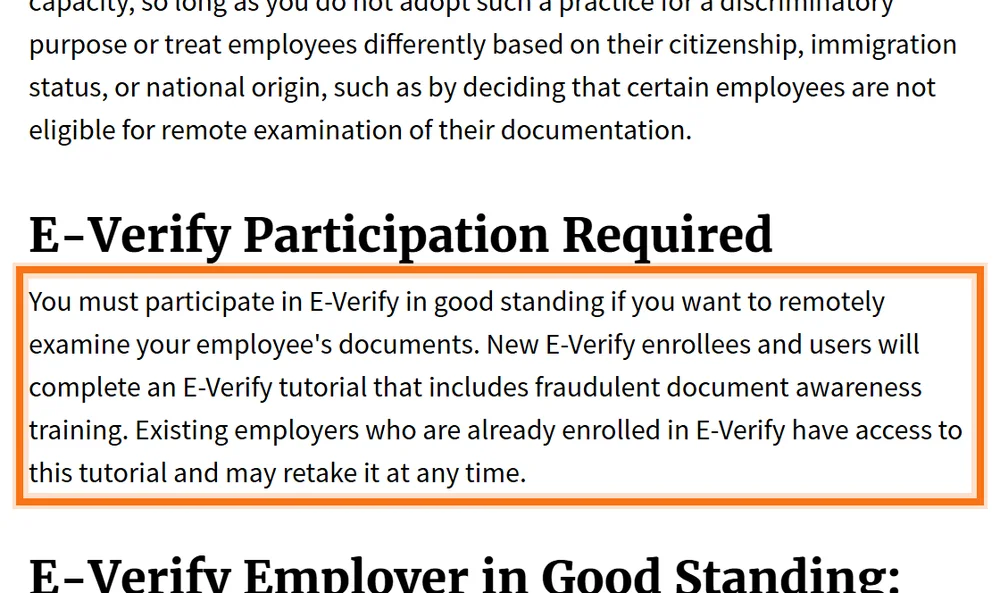
E-Verify adds its own required training. USCIS says new E-Verify enrollees and users complete an E-Verify tutorial that includes fraudulent document awareness training, and existing users can retake it at any time. That tutorial matters most if you want to examine documents remotely, because only E-Verify employers in good standing may use the video procedure.
The tutorial teaches the system. It does not replace training on what to do when E-Verify returns a Tentative Nonconfirmation, or mismatch. The steps are fixed: notify the employee as soon as possible, give them a copy of the Further Action Notice, review it with them in private, and tell them they have 10 federal government working days to say whether they will take action. If they do not answer by the end of the tenth day, you close the case.
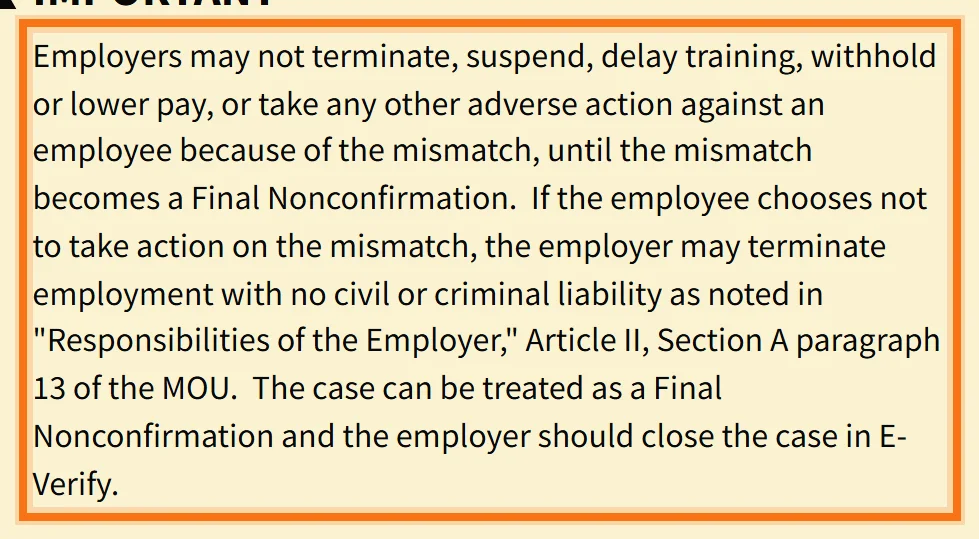
Put that box in front of every manager who supervises new hires, not only E-Verify users. A supervisor who pulls a new employee off the schedule "until the paperwork clears" can create the exact liability the rule forbids.
Want I-9 training built around your own forms?
Book a free consultation. Tell us how many people complete Section 2, whether you use E-Verify, and where your sites are, and we will explain how our training, written policies and self-audit work fit your company.
Free webinars or attorney-led training: which one you need
The federal sessions teach the rules to everyone at once. They will not look at your forms, tell you which errors your team keeps making, or write the policy that tells a store manager in Fort Worth what to do on day three. That is the gap attorney-led training fills.
- Free government training is enough for a new HR assistant at a company with clean forms, one location, and no E-Verify issues: the Form I-9 Overview, Document Training, and the IER employer webinar cover the basics.
- Attorney-led training makes sense when a self-audit has turned up repeat errors, when several people at different sites complete Section 2, when you are adding E-Verify or remote examination, after a merger brings in another company’s I-9s, or after a Notice of Inspection.
- Training without a written policy fades. People change jobs. A written procedure, kept with the training materials, is what the next hire learns from.
- Training after an audit should use your findings. If a self-audit found late Section 2s at one site, that site’s team is where the training starts.
Ask any provider the same questions: Will the training use our actual forms and errors? Will we get written procedures, including E-Verify guidance? Who answers questions after the session? And if errors turn up, will you help correct them lawfully? Our guide to choosing a corporate immigration firm covers the wider decision.
After the training: audit, correct, and keep a record
Training is one step of a cycle, not a one-time event. The usual order is a risk assessment, a self-audit of existing forms, lawful corrections, then training and written procedures so the same errors stop. Our guide to I-9 compliance for Texas employers explains how to run that self-audit and which errors it finds most often.
- Keep an attendance record. Date, trainer, who attended and what was covered. If ICE inspects, it shows good faith, one of the factors that affect fines.
- Retrain after any rule change. A new form edition or a new remote-examination rule is a reason to run a short refresher.
- Retrain new Section 2 reviewers before their first hire, not after their first audit finding.
- Tie training to your calendar. Reverification dates, retention purges and annual self-audits are easier to keep when the people who own them were trained together. Our compliance program guide for HR teams lays out that calendar for visa workers too.
If ICE has already served a Notice of Inspection, training comes after the response, not instead of it. See what to do after a Notice of Inspection for the three-day deadline and the notices that follow.
How Atlas Immigration Law helps Texas employers with I-9 training
Training and policy are part of our I-9 compliance services for Texas employers. As the service page puts it, we train HR staff on proper I-9 completion, write policies that include E-Verify guidance, and work to prevent the errors that trigger penalties. Training sits inside a larger process: a risk assessment, a self-audit with lawful corrections, written procedures and HR training, and a response on deadline if a Notice of Inspection arrives.
We are immigration compliance lawyers based in Dallas, at 1920 McKinney Ave, and we help employers nationwide audit their records, fix errors and respond to ICE and Department of Labor enforcement. The first step is a free consultation to review your records. Call (945) 219-5599.
Frequently asked questions
Who provides I-9 compliance training for HR managers in Texas?
Two kinds of providers. USCIS and E-Verify run free live webinars such as Form I-9 Overview and Form I-9 Document Training, and the Justice Department’s IER runs free employer webinars on anti-discrimination rules. Immigration law firms provide training built around a company’s own forms and policies; in Dallas, Atlas Immigration Law trains HR staff on proper I-9 completion as part of its I-9 compliance services.
Is I-9 training required by law?
There is no general federal rule requiring a training course before someone completes Form I-9. E-Verify is different: new E-Verify enrollees and users complete an E-Verify tutorial that includes fraudulent document awareness training. In practice, untrained reviewers cause most paperwork violations, and fines are assessed per form.
Is federal I-9 training free?
Yes. The E-Verify and Form I-9 webinars listed on e-verify.gov are free, and IER’s employer webinars on justice.gov have free registration. Space in live sessions is limited, so register early.
Do E-Verify and Form I-9 webinars count for SHRM or HRCI credits?
E-Verify says its free E-Verify and Form I-9 trainings, except E-Verify in 30 and myE-Verify, are eligible for professional development credits through SHRM and HRCI.
What should an I-9 training for HR staff cover?
The current form edition, the Section 1 and Section 2 deadlines, how to examine documents without asking for specific ones, remote examination rules for E-Verify employers, how to handle an E-Verify mismatch, reverification, lawful corrections, and retention.
Can a supervisor suspend a new hire while an E-Verify mismatch is pending?
No. E-Verify says employers may not terminate, suspend, delay training, withhold or lower pay, or take any other adverse action because of a mismatch until it becomes a Final Nonconfirmation.
Can we be fined for I-9 paperwork mistakes if all our employees are authorized to work?
Yes. Under 8 CFR 274a.10, paperwork violations carry $288 to $2,861 per form, whether or not any worker was unauthorized. Training the people who complete Section 2 is the most direct way to cut that exposure.
This guide is part of our business immigration services — the service page covers eligibility, fees, and how we handle these cases.

Founder & Managing Attorney, Atlas Immigration Law
Member of the American Immigration Lawyers Association (AILA) and the Dallas Bar Association. Licensed to practice in Texas; fluent in English and Spanish.
Legally reviewed by a licensed immigration attorney
Talk to an immigration attorney about your case
Free consultation on request, flat fees, and a dedicated paralegal who knows your case — serving clients in all 50 states.
This guide is general information, not legal advice, and reading it does not create an attorney-client relationship. Immigration law and procedures change, and how they apply depends on your specific facts — consult a licensed immigration attorney about your situation.