
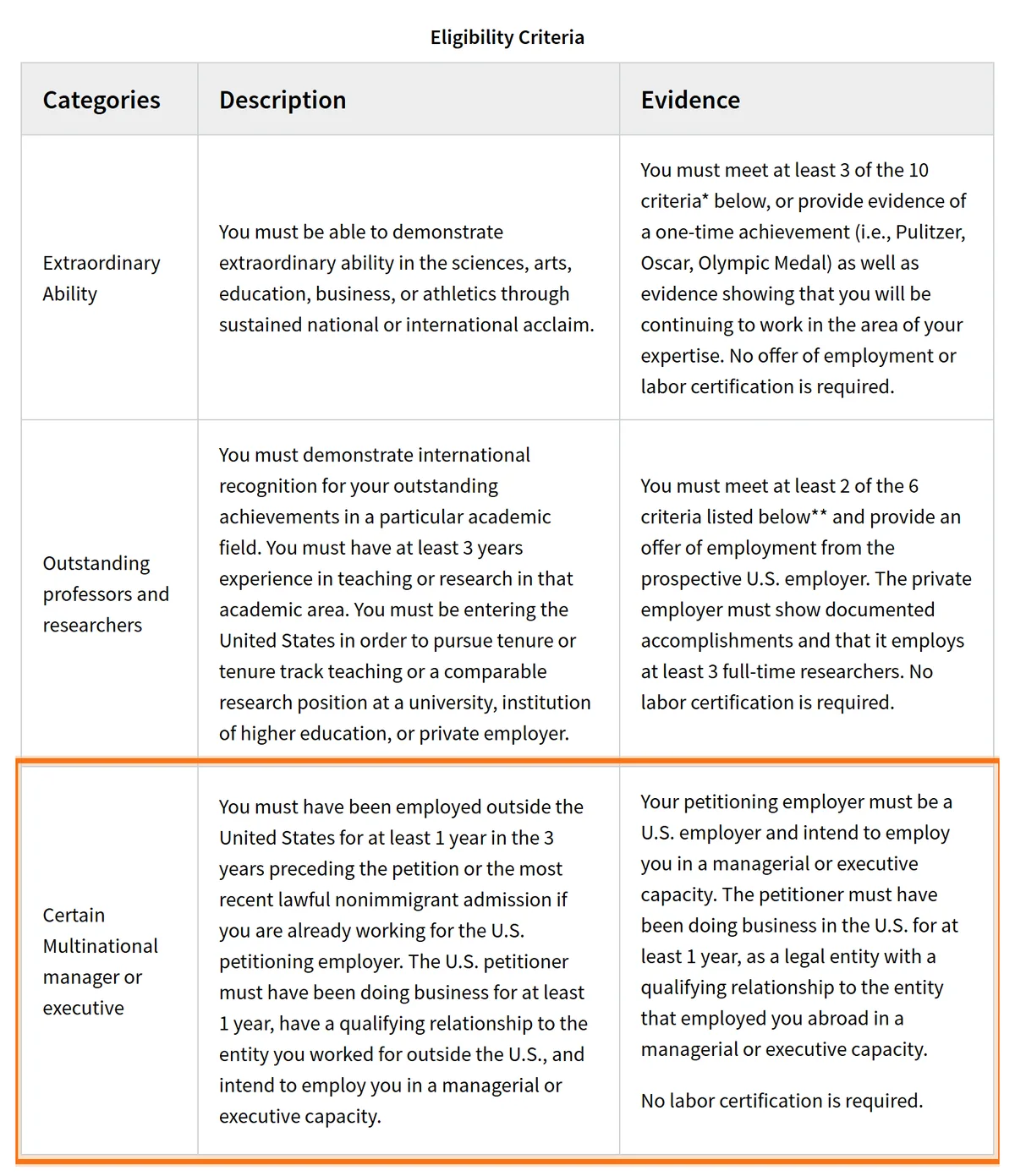
The EB-1C green card is for executives and managers moved inside one company group. You qualify if you worked abroad for at least one year in the last three as a manager or executive, for a company related to the U.S. employer, and the U.S. company has done business for at least a year and will employ you as a manager or executive. No PERM is needed. We file these from our Dallas office for employers nationwide.
Key takeaways
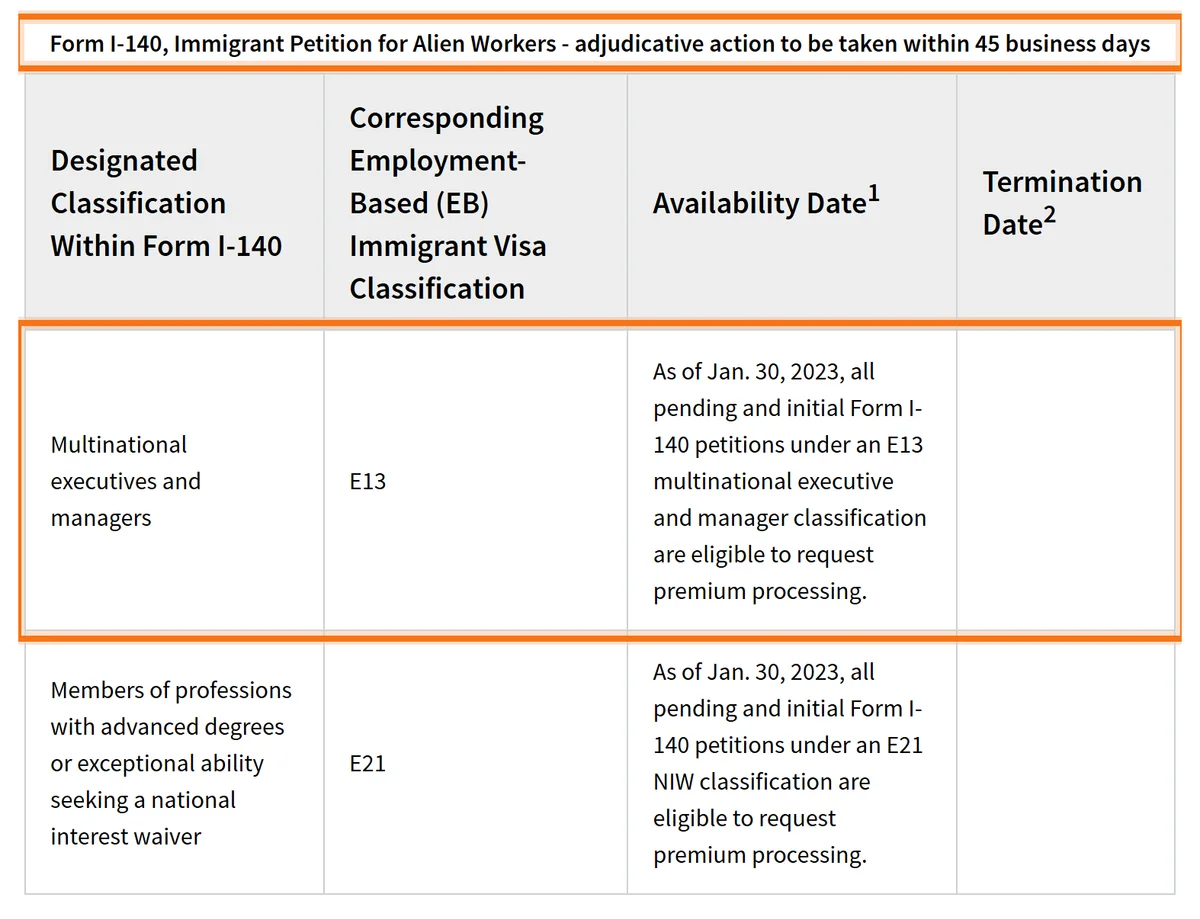
Three things must line up: a year of managerial or executive work abroad in the last three years, a parent, subsidiary, affiliate or branch link between the two companies, and a U.S. company that has done business for a full year. The employer files Form I-140; you cannot self-petition. There is no PERM labor certification. Premium processing for the EB-1C costs $2,965 and has a 45-business-day clock, not 15. A new-office L-1A holder normally waits until the U.S. company passes its first anniversary.
What is the EB-1C visa (and the EB-1C green card)?
EB-1C is the third group of the first-preference employment-based (EB-1) green card. USCIS lists three EB-1 groups: people of extraordinary ability (EB-1A), outstanding professors and researchers (EB-1B), and certain multinational managers or executives (EB-1C). People often call it the “EB-1C visa,” so what is EB-1C green card status in practice? Permanent residence, not a temporary work visa. On USCIS forms the classification is coded E13.
The EB-1C is the usual destination for L-1A transferees, but the two are not interchangeable. The green card has a stricter rule for the job abroad and a one-year-in-business rule that the L-1A new-office petition does not have.
EB-1C eligibility criteria: who qualifies
| Requirement | What it means in practice | Typical evidence |
|---|---|---|
| One year abroad in the last three | At least 12 months of managerial or executive work for the foreign related company within the 3 years before the petition (or before your last nonimmigrant admission, if you already work for the U.S. petitioner). | Foreign payroll, employment letters, tax records, organizational charts for that period |
| Qualifying relationship | The foreign employer and the U.S. petitioner are the same company, or parent and subsidiary, or affiliates under common ownership and control. | Stock certificates, share registers, articles of incorporation, annual reports showing ownership |
| U.S. employer doing business for one year | Regular, systematic, and continuous provision of goods or services, not just an office or an agent. | Tax returns, contracts, invoices, payroll, leases |
| Managerial or executive job in the U.S. | The offered position meets the legal definition (below), not merely the title. | Job description, organizational chart, subordinates’ titles and degrees, evidence of discretion |
| Ability to pay | The petitioner can pay the offered wage from the priority date onward. | Annual report, federal tax return, or audited financial statements |
How to read this table: these are the EB-1C criteria, and every row must be proven, not just one or two. Most cases are decided by the second and fourth rows, the ownership link and the U.S. job, so gather those documents first and expect USCIS to read them closely.
What counts as a “manager” or “executive” for the EB-1C?
Both words have legal definitions in the Immigration and Nationality Act, section 101(a)(44), and the USCIS Policy Manual (Volume 6, Part F, Chapter 4) explains how officers apply them. The job title on a business card does not decide it; the actual duties do.
A manager primarily manages the organization, a department, a subdivision, a function, or a component of it; supervises and controls the work of other supervisory, professional, or managerial employees, or manages an essential function; has authority to hire and fire or recommend those actions (or, for a function manager, works at a senior level); and exercises discretion over the day-to-day operations of the activity managed. A first-line supervisor is not a manager unless the people supervised are professionals.
An executive primarily directs the management of the organization or a major component or function; sets goals and policies; has wide latitude in discretionary decisions; and receives only general supervision from higher-level executives, the board of directors, or the stockholders.
Where the definitions bite
A “manager” with no subordinates who spends most of the day doing the work rather than directing it fails the test. So does an “executive” of a three-person U.S. office who is also the salesperson and the bookkeeper. The function-manager route exists for people who manage an essential function without a large staff, but it needs evidence that others perform the day-to-day tasks, inside or outside the company.
EB-1C versus L-1A: the differences that decide timing
The L-1A is the temporary visa for the same kind of transfer, and most EB-1C beneficiaries hold one. The USCIS L-1A page and the EB-1 page describe rules that look alike but differ in three places:
- The year abroad. For an L-1 it can be in a managerial, executive, or specialized-knowledge role. For the EB-1C it must have been managerial or executive. An L-1B specialized-knowledge worker promoted into management in the United States does not automatically qualify.
- The U.S. company’s age. The L-1A allows a “new office” petition for a company that has just opened, with a one-year first approval. The EB-1C requires the U.S. petitioner to have done business for at least one year, so a new-office transferee usually files the I-140 after the first anniversary, often alongside the L-1A extension.
- The level of review. The I-140 is a permanent benefit. Officers look harder at the organizational chart, the subordinates, and whether the U.S. operation is large enough to need an executive.
Companies planning a transfer from the start should treat the L-1A petition as the first draft of the EB-1C: the same ownership documents, the same job descriptions, and a staffing plan that produces real subordinates by month twelve. Our guide to the L-1 new-office investment covers that first year, and our L-1A vs L-1B guide explains why the type of L-1 matters later.
EB-1 for managers on H-1B and other work visas
A manager in the United States on an H-1B, or another work status, can still qualify for the EB-1C. The key is the one-year-abroad rule. If you already work for the U.S. petitioner (or its related company), USCIS counts the three-year window back from your most recent lawful nonimmigrant admission, not from the filing date. So a manager who worked abroad for the same company group for a year before coming to the U.S. on an H-1B may still qualify years later, as long as that year abroad was managerial or executive and falls in the three years before the last admission.
What does not work: an H-1B employee whose year abroad was with an unrelated company, or whose role abroad was technical rather than managerial. In those cases EB-2 or EB-3 through PERM, or the EB-2 National Interest Waiver, is usually the path.
Transferring an executive or manager to the United States?
Request a free consultation. We review the corporate relationship, the role abroad, and the U.S. organization chart and tell you whether the EB-1C fits now or after the L-1A year, with a flat fee in writing.
The EB-1C process and fees, step by step
1. The I-140 petition
The U.S. employer files Form I-140 with the evidence in the table above. The receipt date becomes the priority date. You cannot file it yourself; self-petitioning exists only for EB-1A and the EB-2 National Interest Waiver.
2. Premium processing, if wanted
All EB-1C (E13) petitions have been eligible for premium processing since January 30, 2023. USCIS sets a 45-business-day clock for E13 petitions, rather than the 15 business days most other I-140 categories get, for a fee of $2,965. It is worth paying when an L-1A is near its seven-year limit or when the employee needs an approved I-140 to extend status. Our premium processing guide covers when it pays off.
3. The visa number
The EB-1 category is often current for most countries, but it has retrogressed for applicants born in India and China. The monthly Visa Bulletin controls whether the final step can be filed now; our guide to priority dates explains how to read it. When the date is current, the I-485 can be filed together with the I-140.
4. Adjustment of status or consular processing
An executive already in the United States in L-1A or another status files Form I-485, with the medical exam and, if wanted, applications for a work permit and advance parole. An executive abroad completes consular processing through the National Visa Center and a U.S. consulate. The spouse and unmarried children under 21 follow as derivatives.
| Fee | Amount | Who pays it |
|---|---|---|
| Form I-140 filing fee | $715 on paper, $665 online | The employer |
| Asylum Program Fee (with the I-140) | $600 regular, $300 small employer, $0 nonprofit | The employer |
| Premium processing (optional) | $2,965, action within 45 business days | Usually the employer |
| Form I-485 (adjustment of status) | $1,440 on paper for applicants 14 and older; $950 for a child under 14 filing with a parent | Each applicant in the U.S., per person |
How to read this table: a regular employer filing the I-140 on paper pays $715 plus $600, or $1,315 before premium processing. The I-485 fee is per person, so a spouse adjusting with you pays it too, at the lower rate only for a child under 14. Fees change; confirm on the USCIS fee page before filing.
The evidence that decides EB-1C cases (and whether you need a business plan)
- Organizational charts, before and after. One for the foreign company showing your position and reports during the qualifying year; one for the U.S. company showing the offered position, its reports, and their titles, degrees, and duties.
- Percentages of time. A duty breakdown that shows most of the role is managerial or executive, with the hands-on work assigned to named subordinates or contractors.
- Corporate ownership, traced. Share registers, stock certificates, and, where ownership passes through holding companies, every link in the chain. USCIS does not infer affiliation from a shared name.
- Business substance in the United States. Revenue, payroll, contracts, and premises that show an operation large enough to need the role.
- Ability to pay from the priority date. Tax returns or audited statements, or proof that you are already on the U.S. payroll at the offered wage.
Is an EB-1C business plan required? No. A business plan is part of an L-1A new-office petition, but the EB-1C looks at a company that has already operated for a year, so USCIS wants proof of what exists now. A short growth and hiring plan can still help explain why the U.S. role is managerial when the staff is small and growing.
Where EB-1C petitions go wrong
The weak points are predictable. A small U.S. office with a single “president” who does everything. A foreign role described as managerial in the letter but shown as technical on the foreign payroll records. A holding structure where the ownership chain cannot be documented. A gap between the year abroad and the petition that pushes the qualifying work outside the three-year window. And a U.S. company that existed for a year but did little business during it. Each of these is fixable before filing and expensive after.
How long does the EB-1C take?
Gathering the corporate and payroll evidence usually takes longer than drafting. Once filed, regular I-140 processing times are on our processing times page; premium processing promises an action within 45 business days. The I-485 stage adds its own months. An executive who arrives on a new-office L-1A can usually file the I-140 around the U.S. company’s first anniversary; for applicants born in India or China, the Visa Bulletin is the main variable after that.
How Atlas Immigration Law helps
We represent companies moving executives and managers to the United States, from the first L-1 petition through the EB-1 green card. The work starts with a candid read of the organization chart against the legal definitions, because that is where the case is won or lost, and a plan for what the U.S. company needs to show by the time the I-140 is filed. Each filing has a flat fee agreed in writing with milestone billing and a dedicated paralegal reachable by call, email, or text. The firm is led by founder and managing attorney Jordan Weinberg. The company and the executive follow the case in the Atlas Vision client portal. Atlas is based in Dallas and represents employers in all 50 states; see our employment-based green card services.
Related guides: the full EB-1 green card guide (EB-1A, EB-1B, EB-1C), L-1 visas for Dallas employers, and how much to invest in an L-1 new office.
Frequently asked questions
How should employers use EB-1B for executives and managers?
They should not: EB-1B is for outstanding professors and researchers. Executives and managers transferred inside a company group use the EB-1C, which the employer files on Form I-140 without PERM.
What is EB-1C visa status, and is it a green card?
EB-1C is a first-preference green card (permanent residence) for multinational managers and executives, coded E13. It is not a temporary visa, though most people reach it from an L-1A.
Does the EB-1C require PERM labor certification?
No. The EB-1C is a first-preference category and no labor certification is required. The employer files Form I-140 directly.
Do I need an L-1A visa first?
No. The EB-1C can be filed for an executive still abroad. In practice most beneficiaries hold an L-1A because the U.S. company needs a year of business, and the executive often needs to be in the country to build it.
What does one year in the last three mean if I am already in the United States?
If you already work for the U.S. petitioner, the three-year window is measured back from your most recent lawful nonimmigrant admission, not from the petition date.
Is premium processing available for the EB-1C?
Yes. USCIS takes an action on E13 petitions within 45 business days of the premium processing request, for a fee of $2,965 under the fee schedule dated October 26, 2026.
How much does the EB-1C cost in government fees?
Form I-140 is $715 on paper or $665 online, plus the $600 Asylum Program Fee ($300 for small employers, $0 for nonprofits). Form I-485 is $1,440 on paper for each applicant 14 or older. Premium processing is optional at $2,965. Attorney fees are separate; Atlas quotes a flat fee in writing.
Can my spouse and children get green cards with me?
Yes. Your spouse and unmarried children under 21 are derivative beneficiaries and receive permanent residence through the same petition, either by adjusting status with you or through consular processing.
This guide is part of our employment-based green card services — the service page covers eligibility, fees, and how we handle these cases.

Founder & Managing Attorney, Atlas Immigration Law
Member of the American Immigration Lawyers Association (AILA) and the Dallas Bar Association. Licensed to practice in Texas; fluent in English and Spanish.
Legally reviewed by a licensed immigration attorney
Talk to an immigration attorney about your case
Free consultation on request, flat fees, and a dedicated paralegal who knows your case — serving clients in all 50 states.
This guide is general information, not legal advice, and reading it does not create an attorney-client relationship. Immigration law and procedures change, and how they apply depends on your specific facts — consult a licensed immigration attorney about your situation.