A foreign degree and few publications do not rule out an EB-2 national interest waiver. USCIS accepts a foreign degree that a credential evaluation shows equals a U.S. master’s, or a U.S. bachelor’s followed by 5 years of progressive experience. Papers are one kind of proof among many: contracts, patents, adoption of your work, and investment also count. Atlas Immigration Law prepares these petitions for professionals in Dallas, North Texas, and nationwide.
Key takeaways
A foreign degree works if it is the equivalent of a U.S. degree; the credential evaluation must rest on the degree itself, and the officer makes the final call. The 5 years of experience that turn a bachelor’s into a master’s must come after the degree and relate to it. USCIS’s own evidence list for the NIW names contracts, patents, licenses, investment, grants, and proof that others use your work, not only publications. Letters help only when other records back them up. On the fee schedule dated October 26, 2026, a self-petitioner pays $715 on paper or $665 online, plus a $300 Asylum Program Fee.
Does a foreign degree qualify for the EB-2 NIW?
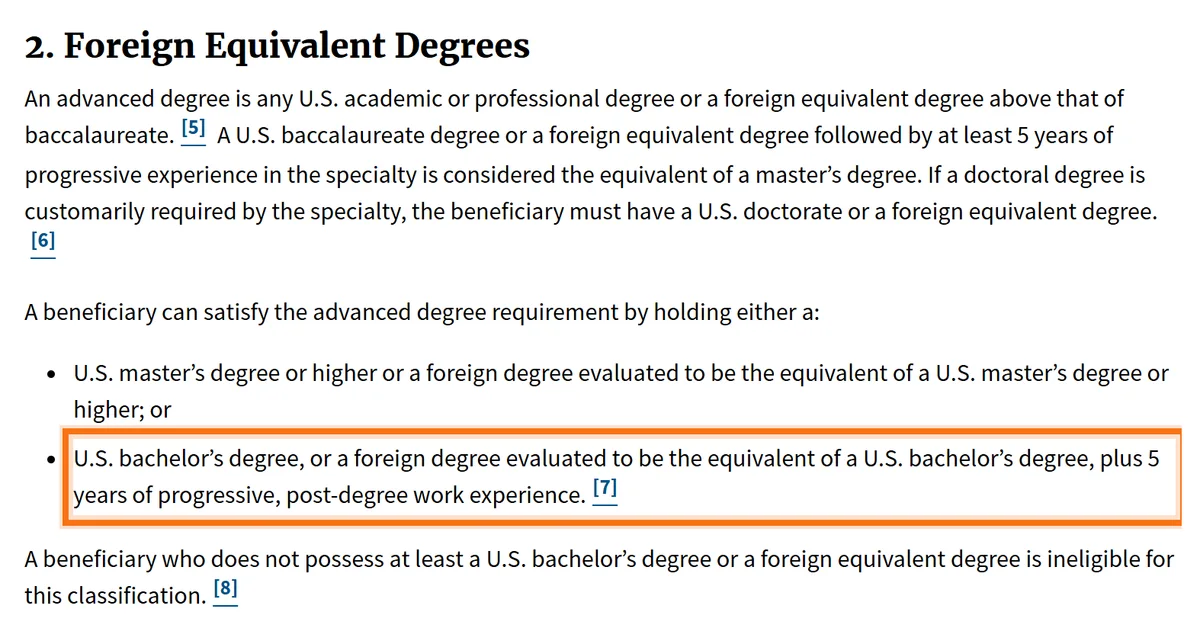
It does, if it is the equivalent of a U.S. degree. Under 8 CFR 204.5(k)(2), an advanced degree is a U.S. degree above a bachelor’s or a foreign equivalent degree. A U.S. bachelor’s or its foreign equivalent, followed by at least 5 years of progressive experience in the specialty, counts as a master’s. Where the specialty normally requires a doctorate, you need a U.S. doctorate or its foreign equivalent.
The NIW is a waiver inside EB-2, so this is the first thing an officer checks. If you do not meet the EB-2 threshold, USCIS says it may deny without ever reaching the national interest question. Two more tests apply to every advanced degree NIW:
- The occupation must be a profession. The work you will do to advance your endeavor must normally require at least a bachelor’s degree to enter. USCIS’s example: an engineering Ph.D. starting a bakery may not qualify, because baking does not require a degree.
- The 5 years must come after the degree and relate to it. Experience earned before graduation does not count. Neither does experience in an unrelated field: USCIS says a chemistry degree followed by 5 years as a restaurant manager does not equal a master’s in chemistry.
What changed in 2025
On January 15, 2025, USCIS issued a policy alert, "Second Preference Eligibility for National Interest Waiver Petitions," which added this guidance to the Policy Manual. Because no Department of Labor certification defines the job in an NIW, the officer now reviews your endeavor to decide whether the occupation is a profession and whether your experience is "in the specialty." This is final USCIS policy, not a proposed rule, and it is in the Policy Manual chapter current as of October 27, 2026. We found no proposed NIW regulation pending when we checked on November 13, 2026.
No bachelor’s or foreign equivalent at all? The advanced degree route is closed, but exceptional ability may still work: at least 3 of 6 criteria in 8 CFR 204.5(k)(3)(ii), such as 10 years of full-time experience shown by employer letters, a professional license, or a salary that shows exceptional ability. USCIS says the area of exceptional ability must relate directly to the endeavor.
What your credential evaluation must show
A credential evaluation is the document that tells USCIS what your foreign degree equals in U.S. terms. The Policy Manual describes what officers give weight to, and what they do not:
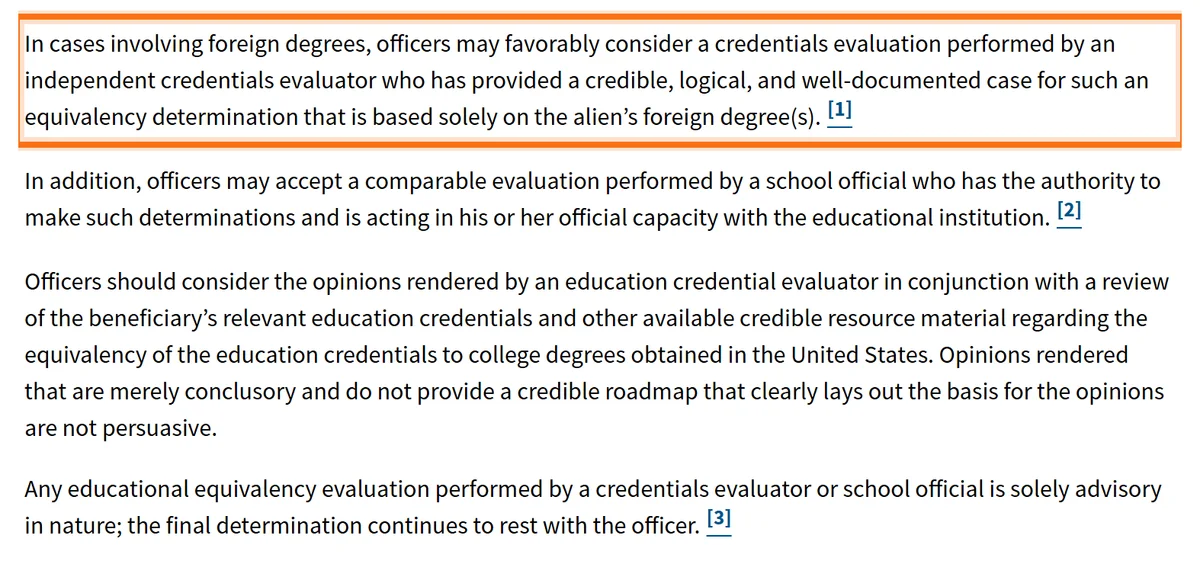
- It rests on the degree. For EB-2, the evaluation should not add years of work experience to reach a bachelor’s equivalent. Experience is proven separately, with employer letters.
- It shows its reasoning. USCIS says conclusory opinions without a "credible roadmap" are not persuasive. The evaluation should name the program, its length, the courses, and why it matches a U.S. degree.
- It comes with the records. File your diploma and transcripts with certified English translations. Under 8 CFR 103.2(b)(3), every translation needs the translator’s certification that it is complete and accurate and that they are competent to translate.
Experience letters carry the second half of the bachelor’s plus 5 route. Under 8 CFR 204.5(g)(1), each letter gives the writer’s name, address and title and a specific description of your duties. Add exact start and end dates, so the officer can count the months after your graduation date. If a past employer has closed, USCIS will consider other records, such as contracts or pay records.
| Your education and experience | EB-2 route | What to prove |
|---|---|---|
| Foreign master’s or doctorate | Advanced degree | Evaluation showing a U.S. master’s or higher, diploma, transcripts |
| Foreign bachelor’s and 5+ years of related work after it | Bachelor’s plus 5 years | Evaluation showing a U.S. bachelor’s, employer letters with dates and duties |
| Foreign bachelor’s, but some of the 5 years came before graduation | Bachelor’s plus 5, only if 5 full years came after | Count only post-degree months; otherwise wait or use exceptional ability |
| Degree whose U.S. equivalence is unclear | Depends on the evaluation | An evaluation that explains the program in detail; USCIS decides |
| Degree in one field, career in an unrelated one | Often exceptional ability instead | At least 3 of 6 criteria tied to your endeavor |
| No bachelor’s or foreign equivalent | Exceptional ability only | At least 3 of 6 criteria, then a final merits review |
How to read this table: find your row before you think about the three prongs. If you sit in rows 3 to 5, settle the route first, because a weak EB-2 basis can sink an otherwise strong impact case. Our guide to the EB-2 NIW in Dallas explains the Dhanasar prongs that come next.
Few publications? What USCIS counts instead
Nothing in the NIW standard requires publications. Since Matter of Dhanasar, 26 I&N Dec. 884 (AAO 2016), USCIS asks three questions: does your endeavor have substantial merit and national importance, are you well positioned to advance it, and on balance would waiving the job offer benefit the United States. Papers are evidence for the first two questions, not a condition.
For prong 1, the Policy Manual says merit "may be established without immediate or quantifiable economic impact," and gives industry examples. A technology built for one company can reach national importance through "widespread interest in adoption or licensing," a novel manufacturing or operational process, or its effect on similar technology at other companies. A drug developer can point to public health benefits rather than company profits. On the other side, a software engineer adapting an employer’s code for its clients will have difficulty without broader impact.
For prong 2, USCIS looks at your education and skills, your record of success, a detailed plan, progress so far, and interest from customers, users, investors or agencies. Its list of example evidence is where industry professionals find their proof:
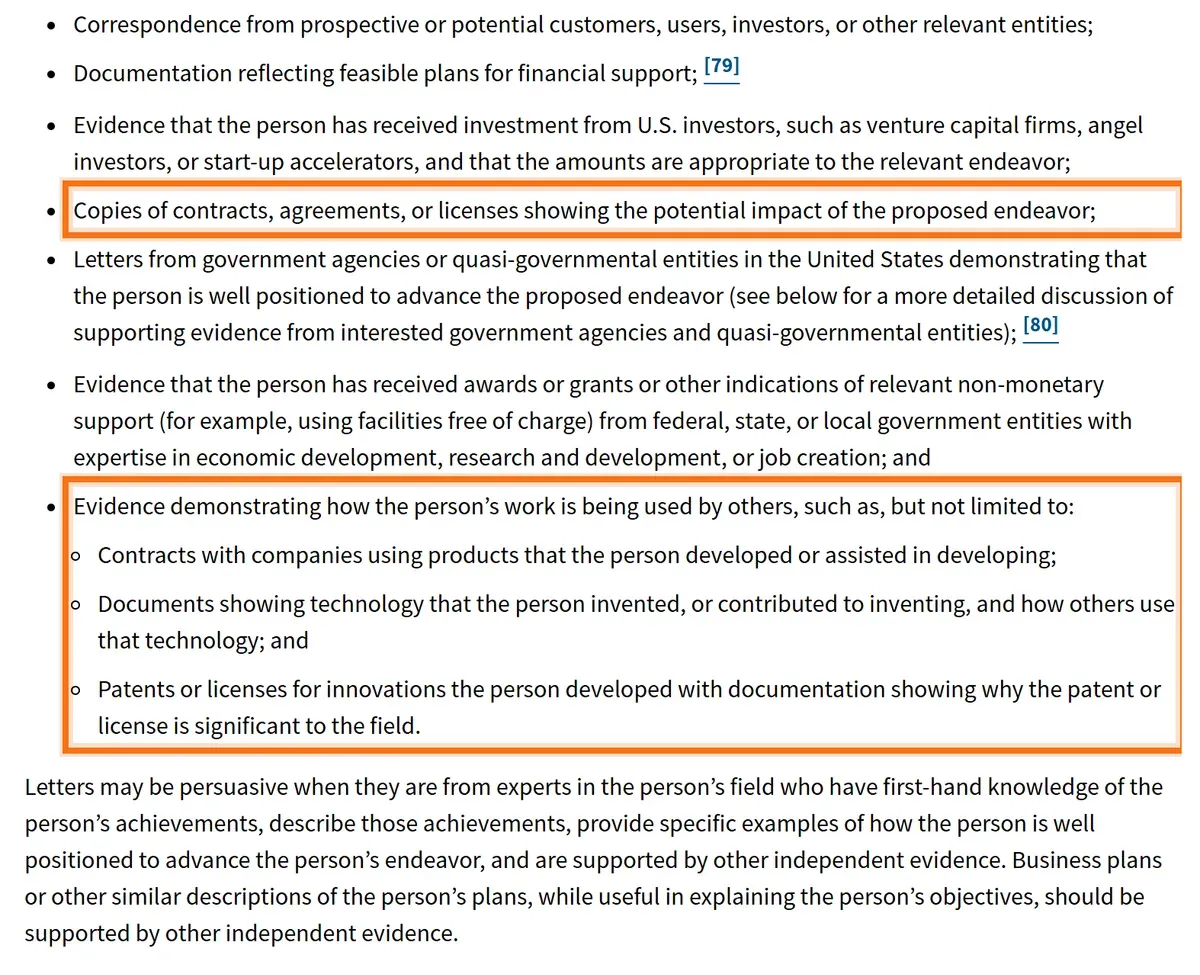
USCIS calls the list non-exhaustive and says no single item is required or enough. It also says you can be well positioned even if you cannot show the endeavor is more likely than not to succeed, but unsupported claims do not count. The more central you are to the work, the stronger this prong becomes.
Industry evidence, prong by prong
The table pairs the evidence industry professionals usually have with the prong it supports and what turns it from a mention into proof. It draws on USCIS’s own examples in the Policy Manual.
| Evidence type | Prong it supports | What makes it strong |
|---|---|---|
| Patents and licenses | 2, and 1 when licensed or used widely | You are a named inventor, plus proof the patent is licensed, built into products, or significant to the field |
| Contracts with companies using your product or method | 2, and 1 when use spreads across the industry | Signed contracts naming the product you built, with your role shown in other records |
| Adoption by others (deployments, users, standards) | 1 and 2 | Numbers from a source outside your team: client lists, usage reports, third-party announcements |
| Revenue growth and U.S. jobs created | 2, and 1 when job creation is significant for the region | Tax returns or payroll records, and how your work drove the growth |
| Investment from U.S. investors or accelerator admission | 2, and merit under 1 | Term sheets or wire records, amounts suited to the endeavor, the accelerator’s track record |
| Government grants or agency letters, work used in public policy | All three prongs | A detailed letter from the agency saying why it needs your work and why it is urgent |
| Expert letters from people outside your company | 2, sometimes 1 and 3 | First-hand knowledge, specific results, and an exhibit behind each claim |
| Media coverage of your work | 2 | The outlet’s reputation and your named role in the story |
| A few papers or conference talks | 2 | Who cites or uses them, not how many there are |
How to read this table: one strong row usually beats four weak ones. A single license agreement with a company outside your employer, plus a usage report, says more about national importance than a stack of internal awards. Pick the two or three rows where your proof is independent, and build the petition around them.
Founders get some extra room. USCIS says entrepreneurs often skip academic peer review, so review by investors, retailers or industry experts can play the same role. It also says owning a company "rarely establishes eligibility on its own": your active, central role is what counts.
Strong industry record, short publication list?
Bring your degree, your experience letters and the proof of what your work has done. In a free 20-minute consultation we check the EB-2 route first, then tell you which evidence carries each prong and where the file is thin.
Letters: the bridge when the paper trail is thin
With few publications, letters do more of the explaining, so they face more scrutiny. USCIS says letters may be persuasive when the writer is an expert in your field with first-hand knowledge of your achievements, describes them, gives specific examples of how you are well positioned, and is supported by other independent evidence.
- Ask the people who use your work. A client engineer who deployed your system, a hospital that adopted your process, or a licensee carries more weight than a manager who signs your reviews.
- Tie each claim to an exhibit. A letter that says your design cut downtime should point to the report that shows by how much.
- Keep the endeavor the same in every letter. If the writers describe different projects than your statement does, the officer will notice.
- Do not ask a letter to replace proof. USCIS says claims lacking corroborating evidence do not meet the burden of proof, and business plans need independent support too.
Prong 3 for industry professionals: why skip PERM?
The third prong asks whether, on balance, the United States gains from waiving the job offer and the labor certification. USCIS lists factors you can use: a labor certification is impractical for your situation, the country benefits from your work even if other workers are available, the work is urgent, or your skills go beyond the minimum requirements a labor certification can capture. For a self-employed founder or a business owner who hires U.S. workers, USCIS says there may be little benefit from the labor certification.
Two points matter for employees in industry. Your employer’s ability to file PERM for you does not bar an NIW. And a national shortage in your occupation does not satisfy this prong by itself. If an employer is willing to sponsor you, our comparison of EB-1A, EB-2 NIW and O-1 shows how routes can run side by side.
Fees, premium processing and timing in 2026
These amounts are from USCIS Form G-1055, the fee schedule dated October 26, 2026:
- Form I-140: $715 on paper or $665 online.
- Asylum Program Fee: $300 for a self-petitioner or small employer, $600 for a regular employer petitioner, $0 for a nonprofit.
- Premium processing (Form I-907): $2,965. USCIS must act on an NIW within 45 business days, not the 15 used for most I-140s.
A self-petitioner filing on paper pays $1,015 before premium processing, or $965 online. Without premium processing, USCIS’s October 2026 data on our wait times page showed 80% of NIW I-140s decided within about 30 months. If USCIS issues an RFE on a premium case, the 45-day clock stops and a new one starts when it receives your response. Our premium processing guide covers when the fee is worth it. Visa availability for EB-2 then depends on your country of birth.
RFE risks for this profile, and how to get ahead of them
A foreign-degree, few-publications NIW tends to draw requests for evidence in predictable places. Most can be headed off in the first filing:
- Degree equivalency. An evaluation that is vague or leans on work experience invites a question on the EB-2 threshold itself.
- Experience before the degree. Letters without exact dates, or months counted before graduation, can drop you below 5 years.
- Unrelated experience. Work outside the degree field or the endeavor does not count toward the master’s equivalent.
- An occupation that is not a profession. The work you will do must normally require a bachelor’s degree.
- An endeavor that reads like a job. USCIS wants specific projects and who benefits beyond your employer.
- Letters with nothing behind them, and business plans without independent proof.
If an RFE arrives, the deadline is the date printed on the notice: at most 12 weeks for an RFE and 30 days for a NOID under 8 CFR 103.2(b)(8)(iv), with no extensions. Your answer must show you were eligible when you filed; under 8 CFR 103.2(b)(1) and (b)(12), a degree finished or a contract signed afterward cannot fix the petition. Our guide to answering an I-140 RFE covers NIW requests in detail.
How Atlas Immigration Law helps
We start where USCIS starts: your EB-2 basis. We read your diploma, transcripts and experience letters, confirm whether the advanced degree or exceptional ability route fits, and make sure the credential evaluation and the dates line up before anything else is built. Then we frame your endeavor statement, shape expert letters around the legal standard rather than praise, and organize the contracts, patents, adoption records and other proof prong by prong. See our EB-2 NIW services, and our self-petition guide for the forms and filing steps.
The firm is led by Jordan Weinberg, founder and managing attorney, licensed in Texas and a member of AILA and the Dallas Bar Association. You get a flat fee quoted in writing at the consultation and billed by milestone, a dedicated paralegal reachable by call, email or text, same-business-day responses and a client portal. We work from 1920 McKinney Ave in Dallas with clients in all 50 states. Call (945) 219-5599 for a free 20-minute consultation.
Frequently asked questions
Can an immigration lawyer handle an EB-2 NIW for a professional with a foreign degree?
Yes. A foreign degree qualifies if it is the equivalent of a U.S. master’s or higher, or of a U.S. bachelor’s followed by 5 years of progressive experience after the degree. Atlas Immigration Law prepares NIW petitions for foreign-educated professionals in Dallas and nationwide, starting with the credential evaluation and the experience letters that prove the EB-2 basis.
Can I get an NIW with few publications but strong industry impact?
Yes, if the impact is documented. USCIS’s own evidence list includes contracts, licenses, patents with proof of their significance, investment, grants, government letters, and proof that others use your work. Publications are one option, not a requirement. What matters is independent proof for each prong.
Do I need a credential evaluation for an NIW with a foreign degree?
In practice, yes. USCIS gives weight to an evaluation by an independent evaluator, or a qualified school official, that explains the equivalency and is based solely on the foreign degree. The evaluation is advisory; the officer makes the final decision.
Does work experience before my bachelor’s degree count toward the 5 years?
No. For the bachelor’s plus 5 years route, USCIS says the experience must come after the degree, be progressive, and be in the specialty related to the degree and your endeavor.
What if I do not have a bachelor’s degree or a foreign equivalent?
The advanced degree route is closed, but you may qualify through exceptional ability by meeting at least 3 of 6 criteria in 8 CFR 204.5(k)(3)(ii), such as 10 years of full-time experience, a license, or a high salary. The ability must relate directly to your proposed endeavor.
Did USCIS change the NIW rules in 2025?
USCIS updated its Policy Manual on January 15, 2025, with guidance on EB-2 eligibility in NIW cases: the occupation must be a profession, and the 5 years of experience must follow the degree and relate to the specialty. It is final policy, not a proposed rule.
How much does an NIW cost in USCIS fees in 2026?
On the fee schedule dated October 26, 2026, Form I-140 is $715 on paper or $665 online, plus a $300 Asylum Program Fee for a self-petitioner. Premium processing is $2,965, and USCIS must act on an NIW within 45 business days. Legal fees are separate.
This guide is part of our employment-based green card services — the service page covers eligibility, fees, and how we handle these cases.

Founder & Managing Attorney, Atlas Immigration Law
Member of the American Immigration Lawyers Association (AILA) and the Dallas Bar Association. Licensed to practice in Texas; fluent in English and Spanish.
Legally reviewed by a licensed immigration attorney
Talk to an immigration attorney about your case
Free consultation on request, flat fees, and a dedicated paralegal who knows your case — serving clients in all 50 states.
This guide is general information, not legal advice, and reading it does not create an attorney-client relationship. Immigration law and procedures change, and how they apply depends on your specific facts — consult a licensed immigration attorney about your situation.