
If either spouse was married before, a family petition needs proof that every earlier marriage legally ended: a final divorce decree, a death certificate, or an annulment. If a required document truly does not exist, USCIS and the consulate accept proof that it is unavailable plus secondary evidence, and then sworn affidavits. Atlas Immigration Law, based in Dallas, builds these files for families in North Texas and all 50 states.
Key takeaways
Both spouses must prove each prior marriage ended, and the petitioner’s history counts as much as the immigrant’s. A divorce that was never final means the new marriage is not valid for immigration, and no amount of evidence fixes that. Before saying a document is missing, check the State Department’s reciprocity page for that country: if it says the record exists, "I could not get it" is not enough. The order is primary document, then a government statement plus secondary evidence, then two or more affidavits. In Texas, certified divorce decrees come only from the district clerk where the divorce was granted.
Whose prior marriages you must prove ended, and when
This is not just the immigrant’s paperwork. The regulation for a spouse petition, 8 CFR 204.2(a)(2), asks for the civil marriage certificate and proof of the legal end of all previous marriages of both the petitioner and the beneficiary. The same proof comes up again at each stage:
| Stage | Whose prior marriages | What is accepted |
|---|---|---|
| Form I-130 for a spouse | Both the petitioner and the spouse | Final divorce decree, final annulment decree, or death certificate, for each one |
| Form I-130 for a stepchild | The petitioner and the child’s parent | The same, plus a marriage certificate dated before the child turned 18 |
| Form I-129F (K-1 fiancé visa) | Both partners | Proof each prior marriage ended by divorce, death, or annulment |
| National Visa Center and consular interview (immigrant) | The immigrant, for every prior marriage | Original or certified copy of the final decree, death certificate, or annulment papers |
| NVC, spouse case (IR-1, CR-1, F2A) | The petitioning spouse too | Original or certified copy, the same three documents |
| Adjustment of status in the U.S. | Both spouses, as for the I-130 | Usually filed together with the I-130 in a marriage case |
How to read this table: list every marriage either of you ever had, including short ones, ones abroad, and religious or customary ones. Each needs its own ending document, and the forms ask for every marriage, so a gap between the form and the documents is the first thing an officer notices. A legal separation is not an ending: the State Department says a separated person is still married until there is a divorce.
What if an earlier divorce was never finalized?
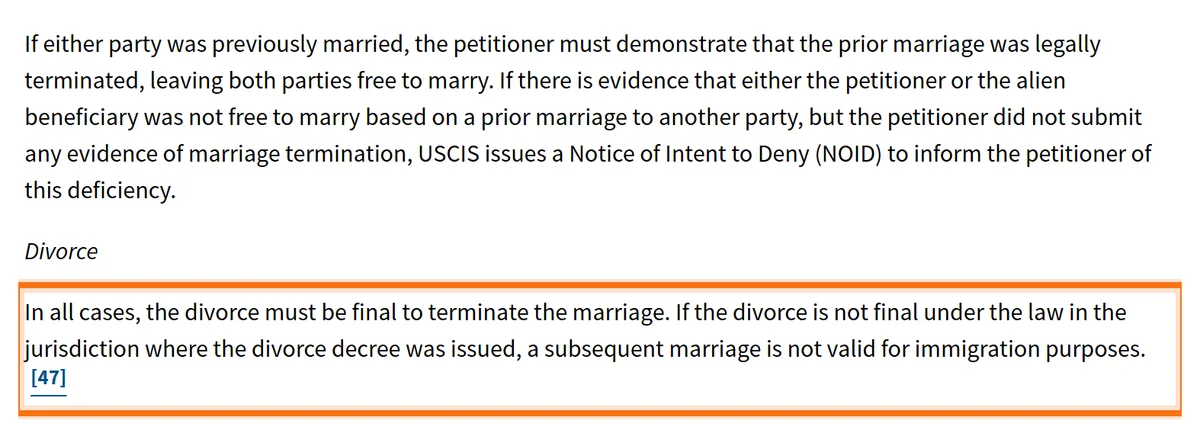
This is the hardest prior-marriage problem, because it is not about paperwork. USCIS says the divorce must be final to end the marriage, and if it was not final under the law where it was granted, a later marriage is not valid for immigration purposes. Some situations that cause it:
- A waiting period had not ended. Some courts issue an interlocutory decree or a decree nisi that becomes final only after a set time. USCIS does not accept these as proof the marriage ended until that time has passed.
- The case was filed but never signed by a judge, or was dismissed. A petition for divorce is not a divorce.
- A foreign divorce the court had no power to grant. USCIS checks that the court had jurisdiction and followed that country’s formalities. If you remarried in the U.S., the foreign divorce must also be one your U.S. state recognizes, and some states require that a spouse lived in the country that granted it.
- A customary or religious divorce with no civil step, where the country’s law requires one.
If a marriage took place before an earlier one was finally ended, USCIS looks at the law of the place of the later marriage. In some places, the later marriage becomes valid once the earlier divorce becomes final; in others, it stays void. When the record shows a spouse was not free to marry and there is no proof the earlier marriage ended, USCIS issues a Notice of Intent to Deny. The fix is usually to finish the divorce and, where the law requires it, marry again before filing a new petition. Which applies depends on your facts, so get advice before you respond. Our guide to answering an RFE or NOID covers the deadlines.
An annulment will not rescue a hidden marriage
USCIS may treat an annulment as making a marriage void from the start. But it says an annulment does not make a later marriage valid if the person concealed the earlier marriage to get an immigration benefit. Disclose every marriage on every form, even one that was annulled.
Check the State Department reciprocity schedule first
Before you tell USCIS or a consulate that a document is missing, look up the country on the State Department’s Visa Reciprocity and Civil Documents by Country page. For each country it lists which birth, marriage, divorce and death records exist, which office issues them, what they look like, and what to submit when they are not available. Both USCIS and consular officers use it.
- The schedule says the record is "unavailable" for your country or time period. USCIS does not require a foreign government letter saying it does not exist, and you go straight to secondary evidence.
- The schedule says the record is available, but you cannot get it. USCIS treats this as a presumption that you are not eligible, and your word alone does not overcome it. You need the issuing office’s written statement, or proof of repeated good faith attempts to get one.
- At the consulate, the State Department tells officers that documents listed as available are "rarely" unobtainable. Its regulation calls a record unobtainable only if getting it would cause actual hardship, not just normal delay and inconvenience.
When a document truly does not exist: secondary evidence and affidavits
USCIS’s rule, in 8 CFR 103.2(b)(2), works as a ladder. You climb down a step only after showing the step above is unavailable.
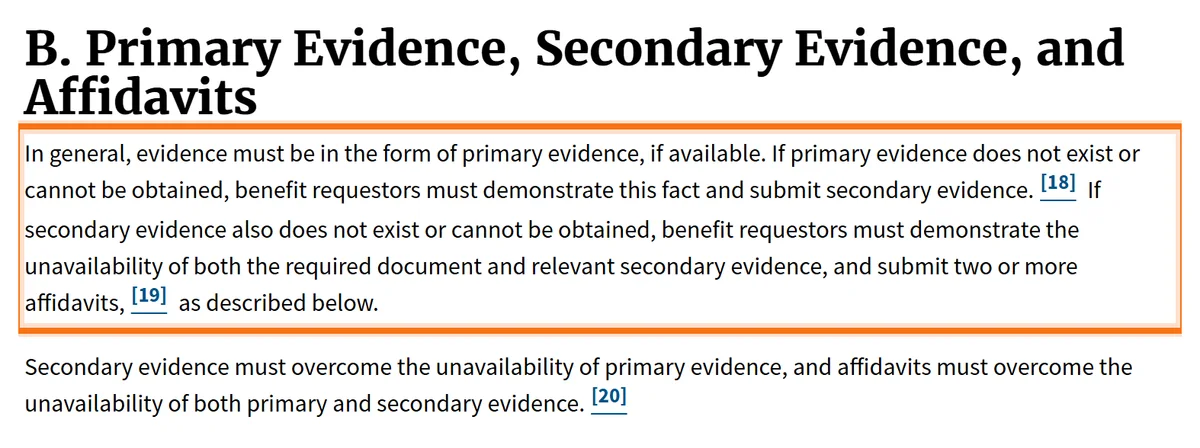
- Step 1, the primary document, such as a civil birth certificate or a court’s divorce decree.
- Step 2, proof it does not exist plus secondary evidence. The proof is an original statement on government letterhead from the office that would hold the record, saying why it does not exist and whether similar records for that time and place exist. Secondary evidence is a record from a less direct source: USCIS gives a church record of a divorce and a baptismal certificate for a birth as examples, and the regulation also names school records.
- Step 3, affidavits. If secondary evidence is also unavailable, show that, and submit two or more affidavits from people who are not parties to the petition and have direct personal knowledge of the event.
A useful affidavit says how the writer knows the people involved, how they know the fact (for example, they attended the wedding or the funeral), and the specific facts, not just conclusions. USCIS gives little weight to affidavits from people without direct knowledge. Older relatives are often the best witnesses for a birth or marriage decades ago.
| Missing document | Try first | If it truly cannot be had |
|---|---|---|
| Divorce decree, lost but the court exists | A certified copy from the court that granted it (in Dallas County, the District Clerk) | Rarely needed: courts keep decrees. Get the clerk’s written answer if the file is gone |
| Divorce decree, court records destroyed | The court’s written statement that the record does not exist and why | Secondary evidence such as a religious record of the divorce, then two or more affidavits |
| Former spouse’s death certificate | A certified copy from the civil registry where the death was recorded | Registry statement, then secondary evidence such as burial or religious records, then affidavits |
| Customary divorce with no court | A court order confirming it, where the country issues one | Proof of the tribe or group, its divorce custom, and that the ceremony was carried out |
| Birth certificate | A certified civil birth record, including a delayed registration if the country allows it | Registry statement, then baptismal or school records, then affidavits |
| Marriage certificate | A certified copy of the registered civil certificate | Registry statement plus secondary evidence; a license alone does not prove a marriage |
| Texas divorce, only a state verification letter | The certified decree from the district clerk | DSHS says its verification letters are not legal substitutes for a decree |
How to read this table: work left to right, and keep proof of every step you tried, including emails, receipts and letters from registries. If the State Department lists a document as unavailable for your country, you may skip the request in the middle column and go straight to secondary evidence, but check that the listing covers the right year and place.
Missing a decree, a certificate, or proof a marriage ended?
Send us the list of marriages on both sides and the documents you have. In a free 20-minute consultation we can tell you which records you still need, where to get them, and whether the reciprocity schedule lets you use secondary evidence.
Getting Texas records: state, Dallas County, and the courts
Many North Texas petitioners were married or divorced here. Texas splits its records between the state and the county, and the wrong office’s document can cost months.
- Birth and death certificates. The Texas DSHS Vital Statistics Section issues certified birth and death certificates. The Dallas County Clerk’s Vital Records Division, at the Records Building, 500 Elm Street, Suite 2100, also takes orders for certified copies of birth and death certificates through its online portal ((214) 653-7099).
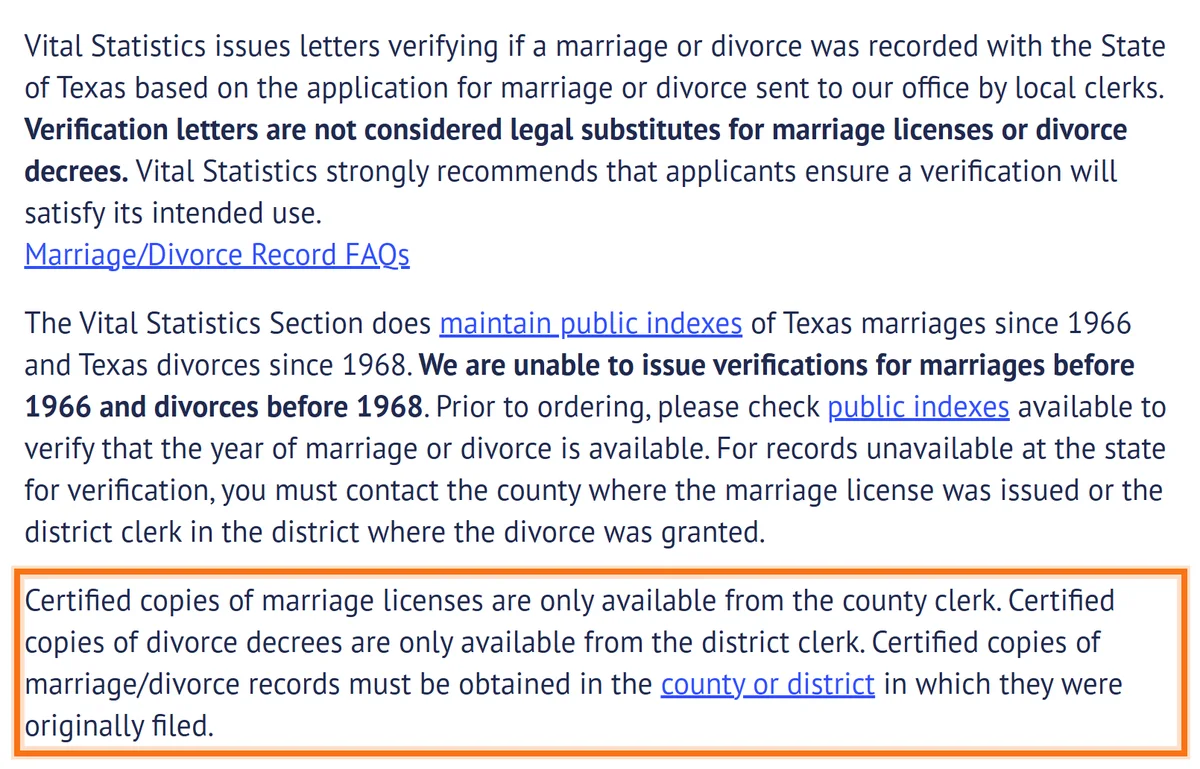
- Marriage records. A certified copy of a Texas marriage license comes only from the county clerk of the county that issued it. For Dallas County, that is the same Vital Records Division.
- Divorce decrees. A certified copy comes only from the district clerk of the county where the divorce was granted. The Dallas County District Clerk takes requests by email using its Civil & Family Records Request Form sent to DCRecords@dallascounty.org, sends a cost estimate first, and also serves the public at the Civil & Family Records desk, George Allen Courts Building, 600 Commerce Street, basement floor west, 8:00 a.m. to 4:30 p.m. weekdays (214-653-6076). Online access to Dallas County family court records is suspended, so plan on a request.
- State verification letters. DSHS can confirm a Texas marriage (from 1966) or divorce (from 1968) was recorded, but says these letters are not legal substitutes for a license or decree. For immigration, order the certified decree.
Divorced in another county or state? The rule is the same: ask the clerk of the court that granted it. Fees and turnaround are set by each office, so check its page before you send payment.
Translations, copies, and originals
Translations. Under 8 CFR 103.2(b)(3), every foreign-language document filed with USCIS needs a full English translation, with the translator’s certification that it is complete and accurate and that they are competent to translate the language. A summary, or a translation of only the key lines, does not meet the rule. Translate stamps and handwritten notes on the decree too; they can show the date it became final.
Copies and originals. For USCIS, follow the form instructions; photocopies are usually accepted, but USCIS may ask for the original at any time. Its own example is a divorce decree whose copy looks altered or cannot be read. For the immigrant visa, the State Department requires an original or certified copy of each marriage certificate and each divorce decree, death certificate or annulment, submitted the way travel.state.gov instructs for the NVC and the interview. Civil documents such as these do not expire.
Our guide to the NVC stage after I-130 approval walks through the upload, and if the consulate refuses the case for a missing record, our guide to NVC delays and administrative processing covers what happens next.
Other prior-marriage issues that can stop a petition
Even with every decree in hand, a prior marriage can still raise questions. USCIS flags these in its Policy Manual:
- A green card holder who got residence through an earlier marriage. USCIS generally cannot approve their petition for a new spouse within 5 years of becoming a resident, unless they show by clear and convincing evidence that the earlier marriage was not entered to evade immigration law, or that it ended through death.
- Earlier marriage fraud. If the immigrant ever entered or tried to enter a marriage to evade immigration law, INA 204(c) bars approval of any later petition. USCIS must give the petitioner a chance to respond to the evidence it relies on.
- A divorce on paper only. If divorced spouses keep living as a married couple, USCIS may find the divorce does not show the person was free to marry.
- An earlier spouse petition. USCIS interviews when the petitioner filed for a different spouse before, or a prior spousal petition was denied or withdrawn.
Most of these are decided on the record, so the way the history is explained at filing matters. Our guide to why green card applications get denied covers the other common reasons, and the marriage-based green card process guide lays out the full case.
How Atlas Immigration Law helps
Civil documents and translations are part of every family immigration case we prepare, and when records are missing we use secondary evidence. We start by listing every marriage on both sides and checking each ending document against the forms, the law where it was granted, and the State Department’s reciprocity schedule. Then we tell you which records to order, from which office, and what to file instead if a record does not exist, before the petition or the green card application goes in.
The practice is led by Jordan Weinberg, founder and managing attorney, licensed in Texas and a member of AILA and the Dallas Bar Association. You get a free 20-minute consultation, a flat fee quoted in writing at the consultation and billed by milestone, a dedicated paralegal reachable by call, email or text, same-business-day responses, and a client portal. We are at 1920 McKinney Ave in Dallas and work with families in all 50 states. Call (945) 219-5599.
Frequently asked questions
Can a nationwide immigration lawyer handle a complex family petition with prior marriages and missing civil documents?
Yes. Family petitions are federal, so the same rules apply in every state. Atlas Immigration Law prepares family petitions, including the civil documents, translations and secondary evidence, for families in all 50 states from its Dallas office, with consultations by phone or video and documents shared online.
Do I need my spouse’s divorce papers, or only mine?
Both. A spouse petition needs proof that every previous marriage of both the petitioner and the immigrant legally ended: a final divorce decree, a final annulment decree, or a death certificate for each one. At the consular stage, the immigrant brings an original or certified copy of each.
What happens if my earlier divorce was never finalized?
Then the later marriage is not valid for immigration purposes, and the petition cannot be approved on it. USCIS issues a Notice of Intent to Deny when a spouse appears not free to marry. The usual fix is to finish the divorce and, if the law where you married requires it, marry again and file a new petition.
What if a birth or divorce record does not exist in my home country?
Check the State Department reciprocity page for that country first. If it lists the record as unavailable, submit secondary evidence such as religious or school records. If it lists the record as available, you need a statement from the issuing office explaining why it does not exist, then secondary evidence, and if that fails, two or more affidavits from people with direct knowledge.
Can affidavits replace a missing divorce decree or birth certificate?
Only as the last step. USCIS accepts affidavits after you show that both the primary document and secondary evidence are unavailable, and it requires two or more, from people who are not parties to the petition and have direct personal knowledge of the event.
Where do I get a certified copy of a Dallas County divorce decree?
From the Dallas County District Clerk, which holds family court records. You can email the Civil & Family Records Request Form to DCRecords@dallascounty.org for a cost estimate, or visit the records desk at the George Allen Courts Building, 600 Commerce Street. A Texas DSHS verification letter is not a substitute for the decree.
Do foreign documents need certified translations?
Yes. Every foreign-language document filed with USCIS needs a full English translation and the translator’s certification that it is complete and accurate and that they are competent to translate. Translate the whole document, including stamps and notes.
This guide is part of our family immigration services — the service page covers eligibility, fees, and how we handle these cases.

Founder & Managing Attorney, Atlas Immigration Law
Member of the American Immigration Lawyers Association (AILA) and the Dallas Bar Association. Licensed to practice in Texas; fluent in English and Spanish.
Legally reviewed by a licensed immigration attorney
Talk to an immigration attorney about your case
Free consultation on request, flat fees, and a dedicated paralegal who knows your case — serving clients in all 50 states.
This guide is general information, not legal advice, and reading it does not create an attorney-client relationship. Immigration law and procedures change, and how they apply depends on your specific facts — consult a licensed immigration attorney about your situation.