
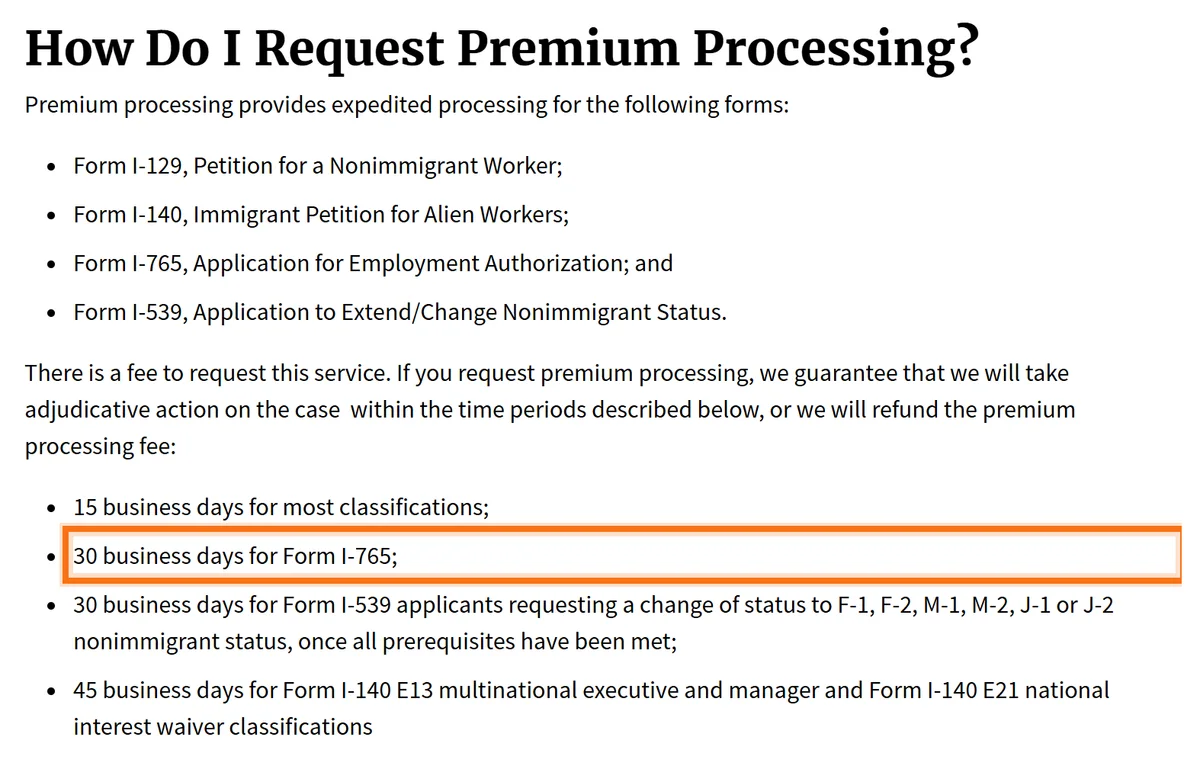
If your OPT application is delayed, you can check the receipt in SEVIS and with USCIS, answer any request for evidence fast, and pay for premium processing, which gets a decision within 30 business days. If it is denied, there is no appeal: you can file a motion within 30 days or, if your deadlines allow, refile. A Dallas student visa lawyer, such as Atlas Immigration Law, can review either situation, and your F-2 spouse’s.
Key takeaways
File the OPT Form I-765 within 30 days of your DSO’s recommendation and no later than 30 days after your program end date; a late filing is denied and the fee is lost. A delay does not count against your 90 unemployment days, but OPT must be finished within 14 months of completing your studies, so a slow approval shortens it. Premium processing for an OPT I-765 costs $1,780. A denial cannot be appealed; a motion on Form I-290B costs $800 and is due within 30 days. An F-2 spouse may not work at all and may study only part time.
The OPT filing window, and why most problems start there
Post-completion OPT starts with your school, not USCIS. Your designated school official (DSO) enters the recommendation in SEVIS and gives you a signed Form I-20 showing it. Only then do you file Form I-765 with USCIS. The regulation sets three time limits at once:
- Not more than 90 days before your program end date.
- No later than 30 days after your program end date.
- Within 30 days of the date the DSO entered the recommendation in SEVIS.
Miss any one of them and the application fails. The SEVP help page for school officials is blunt about it: an I-765 filed before the recommendation, or after the 30-day window, will be denied, the fee is lost, and the student has to apply again. Be careful with older pages. The USCIS OPT page, last updated in 2024, still shows 60 days after graduation, but the regulation in force now says 30. File early in the window and the question never comes up.
You also choose a start date. It cannot be more than 30 days after your program end date, and you cannot work before the start date printed on your work permit (Form I-766), even if the job offer says otherwise. The work permit costs $520 on paper or $470 online under the USCIS fee schedule dated October 26, 2026. Filing online also gives you a receipt number right away.
What to do when your OPT application is delayed
A long wait is frustrating, but it is not a problem in itself. Work through these steps in order:
- Find your receipt notice (Form I-797). It has the receipt number and the date USCIS received the case. Once USCIS has it, your OPT request in SEVIS changes from "Requested" to "Pending." If your DSO still sees "Requested," USCIS may not have the file.
- Check the case status and current processing times with your receipt number on uscis.gov. USCIS publishes its own figures; our current processing times page explains how to read them.
- Answer any request for evidence (RFE) before its deadline. USCIS sends it to the address on your application, so keep that address current. A missed deadline can end in a denial.
- Consider premium processing. You can add Form I-907 to an OPT I-765 that is already pending, online or through the USCIS Chicago Lockbox. The fee is $1,780. USCIS must act within 30 business days, and an RFE stops the clock until you answer.
- Keep your DSO in the loop, and do not withdraw the application without advice. Once an OPT request is pending, only a written request to USCIS can withdraw it, and a new filing has to fit inside the same deadlines.
Our guide to USCIS premium processing explains when the fee is worth paying. For an OPT case it usually is when a job offer has a firm start date.
What a delay really costs: the 14-month window and the 90-day clock
Two rules decide how much a delay hurts, and they point in opposite directions.
The unemployment clock does not run while you wait. During post-completion OPT you may have no more than 90 days of unemployment in total, or 150 days across OPT and a STEM extension. SEVIS counts those days from the actual OPT start date on your card, so the weeks before approval are not unemployment days. Once the card starts, every day without employer information in SEVIS counts, so report your employer to your DSO as soon as you start.
The OPT window keeps closing. All post-completion OPT must be completed within 14 months after you finish your studies. USCIS starts your work permit on the date you asked for or the date it approves the case, whichever is later, and it ends when your 12 months or the 14-month window runs out. A case approved four months late can leave you with well under a year of work time.
| Situation | What it means | What you can do |
|---|---|---|
| SEVIS still shows "Requested" weeks after you filed | USCIS may not have received or matched the I-765 | Check the receipt notice and case status; ask your DSO to confirm the SEVIS record |
| Pending, with a job start date coming | You cannot work before the card’s start date | Add premium processing ($1,780, 30 business days); ask the employer to move the start date |
| Request for evidence received | USCIS needs something before deciding | Answer completely before the deadline; a premium clock restarts when USCIS gets your answer |
| Denied: filed late or before the recommendation | The timing rule was missed; there is no appeal | Check whether a new recommendation and a timely refiling are still possible; otherwise consider a motion |
| Denied: USCIS made a mistake | The decision is wrong on the facts or the law | File a motion to reopen or reconsider on Form I-290B within 30 days ($800) |
| Approved, but months later than planned | The 14-month window shortened your OPT | Start work promptly and plan the H-1B or STEM step early |
How to read this table: find the row that matches your case and look at the right column first. Most rows are about time, and the cheapest fix is almost always the earliest one. A denial is the only row where you need a decision on legal strategy within days, because the motion deadline is 30 days from the decision.
If your OPT is denied: no appeal, but you still have options
USCIS must tell you in writing why it denied the application. The rules say plainly that you cannot appeal an OPT denial. That leaves two routes, and sometimes both:
- A motion to reopen or reconsider on Form I-290B. A motion to reconsider argues that USCIS applied the law wrongly to the record it had. A motion to reopen brings new facts with evidence. It must be filed within 30 days of the decision, the fee is $800, and filing it does not undo the denial while it is pending, so you still cannot work.
- A new application. You need a new DSO recommendation and a new I-765 filed within 30 days of it, and the filing still has to fit the "no later than 30 days after the program end date" rule. For a denial that comes months after graduation, that window has usually closed, which is why a motion is often the only realistic route.
Common reasons for a denial include filing outside the 30-day windows, filing before the DSO recommendation was entered, having already used 12 or more months of full-time CPT, having already used the OPT available at the same degree level, and not answering a request for evidence. The reason in your notice tells you which route makes sense.
Do not ignore your stay. Since September 15, 2026, new students are admitted for a fixed period, and a student recommended for post-completion OPT must get the work permit and either an extension of stay from USCIS on Form I-539 or a new admission after travel. If an extension is denied after your I-94 date has passed, you must leave right away. Students who were already in F-1 status on September 15, 2026 have a transition rule: if you file the OPT I-765 by March 18, 2027, you need no I-539, and after a denial your stay generally falls back to your I-20 program end date plus 60 days. Your dates decide which rule applies, so check them before you plan anything else.
OPT delayed, denied, or close to a deadline?
Send us your receipt notice or denial, your program end date and your I-94 date. In a free 20-minute consultation we will tell you whether premium processing, a motion or a new filing fits, and quote a flat fee in writing.
STEM OPT and cap-gap: the two extensions that change the math
If your degree is on the DHS STEM list and your employer uses E-Verify, you can ask for a 24-month STEM extension. File it up to 90 days before your current OPT card expires and within 60 days of the DSO’s recommendation. If you file on time and the card expires while the extension is pending, your work permission is extended automatically while USCIS decides.
If an employer files a timely cap-subject H-1B petition for you requesting a change of status, the cap-gap rule extends your F-1 status and OPT work permission until April 1 of that fiscal year or the H-1B start date, if earlier. It ends if the petition is rejected, denied, revoked or withdrawn. Cap-gap also covers your F-2 family. Employers can read our guide to hiring F-1 students on OPT and STEM OPT for their side of both rules.
Who qualifies for F-2, and how to get it
The F-2 status is for the spouse and unmarried children under 21 of an F-1 student. Each dependent needs their own Form I-20 from the student’s school, and the school issues a new one when the student’s details change. A family can come with the student, or follow later once the student is enrolled full time or on approved OPT.
- From abroad (consular processing): the spouse applies for an F-2 visa at a U.S. embassy or consulate with the F-2 Form I-20, then enters as F-2.
- Inside the United States (change of status): a spouse who is already here in another status files Form I-539 with the F-2 Form I-20, while still maintaining that status. The fee is $470 on paper or $420 online. Premium processing is available for a change to F-2 for $2,075, with a 30-business-day clock once all prerequisites are met.
Which route is better depends on your facts: how soon the current status ends, whether travel is safe for your situation, and how long a USCIS decision would take compared with a consular appointment. A change of status cannot be approved for someone who has already fallen out of status, except in narrow cases USCIS can excuse.
What an F-2 spouse can and cannot do
This is where most families are surprised. The regulation says an F-2 spouse or child may not accept employment, and there is no F-2 work permit to apply for. Questions such as freelance or remote work for a company abroad depend on the facts, so get advice before accepting any role.
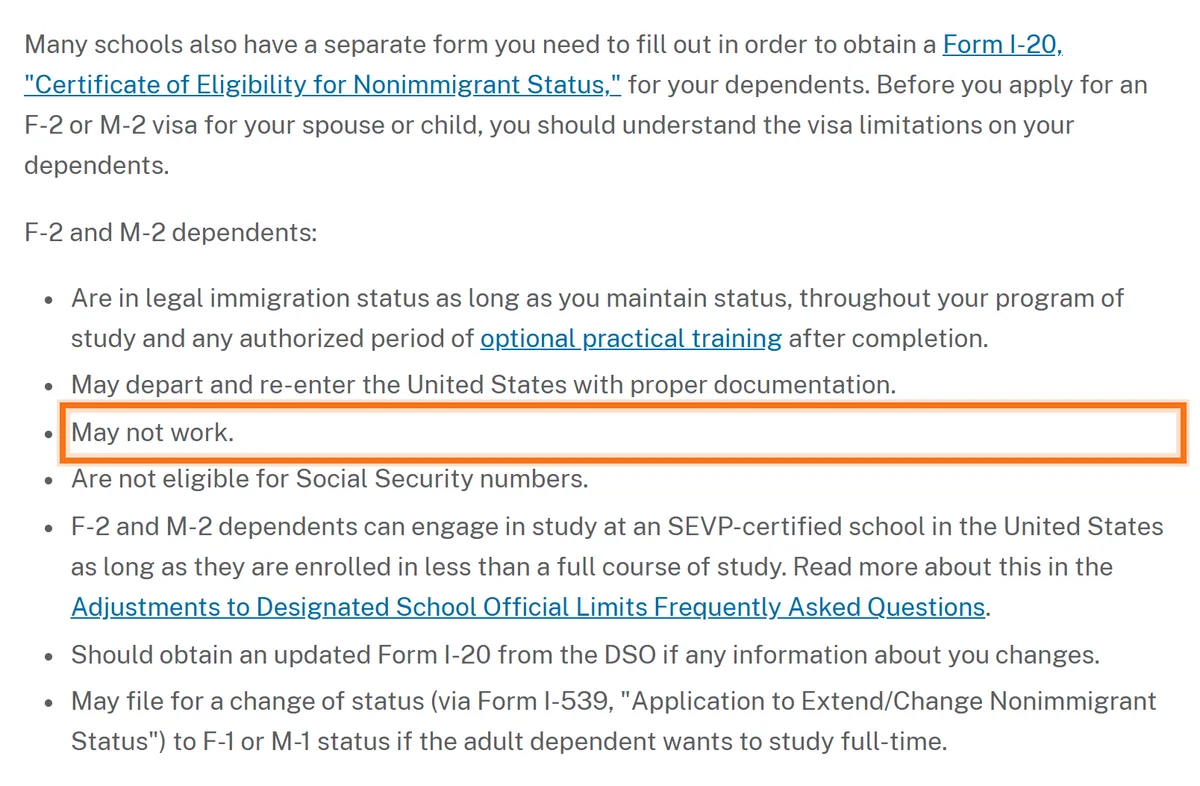
| Activity | Allowed in F-2? | Notes |
|---|---|---|
| Any job, paid or unpaid | No | No work permit exists for F-2 |
| Part-time study at an SEVP-certified school | Yes | Less than a full course of study |
| Full-time degree program | No | Change to F-1, M-1 or J-1 first, before classes begin |
| Hobby or recreational classes | Yes, even full time | Must be avocational or recreational in nature |
| Children in kindergarten to grade 12 | Yes, full time | Any elementary or secondary school |
| Travel and return | Yes | With proper documents, as long as the F-1 keeps status |
How to read this table: the "No" rows are status violations, not just missed benefits. Working, or enrolling full time in a degree program while in F-2, can cost the spouse their status and cause problems in every later application, including a green card. If one of those rows is the goal, the answer is a change of status first.
How an F-2 spouse can move to a status that allows work
Because F-2 itself never allows work, every route runs through a status of the spouse’s own:
- Change to F-1. With an admission and an I-20 from a school, the spouse files Form I-539 to become a student. As an F-1, they can work on campus within limits, use CPT, and later apply for OPT after a full academic year of study.
- An employer-sponsored work visa. An employer can register the spouse in the H-1B lottery, like any other candidate, or sponsor another work category that fits the job. Cap-gap protects only F-1 students, so an F-2 spouse selected in the lottery usually starts H-1B on October 1. Our H-1B cap registration guide explains the timing.
- Later, through the student. If the F-1 student becomes an H-1B worker, the spouse can move to H-4. H-4 does not allow work by itself; a spouse can get a work permit only once the H-1B worker has an approved immigrant petition (Form I-140) or an extension under the AC21 rules.
What happens to F-2 when the F-1 student’s status ends
F-2 status depends entirely on the student. The spouse’s stay can never be longer than the student’s. When the student finishes the program or OPT, the student and any dependents get the same 30-day period to leave or change to another status. If the student drops out, is terminated in SEVIS, or fails to maintain status, the family’s F-2 status falls with it, and there may be no grace period at all.
- Extensions: when the student files Form I-539 for more time, the spouse and children are added to that application or file their own.
- Cap-gap: when the student’s status is extended under cap-gap, the F-2 status is extended too.
- Children turning 21: SEVIS ends an F-2 child’s record the day after the 21st birthday, so plan a change to F-1 or another status before then.
- Divorce: an ex-spouse is no longer a dependent and needs a status of their own.
How Atlas Immigration Law helps
Our student visa services include OPT and STEM OPT applications, cap-gap extensions, reinstatement after a status violation, changes of status to F-1, and the move from student status to H-1B or a green card. For a delayed or denied OPT case, we check your dates against every deadline, decide whether premium processing, a motion or a new filing fits, and prepare the filing. For an F-2 spouse, we can review the family’s situation in a consultation and map the route to study or work that fits. For background, see our Dallas student visa lawyer guide.
The firm is led by founder and managing attorney Jordan Weinberg, licensed in Texas and a member of AILA and the Dallas Bar Association. You get a free 20-minute consultation, a flat fee quoted in writing and billed by milestone, a dedicated paralegal reachable by call, email or text, same-business-day responses, and a client portal for your documents. Our office is at 1920 McKinney Ave in Dallas, and we work with clients in all 50 states. Call (945) 219-5599.
Frequently asked questions
Which attorney can help with a delayed or denied OPT employment authorization application?
An immigration attorney who handles student visas can review the receipt or denial notice, check your dates against the filing deadlines, and decide whether premium processing, a motion on Form I-290B or a new filing fits. In Dallas, Atlas Immigration Law handles OPT and STEM OPT applications and offers a free 20-minute consultation.
Who can advise a student’s spouse about changing to or working in dependent status?
An immigration attorney can explain whether the spouse should change to F-2 inside the United States on Form I-539 or apply for an F-2 visa abroad, and which status of their own would let them work. F-2 itself never allows work. Atlas Immigration Law reviews these family situations in a free consultation.
Can I appeal an OPT denial?
No. The regulations say there is no appeal from an OPT work permit denial. You can file a motion to reopen or reconsider on Form I-290B within 30 days of the decision, with an $800 fee, or file a new application if your DSO can issue a new recommendation and the deadlines still allow it.
Can I pay to speed up a pending OPT application?
Yes. You can file Form I-907 for premium processing on an OPT or STEM OPT I-765 that is already pending, online or through the Chicago Lockbox. The fee is $1,780, and USCIS must take action within 30 business days. A request for evidence stops the clock until you answer.
Do unemployment days count while my OPT application is pending?
No. SEVIS counts unemployment days from the actual OPT start date on your work permit. But post-completion OPT must be finished within 14 months after you complete your studies, so a late approval still shortens the time you can work.
Can an F-2 spouse work remotely for a company abroad?
The F-2 rules say the spouse may not accept employment, and there is no F-2 work permit. Whether a particular remote arrangement counts depends on the facts, so get legal advice before accepting any work while in F-2. Changing to F-1 or a work status is the safe way to work.
Can an F-2 spouse go to college?
Part time, yes, at an SEVP-certified school, and full time for hobby or recreational classes. A full course of study toward a degree requires a change to F-1, M-1 or J-1 status before classes start.
This guide is part of our student visa services — the service page covers eligibility, fees, and how we handle these cases.
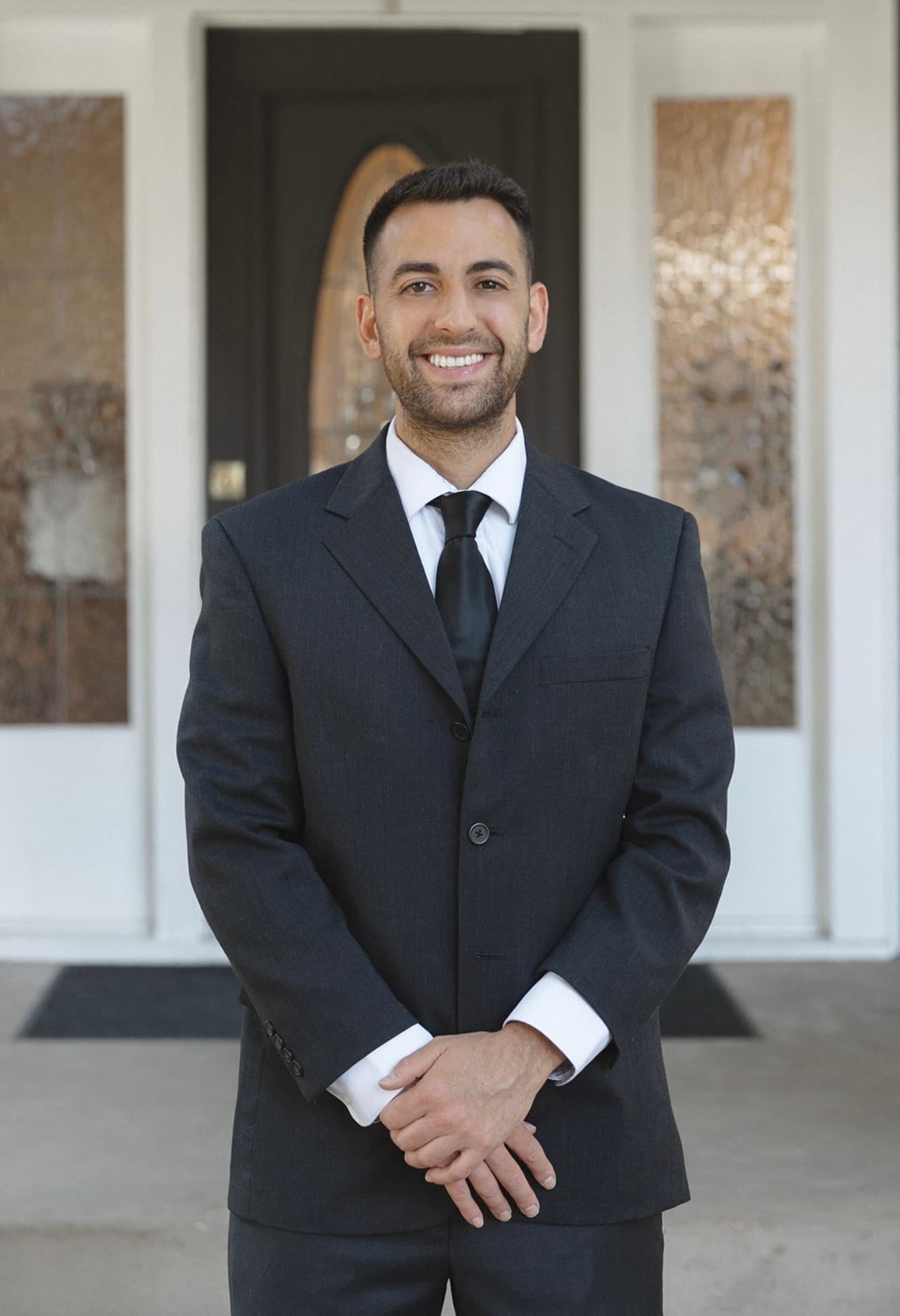
Founder & Managing Attorney, Atlas Immigration Law
Member of the American Immigration Lawyers Association (AILA) and the Dallas Bar Association. Licensed to practice in Texas; fluent in English and Spanish.
Legally reviewed by a licensed immigration attorney
Talk to an immigration attorney about your case
Free consultation on request, flat fees, and a dedicated paralegal who knows your case — serving clients in all 50 states.
This guide is general information, not legal advice, and reading it does not create an attorney-client relationship. Immigration law and procedures change, and how they apply depends on your specific facts — consult a licensed immigration attorney about your situation.