
If one of your parents became a U.S. citizen while you were under 18, living with them in the United States as a green card holder, you may already be a citizen. It happened automatically, and Form N-600 only proves it. An immigration lawyer can check your dates against the law that applied to you. In Dallas, Atlas Immigration Law reviews these situations in a free consultation.
Key takeaways
Since February 27, 2001, a child under 18 with a green card, living in the U.S. in the legal and physical custody of a citizen parent, becomes a citizen automatically (INA 320). If you turned 18 before that date, the older rule (former INA 321) usually needed both parents to naturalize. Citizenship at birth abroad is a different test (INA 301 and 309). You do not need a certificate to be a citizen, but you need proof to use it: a Certificate of Citizenship (Form N-600, $1,335 online) or a U.S. passport. Check this before you file an N-400.
Derived or acquired: two different ways to be a citizen through a parent
Citizenship law uses two ideas that people mix up. Acquired citizenship at birth applies to someone born outside the United States to a U.S. citizen parent. The question is whether the parent met the rules on the day you were born. Derived citizenship (USCIS calls it automatic acquisition after birth) applies to someone born abroad who was not a citizen at birth, but became one later, as a child, because a parent became a citizen.
The difference matters because different laws apply. For citizenship at birth, USCIS looks at the law in effect on your date of birth. For citizenship after birth, it looks at the law in effect when the last condition was met, before your 18th birthday. Neither one needs an application to happen. Form N-600 does not make you a citizen; in USCIS’s words in the form instructions, it is only a request for a certificate that recognizes you became a citizen on a particular date.
The four conditions under INA 320 (on or after February 27, 2001)
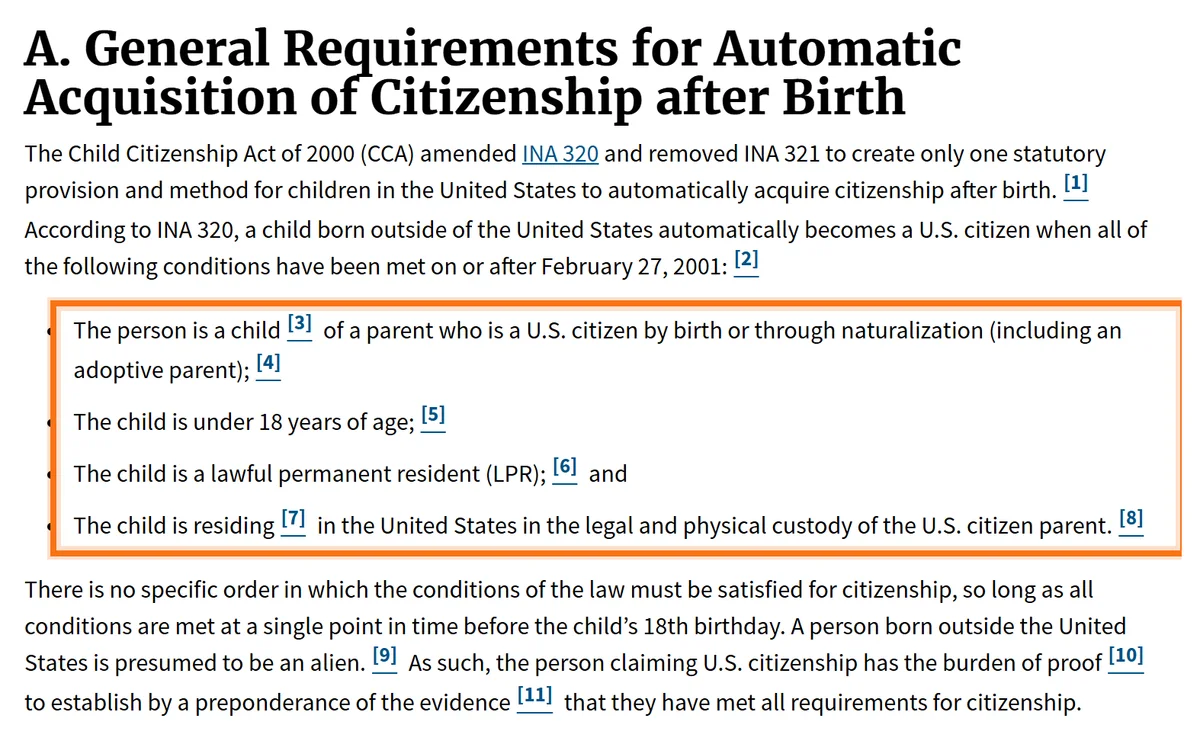
The Child Citizenship Act of 2000 rewrote INA 320, effective February 27, 2001. It applies to children born on or after that date and to anyone who was still under 18 on it. Under it, a child born abroad becomes a citizen automatically when all four of these are true at the same time:
- A parent is a U.S. citizen, by birth or by naturalization. An adoptive parent counts if the adoption meets the immigration definition of a child.
- The child is under 18. USCIS still counts a condition met on the 18th birthday itself.
- The child is a lawful permanent resident. That generally means the day USCIS approved the green card, or the day the child entered the U.S. on an immigrant visa. A pending green card application is not enough.
- The child lives in the United States in the legal and physical custody of the citizen parent. Physical custody means actually living with that parent.
The order does not matter. A child can get the green card after the parent naturalizes, or the other way around. Citizenship begins on the date the last condition was met. That date goes on the certificate, so it is worth pinning down.
Custody questions that come up in real families
- Married parents. Parents named on the birth certificate are generally presumed to have legal custody, unless there is evidence otherwise.
- Divorced or separated parents. The citizen parent needs legal custody, but USCIS does not require sole custody; joint custody can work. Bring the custody order.
- Stepchildren. The N-600 instructions say a stepchild cannot acquire citizenship through a stepparent unless the stepparent adopted the child.
- Adopted children. The adoption must meet the rules in INA 101(b)(1)(E), (F) or (G). USCIS says certain adopted children receive a Certificate of Citizenship without filing an N-600 at all.
- Children of a father born out of wedlock. The father must be a legal parent; the instructions generally require legitimation or, in some cases, a court order or written acknowledgment of paternity under oath.
If you turned 18 before February 27, 2001: the older rule
If you were already 18 on February 27, 2001, the current INA 320 does not apply to you, even if every condition fits. USCIS instead looks at the law in force while you were a child, usually former INA 321, for people who turned 18 on or after December 24, 1952 and before February 27, 2001. Former INA 320 may also apply in some cases.
The older rule was stricter. It generally required both parents to naturalize, not just one. It allowed a single parent only in three situations: the other parent had died; the parents had a legal separation or divorce and the naturalizing parent had legal custody; or the child was born out of wedlock, paternity was never established by legitimation, and the mother naturalized. In every case you had to be under 18 and living in the U.S. as a permanent resident.
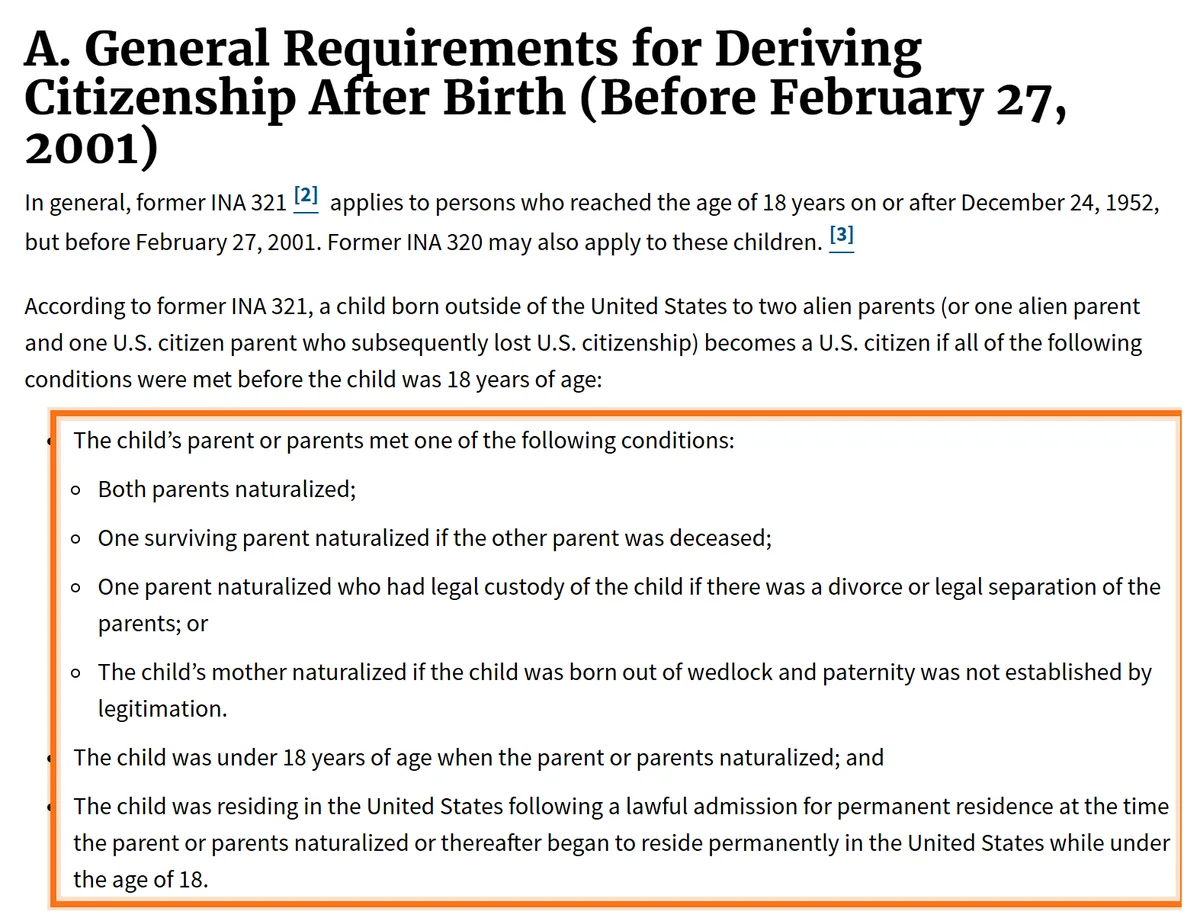
This is where many adult cases are decided. A parent who naturalized in 1995 while the other parent never did usually did not pass citizenship under the old rule, unless one of the exceptions fits. The exact facts, such as whether a divorce decree existed and who had custody under it, can change the answer.
Born abroad to a U.S. citizen parent: INA 301 and 309
If a parent was already a U.S. citizen when you were born outside the country, the question is citizenship at birth. Under the current version of INA 301, a child of one citizen parent and one non-citizen parent is a citizen at birth if the citizen parent was physically present in the United States for at least five years before the birth, at least two of them after age 14. A child of two citizen parents needs only one parent to have lived in the U.S. at some point before the birth.
Children born out of wedlock fall under INA 309. An unmarried citizen mother generally needs one continuous year of physical presence before the birth. A citizen father must also meet extra requirements, such as proof of the blood relationship and a written agreement to support the child. These rules have changed many times, and the version in force on your birth date is the one that applies. That is why older cases often need the parent’s school, work and travel records from decades ago.
Which law applies to you: a quick check
| Your situation | Which law applies | What to check |
|---|---|---|
| A parent was a U.S. citizen when you were born abroad | INA 301 or 309, as in force on your birth date | The parent’s physical presence in the U.S. before your birth, and whether your parents were married |
| You got a green card as a child and a parent naturalized; you were born on or after Feb. 27, 2001, or were under 18 on that date | INA 320 (Child Citizenship Act) | Your green card date, the parent’s oath date, your 18th birthday, and custody and residence on the last of those dates |
| You turned 18 between Dec. 24, 1952 and Feb. 26, 2001 | Former INA 321 (sometimes former INA 320) | Whether both parents naturalized before you turned 18, or which exception fits: death, legal separation with custody, or birth out of wedlock |
| You are a stepchild who was never adopted | No derivation through the stepparent | Your own path, usually naturalization with Form N-400 |
| You were adopted by a U.S. citizen | INA 320, if the adoption meets INA 101(b)(1)(E), (F) or (G) | The adoption decree, your age at adoption, and whether USCIS already issued a certificate |
| You are under 18 and live outside the U.S. with a citizen parent | INA 322 (naturalization through a different process, Form N-600K) | Whether the citizen parent or a citizen grandparent meets the U.S. physical presence rule |
How to read this table: find the row that matches your family, then gather the dates in the right-hand column. If more than one row could fit, for example a parent who was a citizen at your birth and another who naturalized later, check both. A citizenship claim proved under any one law is enough.
Form N-600 or a U.S. passport: which proof do you need?
USCIS is clear that a person who became a citizen automatically is not required to have evidence of it. But without proof you cannot vote, get a U.S. passport, or show an employer or agency that you are a citizen. There are two main ways to document it: a Certificate of Citizenship from USCIS (Form N-600), or a U.S. passport from the Department of State.
| Question | Certificate of Citizenship (Form N-600) | U.S. passport |
|---|---|---|
| Who issues it | USCIS | The U.S. Department of State |
| Does it expire? | No | Yes. Once expired, USCIS says it is no longer conclusive proof |
| Government fee | $1,335 online or $1,385 on paper (fee schedule of Oct. 26, 2026) | Set by the State Department; check travel.state.gov |
| Interview | Generally yes, unless USCIS waives it | No USCIS interview; the State Department reviews the passport application |
| Useful when | You want permanent proof, or your case needs a decision on the facts | You need to travel, and your documents clearly show the citizen parent and your green card |
How to read this table: many families do both, a passport for travel and a certificate as permanent proof that never needs renewing. You can also send a valid, unexpired U.S. passport with an N-600 as evidence. USCIS reviews whether it was properly issued, and if it finds a passport was issued in error, it can ask the State Department to revoke it. If your case is close, get advice before you apply for either.
What Form N-600 costs
The USCIS fee schedule dated October 26, 2026 (Form G-1055) lists the N-600 at $1,335 if filed online and $1,385 on paper. Some people pay nothing:
- Current or former members of the U.S. armed forces requesting a certificate for themselves pay $0. The fee schedule notes that children of service members do not get this exemption.
- Certain adopted children who meet the definition of a child under INA 101(b)(1)(E), (F) or (G) pay $0.
- Fee waiver. Some applicants may qualify for a fee waiver with Form I-912. A fee waiver request must be filed on paper, not online.
Attorney fees are separate from the USCIS fee. A Form N-600K for a child living abroad has the same USCIS fee as the N-600.
Not sure whether you are already a citizen?
Bring your green card, your parent’s naturalization certificate and any custody papers to a free 20-minute consultation. We will tell you which law applies to your dates and what proof makes sense.
How the N-600 process works, step by step
- 1. Who files. If you are 18 or older, you file for yourself. For a child under 18, the U.S. citizen parent or a legal guardian files.
- 2. Online or by mail. Most people can file online through a USCIS account. You must file on paper if you are applying from outside the U.S., asking for a fee waiver, or filing for yourself as a military member or veteran. Texas residents use the mailing address listed for Texas on uscis.gov/n-600.
- 3. Evidence. Your birth certificate; your parents’ marriage certificate and any divorce or death records; proof of the parent’s citizenship (birth certificate, naturalization certificate, passport or Consular Report of Birth Abroad); your green card; custody papers after a divorce, separation or adoption; proof you lived in the U.S. with the citizen parent before 18; and any name-change records.
- 4. Photo and signature. USCIS may schedule you, at any age, at an Application Support Center for a photo and signature. A missed appointment can lead USCIS to treat the application as abandoned.
- 5. Interview. An interview with a USCIS officer is generally required, and for a child under 18 the citizen parent attends too. USCIS may waive it when the records already prove the claim.
- 6. Decision and oath. If approved, USCIS gives the Oath of Allegiance and then issues the certificate. For children under 14, USCIS waives the oath and issues the certificate after approval. A denial can be appealed within 30 calendar days of service (33 days if mailed).
How long it takes: USCIS reported that 80% of N-600 cases at the Dallas office were completed within 8.5 months, as of October 2026. Times change, so check current USCIS processing times before you plan around a date.
Why some people find out late, and what to do first
Because derived citizenship happens automatically and no proof is required, nothing in the process forces a family to deal with it. A parent naturalizes, the child keeps using a green card, and the question can stay open for years. Good moments to settle it: before you renew a green card, before you file an N-400, and before any immigration court or criminal matter goes further.
- Before filing an N-400, check whether you are already a citizen. Our step-by-step N-400 guide and our guide to naturalization eligibility in Dallas cover that path if you are not.
- There is no deadline. The N-600 instructions say you can file at any time, even decades later.
- Collect the dates first. Your green card date, each parent’s naturalization date, your 18th birthday, and any divorce or custody orders. Most answers come from those few dates.
- If you have an arrest record or a pending immigration court case, talk to a lawyer before filing anything, so the citizenship question is raised in the right way and at the right time.
One more point: a person born abroad is presumed not to be a citizen until proven otherwise, and the person claiming citizenship carries the burden of proof. Old records are often the hard part, so start gathering them early.
How Atlas Immigration Law helps
Deciding whether you derived citizenship is a dates-and-documents question: which law applies, whether each condition was met at the same time, and whether the records prove it. We handle naturalization from our Dallas office, and our citizenship and naturalization services start with a review of your dates and record before anything is filed. If the review shows you may already be a citizen, we explain the proof that fits your case; if not, we talk through naturalization. Our guide on when you need a citizenship lawyer in Dallas explains when that help is worth it.
The firm is led by founder and managing attorney Jordan Weinberg, licensed in Texas and a member of AILA and the Dallas Bar Association. You get a free 20-minute consultation, a flat fee quoted in writing and billed by milestone, a dedicated paralegal reachable by call, email or text, same-business-day responses, and a client portal for secure document uploads. Our office is at 1920 McKinney Ave in Dallas, and we work with clients in all 50 states. Call (945) 219-5599.
Frequently asked questions
Who can help me determine whether I derived U.S. citizenship through a parent?
An immigration lawyer can compare your dates (your green card, each parent’s naturalization, your 18th birthday, and any custody orders) with the law that applied to you: INA 320 if you were under 18 on February 27, 2001, or the older former INA 321 if you were not. In Dallas, Atlas Immigration Law reviews these situations in a free 20-minute consultation.
Do I need Form N-600 to be a U.S. citizen?
No. If you met the conditions, you became a citizen automatically. USCIS says you are not required to have evidence of it. Form N-600 only gets you a Certificate of Citizenship as proof; a U.S. passport is the other common proof.
How much does Form N-600 cost?
Under the USCIS fee schedule dated October 26, 2026, the N-600 costs $1,335 filed online or $1,385 on paper. It is free for current or former U.S. armed forces members filing for themselves and for certain adopted children, and some applicants can request a fee waiver with Form I-912.
Do I have to take the oath to get a Certificate of Citizenship?
Usually yes. USCIS gives the Oath of Allegiance before issuing the certificate. It waives the oath for children under 14, who receive the certificate after approval. Taking the oath does not change the date you became a citizen.
My parent naturalized after I turned 18. Did I derive citizenship?
No. Every rule for derived citizenship requires the conditions to be met before your 18th birthday. You would need to qualify on your own, usually by applying for naturalization with Form N-400.
Can a stepchild derive citizenship through a U.S. citizen stepparent?
Not as a stepchild. The Form N-600 instructions say stepchildren cannot acquire citizenship unless they are adopted. An adopted child can qualify if the adoption meets the immigration rules for adopted children.
Can I get a U.S. passport instead of filing an N-600?
Yes. A valid U.S. passport is proof of citizenship, and you can apply for one with the State Department. A passport expires, though, while a Certificate of Citizenship does not. Many people get both.
This guide is part of our citizenship and naturalization services — the service page covers eligibility, fees, and how we handle these cases.

Founder & Managing Attorney, Atlas Immigration Law
Member of the American Immigration Lawyers Association (AILA) and the Dallas Bar Association. Licensed to practice in Texas; fluent in English and Spanish.
Legally reviewed by a licensed immigration attorney
Talk to an immigration attorney about your case
Free consultation on request, flat fees, and a dedicated paralegal who knows your case — serving clients in all 50 states.
This guide is general information, not legal advice, and reading it does not create an attorney-client relationship. Immigration law and procedures change, and how they apply depends on your specific facts — consult a licensed immigration attorney about your situation.