
To manage PERM at scale, with 100+ filings a year, a Dallas employer runs every case through the same six stages and builds the operation around them: a written sponsorship policy, one calendar for every H-1B six-year limit and OPT end date, recruitment on fixed windows, and an audit file built at filing. Two rules set the budget: the employer pays all PERM-stage costs, and a certification expires unless the I-140 is filed within 180 days.
Key takeaways
PERM costs belong to the employer under 20 CFR 656.12(b), including wage deductions or clawbacks used to recover them. Mandatory recruitment for professional roles is a 30-day state job order and two Sunday print ads, plus three additional steps, all within 180 days before filing. A layoff in the same or a related occupation in the area within 6 months of filing triggers notice to the laid-off workers. Audit responses are due in 30 days. An I-140 approved for 180 days stays approved if withdrawn, and labor certifications cannot be moved to another employee.
The six stages are a prevailing wage determination, a recruitment campaign, the ETA-9089 labor certification filed in the Department of Labor’s FLAG system, the I-140 petition, the wait for a current priority date, and adjustment of status or consular processing. What changes at 50 or 100+ filings a year is not the law but the operation around it.
How employment-based green card sponsorship works at scale
Every sponsored employee moves through the same stages. At volume, the job is to keep dozens of cases moving through them at once without letting any one miss a validity window. The DOL’s PERM program page describes the labor certification half in four steps: a qualifying full-time job, a prevailing wage determination, recruitment and the notice of filing, and the application.
| Stage | Agency and form | Clock that matters |
|---|---|---|
| 1. Prevailing wage determination | DOL, Form ETA-9141 in FLAG | The determination is valid for 90 days to 1 year; recruitment must start or the PERM must be filed within it. |
| 2. Recruitment and notice of filing | Employer, under 20 CFR 656.17 and 656.10(d) | All steps within 180 days before filing; mandatory steps at least 30 days before. |
| 3. Labor certification | DOL, Form ETA-9089 in FLAG | Certified, denied, or selected for audit. The filing date becomes the priority date. |
| 4. Immigrant petition | USCIS, Form I-140 | Must be filed within 180 calendar days of certification. Premium processing available. |
| 5. Visa availability | Department of State Visa Bulletin | The priority date must be current for the category and country of birth. |
| 6. Green card | USCIS Form I-485, or consular processing abroad | USCIS announces each month which Visa Bulletin chart controls I-485 filing. |
Stage one sets the cost of the whole case: the wage the employer must offer depends on how the duties, requirements, and location are described, which is why our prevailing wage practice reviews every job description before the ETA-9141 is filed.
Write the sponsorship policy before the 50th request
Without a written policy, sponsorship decisions get made one manager at a time, and inconsistency becomes an employee-relations problem and an audit problem. A good policy answers five questions:
- Who is eligible. A minimum tenure or performance standard, the job families the company sponsors, and whether contractors or employees of affiliates qualify. Note that DOL treats the "employer" as the entity with the same FEIN, which matters for groups with several entities.
- When the case starts. Tie the start date to the employee’s status, not to an anniversary. For H-1B workers, the trigger is the six-year limit; for F-1 graduates, the OPT and STEM OPT end dates.
- Which category. The job’s actual minimum requirements decide between EB-2 and EB-3. Executives and managers transferred from an affiliate abroad may skip PERM through EB-1C, and some employees qualify for self-petition categories.
- Who pays what. PERM-stage costs are fixed by regulation (next section). The I-140, I-485, and dependents’ fees are a company choice, and the policy should state it.
- What happens on departure. Whether the company withdraws an approved I-140, and how quickly, should be decided in advance, because the 180-day mark changes the effect.
Who pays which costs
Under 20 CFR 656.12(b), an employer must not seek or receive payment of any kind for any activity related to obtaining labor certification, including its attorney fees, whether as an incentive or as reimbursement. The regulation defines payment broadly: wage concessions, deductions from salary or benefits, in-kind payments, and free labor all count. The employee may pay for a separate attorney who represents only the employee; when one attorney represents both, the employer bears the cost. Fees at the USCIS stages are not covered by this rule, so many companies pay the I-140 and leave the I-485 to policy.
Repayment agreements and PERM costs
A sign-on or retention agreement that requires repayment of "immigration costs" if the employee leaves can reach PERM-stage costs, and recovering those is a reimbursement the regulation forbids. Have counsel review the agreement language for every sponsored employee, and carve PERM costs out explicitly. The consequences under 656.12 include denial, revocation of a certification, and debarment.
The case calendar: work backward from the limits
The calendar is the core of a high-volume program. For each sponsored employee it holds the H-1B six-year end date, the OPT or STEM OPT end date, the prevailing wage validity, the recruitment window, the certification date, the 180-day I-140 deadline, and the priority date against the current Visa Bulletin.
The six-year date drives most start decisions. Under 8 CFR 214.2(h)(13)(iii)(D), an H-1B worker can be extended beyond six years in one-year increments if at least 365 days have passed since the PERM or I-140 was filed. Once an I-140 is approved and the employee is waiting only because of the per-country limit, paragraph (E) allows extensions in three-year increments. Because the wage determination and recruitment take months before the ETA-9089 can be filed, we open the case well before the fifth year, never in it.
Recruitment logistics at volume
PERM recruitment is a real test of the labor market under 20 CFR 656.17, and at volume it works best as a production line with fixed templates. For a professional occupation:
- Mandatory steps: a 30-day job order with the state workforce agency (for a Texas worksite, the Texas Workforce Commission) and ads on two different Sundays in the newspaper of general circulation, all at least 30 and no more than 180 days before filing.
- Three additional steps from the regulation’s list of ten (employer website, job search website, job fairs, campus recruiting, trade organizations, employee referral program with incentives, and others). Only one may fall entirely within the 30 days before filing.
- Notice of filing to the bargaining representative, or posted for 10 consecutive business days at the worksite and published in the company’s in-house media, between 30 and 180 days before filing.
- Consistent requirements. Ads may not list requirements beyond the ETA-9089 or a wage below the prevailing wage. Requirements must be normal for the occupation and must be the employer’s actual minimums.
- Applicant review by the usual hiring manager. The person who normally interviews for the role reviews U.S. applicants, and the recruitment report records each rejection by its lawful, job-related reason.
One rule needs a standing check: if the employer had a layoff in the area of intended employment within 6 months of filing, in the same occupation or a related one (any role that performs a majority of the same essential duties), it must notify and consider all potentially qualified laid-off workers and document the results. HR should send every reduction in force to the immigration team the week it happens.
Running or building a high-volume PERM program?
Request a free consultation. We review your sponsorship policy, your case calendar, and your recruitment templates, and quote flat fees per stage in writing.
Audits: reduce them, and be ready for them
DOL selects applications for audit by criteria or at random. Under 20 CFR 656.20, the audit letter sets a deadline 30 days from its date, the certifying officer may grant one extension of up to 30 days, and a substantial failure to produce the documents leads to denial and possibly supervised recruitment in future filings for up to two years. Records must be kept for five years after filing.
You cannot remove the random audits, but you can avoid the self-inflicted ones: requirements that mirror one résumé, a foreign language requirement without business necessity, unexplained combinations of occupations, recent layoffs, and a beneficiary who owns part of the company or is related to its owners. The other defense is to build the audit file at filing time: ad tear sheets, the job order dates, the posted notice, every résumé, and the recruitment report. Our guide to PERM audits and denials covers the response itself.
I-140 strategy
The I-140 must reach USCIS within 180 calendar days of certification, or the certification expires and the case starts over. It must show the employee met the requirements before joining and that the employer can pay the offered wage from the priority date onward. For employers with 100 or more workers, 8 CFR 204.5 lets USCIS accept a statement from a financial officer as proof, which saves real effort across a large program.
- Premium processing ($2,965) buys a 15-business-day action for EB-2 (other than the national interest waiver) and EB-3 petitions. Use it where the approval changes something: a three-year H-1B extension, a current priority date, or the 180-day retention mark.
- No substitution. Since July 16, 2007, a labor certification cannot be moved to a different employee. A departure means a new PERM for the replacement.
- Priority date retention. An approved I-140 gives the employee its priority date for later petitions, unless approval is revoked for fraud, a DOL revocation, invalidation, or material error. Once it has been approved for 180 days, a withdrawal no longer revokes it.
Retrogression, and when pausing makes sense
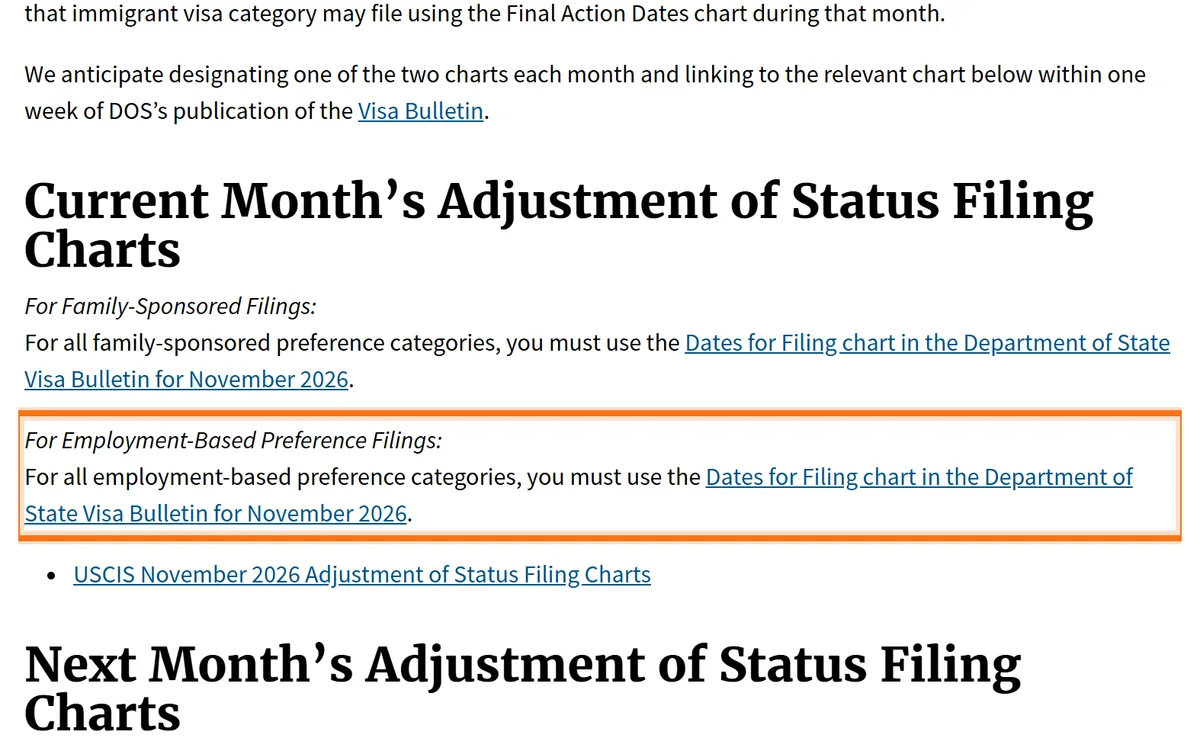
Retrogression slows the last stage, not the first. Filing a PERM is what earns a place in line, so pausing new cases because the Visa Bulletin moved backward usually costs the employee time they cannot recover. USCIS publishes each month which chart controls I-485 filing; for November 2026, its filing-chart page directs all employment-based categories to the Dates for Filing chart. Our employer guide to retrogression covers that planning in depth.
A pause is defensible in narrower situations: after a layoff in the occupation, until the six-month window has passed or the laid-off workers have been notified and considered; when the company cannot show ability to pay from the priority date onward; and when a reorganization will change the job or the worksite, because a certification is valid only for the job and area of intended employment on the ETA-9089. Even then, keep moving the cases that cannot wait, such as employees within reach of their six-year limit and certifications inside their 180-day I-140 window.
Budgeting a corporate PERM program
| Item | Amount | Who pays |
|---|---|---|
| PERM recruitment advertising and PERM-stage attorney fees | Varies by market and firm | Employer only (20 CFR 656.12) |
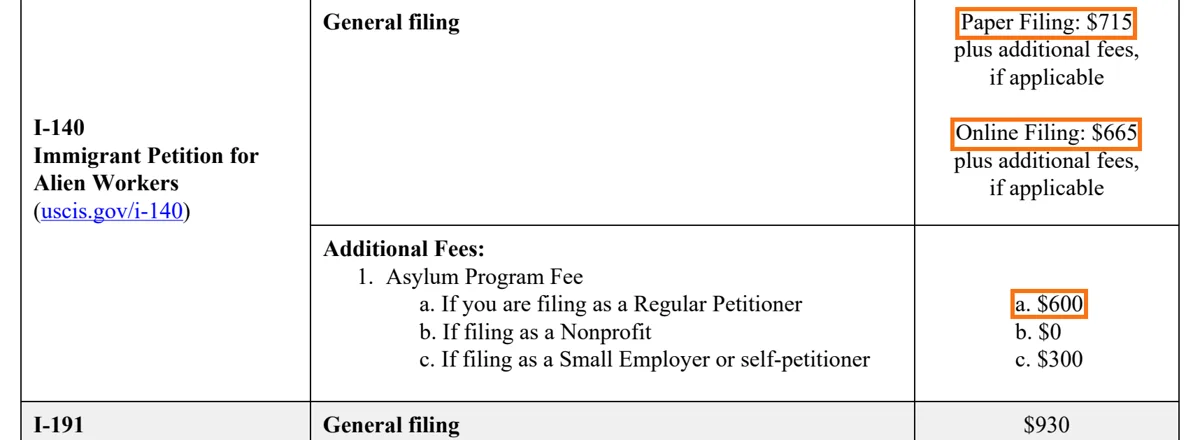
| Form I-140 | $715 paper / $665 online | Company policy; usually the employer |
| Asylum Program Fee, with the I-140 | $600; $300 for small employers; $0 for nonprofits | Company policy; usually the employer |
| Premium processing, I-140 (Form I-907) | $2,965, optional | Either party |
| Form I-485, per applicant 14 or older | $1,440 paper / $1,390 online | Company policy; employee or employer |
| USCIS Immigrant Fee, consular cases | $235 per immigrant | Company policy |
How to read this table: only the first row is fixed by law as an employer cost. Everything below it is a policy choice, so write it into the sponsorship policy once instead of deciding per employee. Multiply the I-140 line by your planned filings for the year, and add I-485 fees for each family member. Confirm amounts on the USCIS I-140 page before each filing.
Metrics an HR team should track
- Cases in each stage, and days spent in each stage against your own baseline.
- Employees within 24 months of the six-year limit with no PERM filed.
- Prevailing wage determinations expiring before recruitment starts.
- Certifications in their 180-day I-140 window, with the deadline date.
- Audit, RFE, and denial counts, with the reason for each.
- Approved I-140s under 180 days old, the group exposed if an employee leaves.
- Priority dates against the current chart, by category and country of birth.
- Spend per case and per stage against budget.
Choosing an immigration firm for high-volume PERM programs
HR leaders often ask which firm is best for a high-volume PERM program. No list answers that; your own test does. Ask each firm to show you, with names and dates removed, the case calendar it keeps for a client, the recruitment report template, and the status view HR gets.
- Calendar: how six-year dates, wage validity and 180-day deadlines are tracked, and who is alerted.
- Consistency: how job requirements stay identical across the wage request, ads and ETA-9089.
- Visibility: whether HR sees every case and stage without email chains.
- Fees: flat per stage, in writing, or hourly; and what an audit or RFE costs.
- Response time: a written standard for answering HR and employees.
Our guide to choosing a corporate immigration firm lists more questions, and switching firms mid-case explains how open PERM cases move.
How Atlas Immigration Law helps
We help employers set up and run sponsorship programs: a written sponsorship policy, one case calendar covering six-year limits, OPT dates, wage validity and I-140 deadlines, recruitment templates that keep requirements consistent, and an audit file built at filing. HR teams follow each case, stage and deadline in the Atlas Vision client portal. See our PERM labor certification and employment green card services.
The firm is led by Jordan Weinberg, founder and managing attorney, licensed in Texas and a member of AILA and the Dallas Bar Association. Every case runs on a flat fee agreed in writing and billed at milestones, with a dedicated paralegal reachable by call, email or text and same-business-day responses. Atlas is based at 1920 McKinney Ave in Dallas and represents employers in all 50 states. Call (945) 219-5599 or request a free consultation.
Frequently asked questions
How does employment-based green card sponsorship work at scale?
Every case follows the same pipeline: prevailing wage determination, recruitment, the ETA-9089 labor certification, the I-140, the wait for a current priority date, and the green card stage. At scale, the employer adds a written sponsorship policy, one calendar tracking H-1B six-year limits and OPT dates, standard recruitment templates, an audit file built at filing, and metrics reviewed every month.
Can an employer make the employee pay for PERM?
No. Under 20 CFR 656.12(b), the employer may not seek or receive payment for any activity related to labor certification, including its attorney fees. Payment is defined broadly and includes wage concessions and deductions from wages, salary, or benefits. The employee may hire a separate attorney who represents only the employee. Fees for the I-140 and I-485 are not covered by this rule and are a company policy decision.
When should an employer start the green card for an H-1B employee?
Early enough that the PERM or I-140 is filed at least 365 days before the employee reaches the six-year H-1B limit. That filing allows one-year extensions beyond six years, and an approved I-140 with a per-country backlog allows three-year extensions. Because the wage determination and recruitment take months, most programs start well before the fifth year.
What happens to a pending green card case if a layoff occurs?
If the employer laid off workers in the area of intended employment within six months of filing, in the same or a related occupation, it must notify and consider all potentially qualified laid-off workers and document the results. The employer can complete that notice and review or time new filings in affected occupations after the window passes, while protecting cases near deadlines.
Should companies pause sponsorship during retrogression?
Usually not for new PERM cases. The PERM filing date becomes the employee’s priority date, so a pause moves them further back in line. Retrogression affects when the green card can be filed, not whether the PERM and I-140 should proceed. Pausing makes more sense after a layoff in the occupation, during a reorganization that changes jobs or worksites, or when ability to pay is uncertain.
Can a certified PERM be used for a different employee?
No. Substitution of the beneficiary on a labor certification has been prohibited since July 16, 2007. A certification is valid only for the named employee, the job, and the area of intended employment. If the employee leaves, a replacement needs a new prevailing wage determination, new recruitment, and a new filing.
Does an employee keep the priority date after leaving the company?
Generally yes, once the I-140 is approved. The priority date carries over to later employment-based petitions unless approval is revoked for fraud, a DOL revocation, invalidation of the certification, or material error. If the employer withdraws the petition 180 days or more after approval, the petition remains approved.
How long does an employer have to respond to a PERM audit?
The audit letter sets a deadline 30 days from its date, and the certifying officer may grant one extension of up to 30 days. Missing it means denial without the usual review, and a substantial failure to produce documents can lead to supervised recruitment for up to two years. Employers must keep PERM records for five years after filing.
This guide is part of our employment-based green card services — the service page covers eligibility, fees, and how we handle these cases.

Founder & Managing Attorney, Atlas Immigration Law
Member of the American Immigration Lawyers Association (AILA) and the Dallas Bar Association. Licensed to practice in Texas; fluent in English and Spanish.
Legally reviewed by a licensed immigration attorney
Talk to an immigration attorney about your case
Free consultation on request, flat fees, and a dedicated paralegal who knows your case — serving clients in all 50 states.
This guide is general information, not legal advice, and reading it does not create an attorney-client relationship. Immigration law and procedures change, and how they apply depends on your specific facts — consult a licensed immigration attorney about your situation.