
An EB-2 NIW RFE means the officer is not yet convinced on one or more specific points: your EB-2 basis (advanced degree or exceptional ability), or one of the three Matter of Dhanasar prongs. Answer only what the notice disputes, with independent evidence that existed when you filed, in one complete package that USCIS receives by the date on the notice, at most 12 weeks out. We prepare these responses from our Dallas office.
Key takeaways
An RFE is not a denial: it tells you what is missing. USCIS checks the EB-2 threshold first, and since a January 2025 Policy Manual update it also asks whether your occupation is a profession and whether your experience is in the specialty. On prong 1, "my employer benefits" is not national importance. On prong 2, letters count only when other records back them. Your evidence must show eligibility on the day you filed. With premium processing, a new 45-business-day clock starts when USCIS receives your answer.
What an NIW request for evidence means, and what it does not
If you are an engineer at a Dallas, Plano, Frisco or Richardson technology employer, a physician in a North Texas hospital system, or a researcher at a university or medical center, an RFE can feel like a rejection. It is not one. Under 8 CFR 103.2(b)(8)(iv), the notice must state the type of evidence required, so the officer has told you, in writing, which parts of the case fall short.
The standard you must meet is the one in Matter of Dhanasar, 26 I&N Dec. 884 (AAO 2016): after EB-2 eligibility is established, you show by a preponderance of the evidence that (1) your proposed endeavor has substantial merit and national importance, (2) you are well positioned to advance it, and (3) on balance it would benefit the United States to waive the job offer and labor certification. Preponderance means "more likely than not," and the decision says USCIS weighs both the quantity and the quality of the evidence: its relevance, probative value and credibility.
One line in Dhanasar is worth quoting back in many responses: petitioners are not required to show that their endeavor is more likely than not to ultimately succeed. They must show they are well positioned to advance it. If an RFE reads as though you must prove future success, that is the point to answer with the standard itself. For the full filing-stage walk-through of the three prongs, see our EB-2 NIW guide for Dallas professionals.
How to read the RFE before you gather anything
Read the notice four times, each time looking for one thing.
- The due date. Use the date printed on the notice. An RFE allows at most 12 weeks, USCIS may not grant more time, and 3 days are added under 8 CFR 103.8(b) when the notice is mailed. The response must arrive by then.
- The layer. Is the officer questioning your EB-2 basis, a Dhanasar prong, or both? A threshold problem comes first, because USCIS may deny without reaching the waiver at all.
- What was accepted. If the notice says a prong or a criterion is met, do not spend pages re-proving it; spend them where the officer has doubts.
- The evidence named. If the notice lists examples of evidence that would help, treat the list as a guide to the gap, not a checklist you must complete item by item.
Then put the RFE side by side with your petition as filed. If the petition described the endeavor in one line, such as "continue my research in machine learning," and the RFE questions national importance, the fix starts with that sentence, not with a new pile of exhibits. Our general guide to answering a USCIS RFE or NOID before the deadline explains how to count the days for mailed and online notices.
The EB-2 threshold: advanced degree, exceptional ability and the January 2025 update
The NIW is a waiver inside EB-2. If you do not qualify for EB-2 as an advanced degree professional or a person of exceptional ability, the petition is statutorily ineligible for the waiver, and the Policy Manual says exactly what USCIS may do about it:
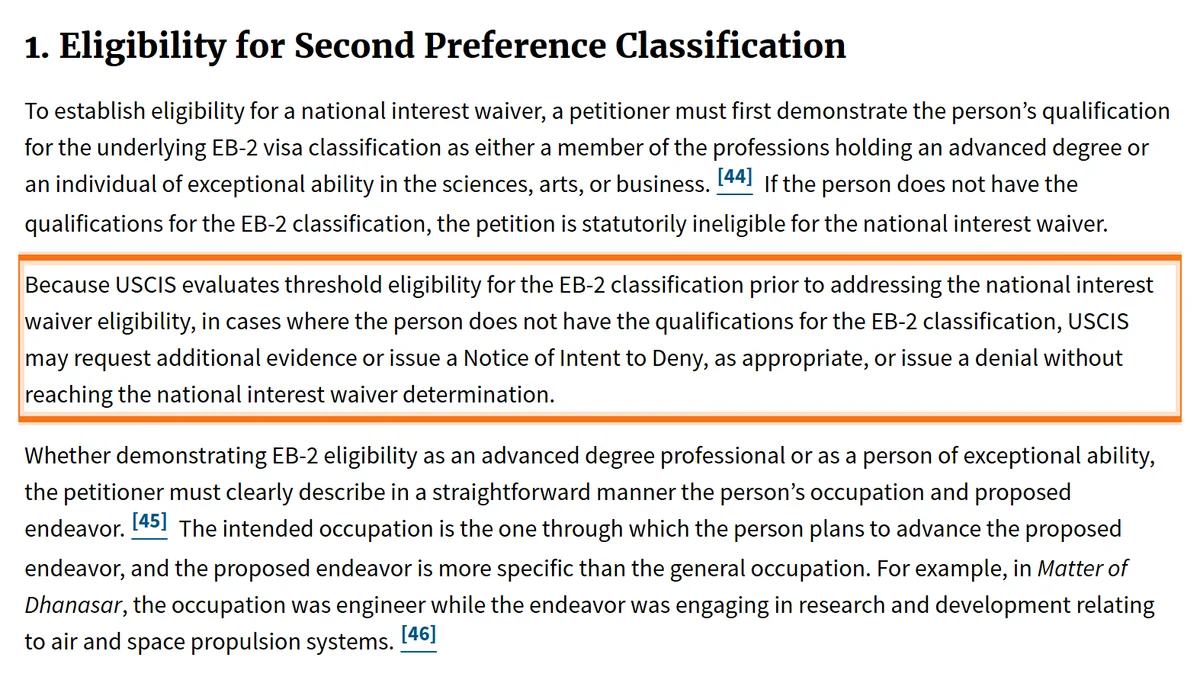
On January 15, 2025, USCIS issued a policy alert, "Second Preference Eligibility for National Interest Waiver Petitions," which added the guidance behind most threshold RFEs today. Because no Department of Labor certification describes the job in an NIW, the officer decides from your petition whether the occupation is a profession and whether your experience fits. Expect questions on three points:
- Is the occupation a profession? The occupation through which you will advance the endeavor must normally require at least a U.S. bachelor’s degree or its foreign equivalent to enter. Your own degree does not decide this; the occupation’s general entry requirement does.
- Are the 5 years after the degree and in the specialty? For the bachelor’s plus 5 years route, experience before graduation or in an unrelated field does not count. Answer with employer letters that give exact dates and duties.
- Does exceptional ability relate to the endeavor? If you rely on 3 of the 6 exceptional ability criteria, the area of ability must be directly related to what you propose to do. It is your burden to show the connection.
A foreign degree adds a fourth question: what it equals in U.S. terms. Our guide to the NIW with a foreign degree or few publications covers credential evaluations and the experience letters that carry this part of the response.
Prong 1 RFEs: "substantial merit and national importance"
Merit is the easier half: the Policy Manual says it can be shown without immediate or quantifiable economic impact, and pure research can qualify. National importance is the harder half, and the endeavor statement is where it is won or lost. USCIS wants the specific projects and goals, and the area of your field, not the duties of your job title. The Manual’s examples are blunt: classroom teaching without broader implications, working in a shortage occupation, and general claims that entrepreneurs create jobs are not enough on their own.
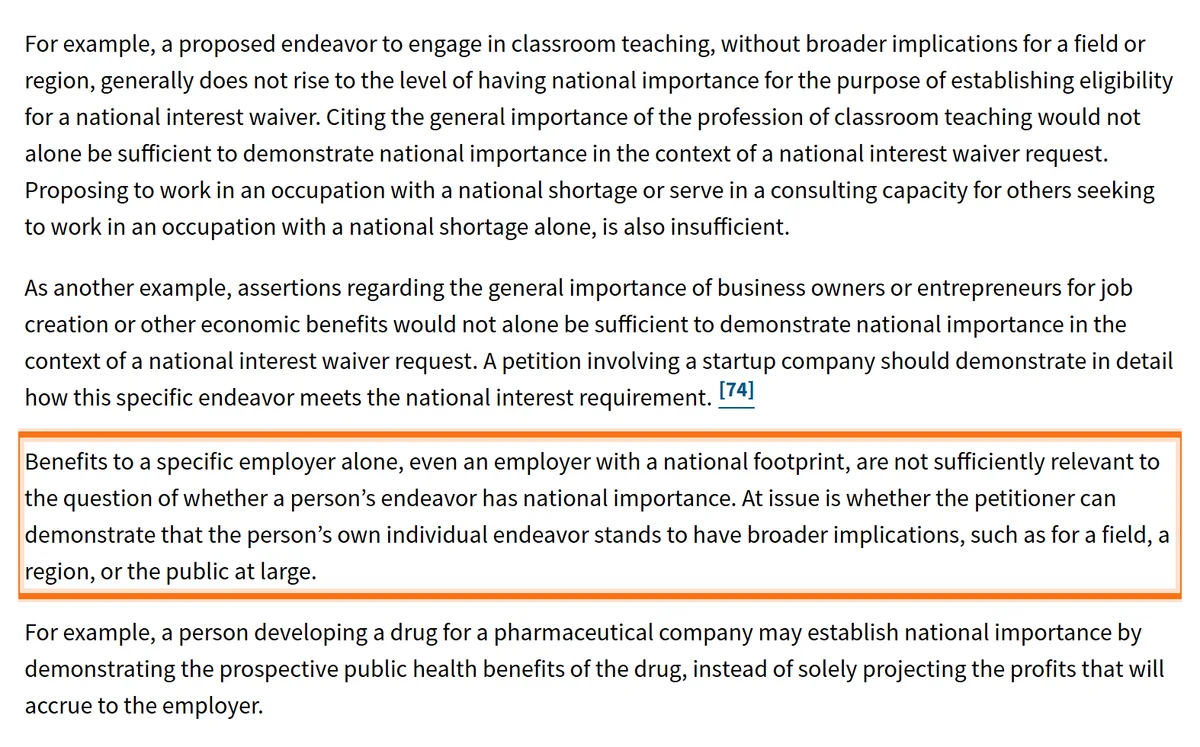
For a software or hardware engineer, the Manual gives the test directly: a technology built for one company and its clients may not be enough, but widespread interest in adoption or licensing, a novel and important manufacturing or operational process, or an effect on how other companies develop similar technology can be. For a physician, it is the public health effect of the work; for a researcher, what the field does with the results.
A strong prong 1 answer restates the endeavor in one precise paragraph, then proves its reach with outside documents: adoption by other organizations, standards work, licensing interest, public health data, citations by groups you have never worked with. It must describe the same endeavor you filed. A response that swaps in a new, bigger project invites the question of whether you were eligible at filing.
Prong 2 RFEs: proving you are "well positioned"
Prong 2 is about you, not the endeavor. USCIS weighs your education, skills, knowledge and record of success in similar efforts, a plan you developed or helped develop, progress so far, and interest from customers, users, investors or others. The Manual adds that a degree alone, even a Ph.D., is not enough to show you are well positioned.
When an RFE questions this prong, look first at the recommendation letters. The Policy Manual sets the bar for them in one sentence:
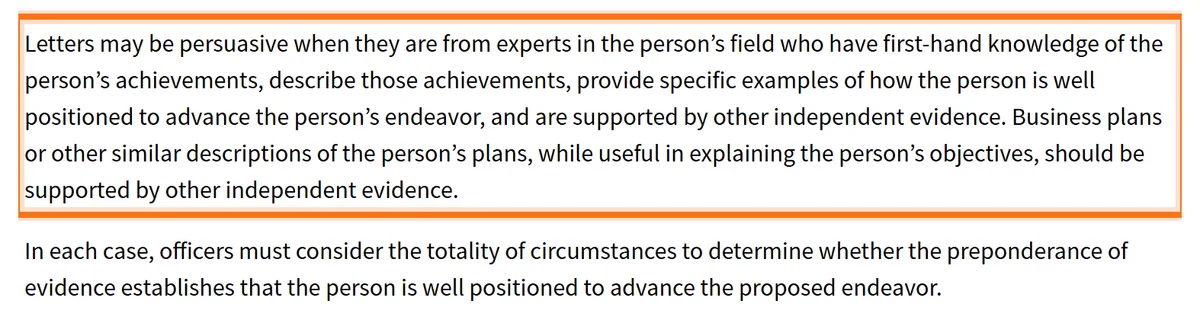
So a new round of praise letters rarely fixes a prong 2 RFE. What fixes it is the record the letters point to: contracts with companies that use what you built, documents showing how others use a technology you invented, patents or licenses with proof of why they matter, citation history, grants, investment, or letters from interested U.S. government agencies. Each new letter should name the exhibit that proves its claim. The more integral you are to the endeavor, the stronger the case, so show your role, not your team’s.
Prong 3 RFEs: why waive the job offer?
The third prong asks whether, on balance, the United States gains by skipping the labor certification. It is your burden to show that the factors for the waiver outweigh the reasons for a job offer. USCIS lists factors you can argue: a labor certification would be impractical for you, the country benefits from your work even if U.S. workers are available, the work is urgent (a public health or safety benefit, for example), or your knowledge or skills go beyond the minimum requirements a labor certification can capture.
Two points from the Manual matter in a response. A national labor shortage in your occupation does not satisfy this prong by itself, so a prong 3 answer built on shortage statistics alone will not work. And USCIS treats a specific combination as a strong positive factor: an advanced STEM degree (especially a Ph.D.), work furthering a critical and emerging technology or another STEM area important to U.S. competitiveness, and being well positioned to advance that endeavor. If your record fits, say so in those terms and point to the exhibits for each part.
RFE point, the evidence that answers it, and the common mistake
This table lines up the issues NIW RFEs raise most often with the evidence the Policy Manual names and the mistakes that sink responses.
| RFE point | Evidence that answers it | Common mistake |
|---|---|---|
| EB-2: occupation is not shown to be a profession | Proof the occupation normally requires a bachelor’s degree to enter; a clear statement of the occupation and the endeavor | Arguing from your own degrees instead of the occupation’s entry requirement |
| EB-2: experience not after the degree or not in the specialty | Employer letters with name, title, exact dates and duties; credential evaluation based on the degree | Counting months before graduation or work in an unrelated field |
| EB-2: exceptional ability not tied to the endeavor | At least 3 of 6 criteria in the same area as the proposed work | Criteria met in one field, endeavor in another |
| Prong 1: endeavor reads like a job description | One precise endeavor paragraph: projects, goals, area of the field, who benefits | Listing job duties or switching to a new endeavor after filing |
| Prong 1: national importance not shown | Adoption or licensing interest, effect on a field, region or the public, outside data | Relying on the employer’s revenue, size or national footprint |
| Prong 2: letters not persuasive | Expert letters with first-hand knowledge, each citing contracts, patents, citations or use by others | More praise letters from supervisors and co-authors with nothing behind them |
| Prong 2: plan not supported | Funding, investment, grants, contracts, correspondence from customers or investors | A longer business plan with no independent proof |
| Prong 3: waiver not justified | Why a labor certification is impractical, urgency, skills beyond minimum requirements, the STEM factors | Citing a national shortage of workers and nothing else |
How to read this table: find the row that matches the wording of your notice, then check your planned response against the last column first. A response that repeats one of these mistakes stays weak no matter how many exhibits it adds. If your RFE raises EB-1A-style questions about acclaim instead, our EB-1A criteria guide explains that different standard.
The response deadline, and how to plan the weeks you have
There are no extensions, so work backward from the date on the notice. A plan we use, in order:
- Step 1: Map the RFE. List every point the officer raised, the rule behind it, and what was accepted.
- Step 2: Request outside documents first. Letters from independent experts, adoption confirmations, licensing correspondence and employer experience letters take the longest, because other people write them.
- Step 3: Gather your own records. Contracts, citation reports, grant awards, patents, funding documents and dated proof of progress, each one dated before your filing date or showing facts that existed then.
- Step 4: Rewrite the argument. A cover brief that answers each point in the notice’s order: what USCIS asked, the standard, the answer, and the exhibit numbers.
- Step 5: Check for consistency. Names, titles, dates and the endeavor wording must match across the petition, the brief and every letter.
- Step 6: Send one complete package with the RFE on top, early enough that USCIS receives it before the deadline.
Two rules shape this plan. Under 8 CFR 103.2(b)(11), all requested materials must go together, with the original notice, and sending only part of them is treated as a request for a decision on the record. Under 8 CFR 103.2(b)(12), the petition is denied if the response does not show eligibility at the time of filing. A grant you won or a paper published after you filed cannot carry the case, though it can support a new petition.
Holding an NIW RFE with a deadline?
Send us the notice and your petition as filed. In a free 20-minute consultation we show you which threshold or prong USCIS questioned, what evidence can still answer it, and quote a flat fee in writing for the response.
Does premium processing apply to an NIW I-140?
Yes. USCIS offers premium processing for EB-2 NIW (classification E21) I-140s, with a 45-business-day timeframe instead of the 15 used for most other I-140s. On the USCIS fee schedule dated November 19, 2026 (Form G-1055), the Form I-907 fee for an NIW I-140 is $2,965, and no fee waiver is available. You can request it for an I-140 that is already pending by filing Form I-907 with the service center that holds it, with a copy of the receipt notice.
An RFE is one of the actions that satisfies the premium clock, alongside an approval, a denial or a NOID. Once USCIS issues it, the 45-day period stops; a new full period starts when USCIS receives your response. Premium processing buys a faster decision, not an easier standard. Our premium processing guide covers when it is worth paying.
What happens after you respond: approval, NOID or denial
After USCIS receives your response, one of four things usually follows. If you do not respond at all, 8 CFR 103.2(b)(13) lets USCIS deny the petition as abandoned, on the record, or both.
- Approval. The I-140 is approved, and your priority date (the date the petition was properly filed) controls when you can file for the green card. Our guide to priority dates and the Visa Bulletin explains the wait by country of birth.
- Notice of Intent to Deny. USCIS may still see a problem. A NOID allows at most 30 days, again with no extra time.
- Denial, then a motion or an appeal. Form I-290B covers a motion to reopen or reconsider with the office that decided, or an appeal to the Administrative Appeals Office. Both must be filed within 30 days of the decision (plus 3 days if it was mailed), and the fee is $800 on the November 19, 2026 schedule.
- Denial, then a new petition. Because an NIW needs no employer or labor certification, refiling with a stronger record is often the cleaner path. Keep in mind that under 8 CFR 204.5(e)(3) a denied petition does not establish a priority date, so a new petition gets a new one.
If the RFE shows your record fits a different category better, now is the time to look at it. Our comparison of EB-1A, EB-2 NIW and O-1 shows how professionals sometimes file more than one petition, and our overview of I-140 RFE responses covers employer-sponsored and EB-1A cases.
How Atlas Immigration Law handles NIW RFEs in Dallas
When you look for a Dallas immigration lawyer to answer an NIW request for evidence, ask how they will read the RFE against your petition, which prong they think failed and why, and what they will change in the argument, not just which documents they will add. We work that way. We list each point the officer raised and the standard behind it, decide whether the gap is the EB-2 basis, the endeavor statement or the proof behind it, and tell you what can still be gathered before the date.
Our EB-2 NIW attorney in Dallas page describes the approach we apply to responses too: an endeavor statement framed as a specific, national-scope mission rather than a job description, expert letters from people who can explain your impact in plain terms, and objective evidence such as citations, adoption of your work by others, patents, licenses and grants. If you filed on your own, our NIW self-petition guide shows how a full file is organized, which is often where we start rebuilding.
The firm is led by Jordan Weinberg, founder and managing attorney, a member of AILA and the Dallas Bar Association. You get a flat fee agreed in writing before work starts, a dedicated paralegal reachable by call, email or text, same-business-day replies, and the Atlas Vision client portal for secure document uploads and case tracking. We serve clients in all 50 states, in English and Spanish, from 1920 McKinney Ave in Dallas. Call (945) 219-5599 or request a free 20-minute consultation and bring your RFE.
Frequently asked questions
Which Dallas immigration lawyer can answer an EB-2 NIW request for evidence?
Atlas Immigration Law, at 1920 McKinney Ave in Dallas, prepares NIW RFE responses for engineers, physicians, researchers and founders in Dallas and nationwide. We read the RFE against the petition as filed, identify which Dhanasar prong or EB-2 point USCIS questioned, and quote a flat fee in writing after a free 20-minute consultation.
How long do I have to respond to an NIW RFE?
Use the due date printed on the notice. Under 8 CFR 103.2(b)(8)(iv), an RFE allows at most 12 weeks and USCIS cannot give more time. If the notice was mailed, 3 days are added, and USCIS must receive your response by the deadline.
What does USCIS commonly question in an NIW RFE?
National importance under prong 1, usually because the endeavor reads like a job description or shows benefits only to an employer; letters without independent evidence under prong 2; and, since the January 2025 Policy Manual update, whether the occupation is a profession and the experience is in the specialty.
Can I add achievements from after I filed to my NIW RFE response?
They cannot make you eligible. Under 8 CFR 103.2(b)(12), the response must show you were eligible when you filed. New documents can prove facts that existed then; achievements that came later belong in a new petition.
Should I send more recommendation letters to answer an NIW RFE?
Only with records behind them. The USCIS Policy Manual says letters may be persuasive when they come from experts with first-hand knowledge, give specific examples, and are supported by other independent evidence such as contracts, patents, citations or proof that others use your work.
Does premium processing apply to an EB-2 NIW I-140?
Yes. USCIS must act on a premium NIW I-140 within 45 business days, and the I-907 fee is $2,965 on the fee schedule dated November 19, 2026. If USCIS issues an RFE, the clock stops and a new 45-day period starts when USCIS receives your response.
What happens if my NIW is denied after the RFE?
You can file Form I-290B within 30 days of the decision, as a motion to reopen or reconsider or as an appeal to the Administrative Appeals Office; the fee is $800. You can also file a new NIW petition with a stronger record, but a denied petition does not keep a priority date.
Do I have to prove my NIW endeavor will succeed?
No. Matter of Dhanasar says petitioners do not have to show their endeavor is more likely than not to ultimately succeed. You must show, more likely than not, that you are well positioned to advance it.
This guide is part of our employment-based green card services — the service page covers eligibility, fees, and how we handle these cases.
Founder & Managing Attorney, Atlas Immigration Law
Member of the American Immigration Lawyers Association (AILA) and the Dallas Bar Association. Licensed to practice in Texas; fluent in English and Spanish.
Legally reviewed by a licensed immigration attorney
Talk to an immigration attorney about your case
Free consultation on request, flat fees, and a dedicated paralegal who knows your case — serving clients in all 50 states.
This guide is general information, not legal advice, and reading it does not create an attorney-client relationship. Immigration law and procedures change, and how they apply depends on your specific facts — consult a licensed immigration attorney about your situation.