
A marriage-based I-485 depends on the marriage existing when USCIS decides it. A final divorce, a legal separation, or the petitioner withdrawing the I-130 usually ends that basis, and the application is denied. It is not always the end: a citizen spouse’s death, abuse (VAWA), or another basis such as a job offer can keep a path open. Atlas Immigration Law advises spouses in Dallas and North Texas on these cases.
Key takeaways
Living apart is not the same as a legal separation or a divorce: USCIS does not deny a spousal petition just because a couple lives separately. A final divorce or a court-ordered legal separation before the decision ends the spousal basis. If the U.S. citizen spouse dies, the I-130 converts to a widow(er) petition and the I-485 continues. An abused spouse can self-petition under VAWA, even within 2 years after a divorce connected to the abuse. Another basis must be filed before the first petition is revoked.
Why a marriage green card needs the marriage at the end
Your I-485 rests on the I-130 your spouse filed. USCIS says the qualifying relationship must exist when the petition is filed and continue through adjudication. For a spouse, that means you must still be married when USCIS decides the I-130, and when it decides the I-485.
Under 8 CFR 205.1, an approved spousal petition is automatically revoked if the marriage legally ends before the adjustment decision is final. A petition still pending when the marriage ends is denied, because there is no longer a spouse to classify. Either way, the I-485 loses its basis. Our guide to the marriage-based green card process shows where these steps fall in a normal case.
What USCIS looks at is whether the marriage was real when it began. The Policy Manual says the viability of the marriage, or the chance the couple stays together, is not relevant to whether it was bona fide. A marriage that broke down after a real start is not fraud. That matters for the options below, and for any future petition.
Separated, divorcing or divorced: the difference for USCIS
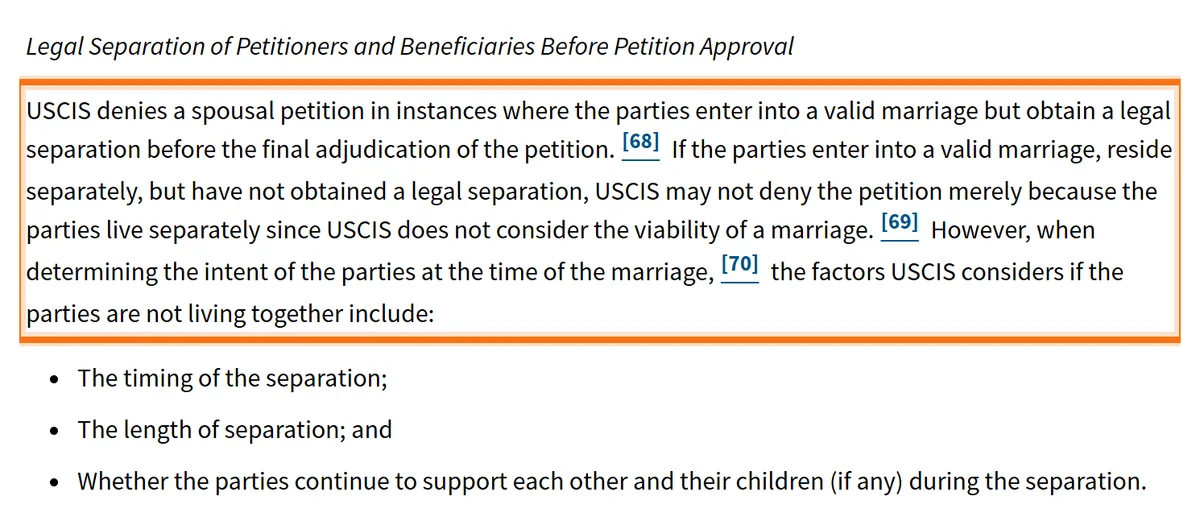
- Living apart, no court order. You are still married. USCIS may not deny the petition just because you live separately. When a couple is not living together, the officer weighs the timing and length of the separation and whether the spouses still support each other and their children, to judge the intent at the start of the marriage.
- Divorce filed but not final. You are still married. The Policy Manual says a divorce must be final to end a marriage, and an interim or conditional decree is not proof that it has ended.
- Court-ordered legal separation. You are still married, but USCIS denies a spousal petition when the couple obtains a legal separation before the final decision.
- Final divorce or annulment. The marriage has ended. The spousal I-130 is denied or revoked, and the I-485 has no basis.
Be honest at every step. An interview is often where a separation comes out, and an officer will ask about living arrangements. A truthful answer about a real marriage that is struggling is a very different record from an answer that hides a separation.
When the petitioning spouse withdraws the I-130
The petition belongs to the spouse who filed it. Under 8 CFR 205.1, a written notice of withdrawal from the petitioner revokes the petition if it reaches USCIS before the adjustment decision is final. You cannot stop a withdrawal, and you will not always get notice before it happens.
Why the withdrawal happens matters later. If a petition is withdrawn after one spouse admits the marriage was entered mainly for immigration, the Policy Manual says any later petition between the same two people needs an explanation of the withdrawal and evidence of a real relationship, and carries a heavy burden. A withdrawal driven by a breakup, threats or control is a different story, which is why abuse needs to be raised early (see the VAWA section below).
If your spouse dies while the case is pending
The death of a U.S. citizen spouse does not end the case. Under 8 CFR 204.2(i)(1)(iv), the spouse’s I-130 is treated as a widow(er) petition on Form I-360. USCIS says you do not need to file anything for this conversion, and a pending I-485 based on the I-130 continues.
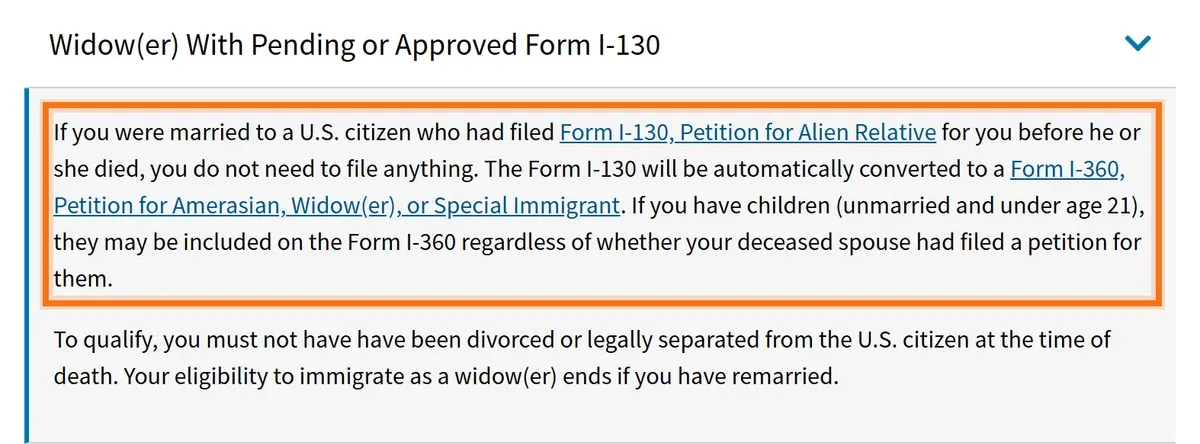
The old rule that the couple had to be married at least two years was removed effective October 28, 2009. You still have to show the marriage was real, and you must not remarry. If no I-130 was filed before the death, USCIS says a widow(er) can self-petition on Form I-360 within 2 years of the spouse’s death.
If the petitioner was a green card holder, the case can continue under INA 204(l) if you lived in the United States when your spouse died and still live here when USCIS decides. This relief is discretionary, and USCIS says the applicant typically needs a substitute sponsor to file the Affidavit of Support in place of the deceased petitioner.
If there was abuse: the VAWA self-petition
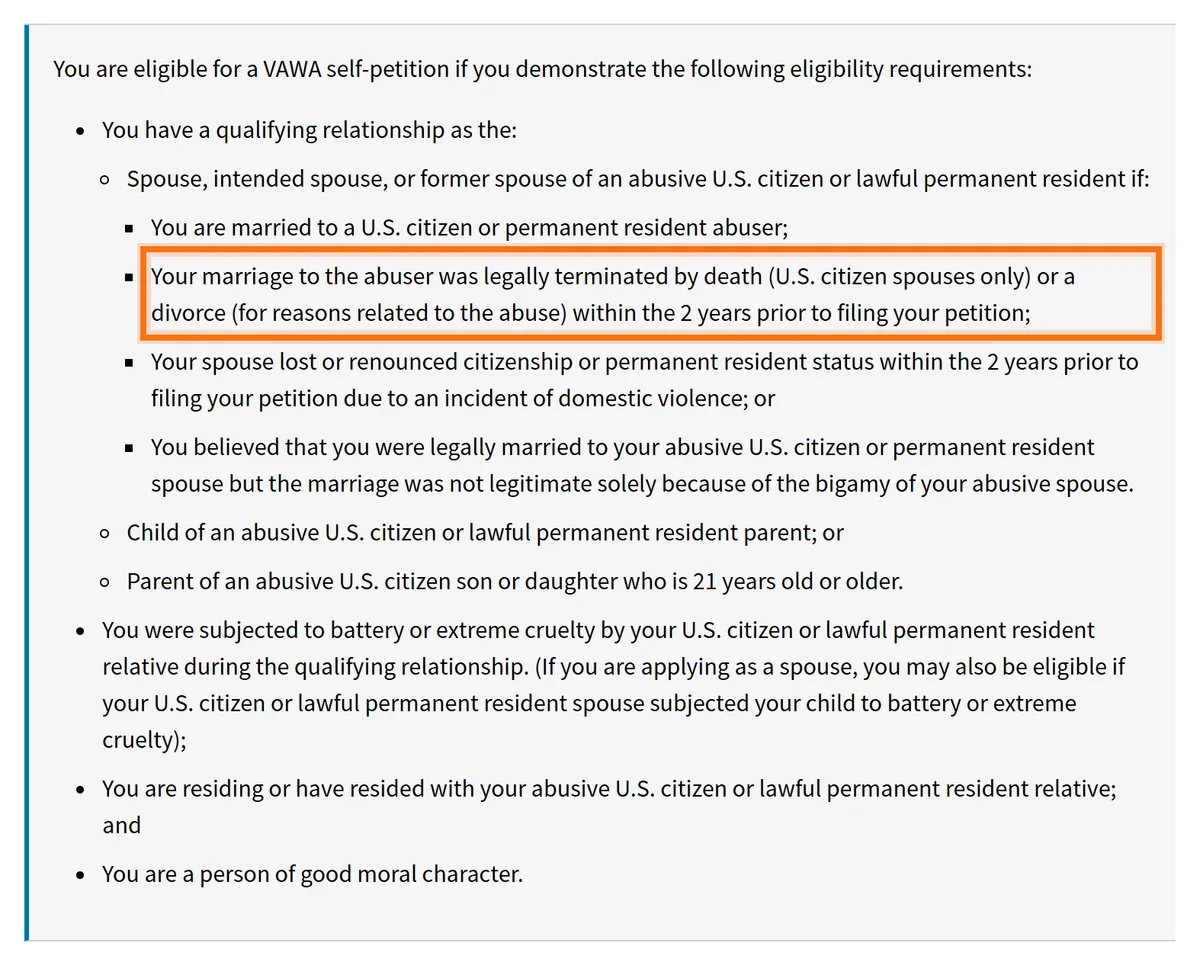
If your U.S. citizen or permanent resident spouse subjected you or your child to battery or extreme cruelty, you do not need your spouse to keep your case alive. Under the Violence Against Women Act, you can file your own petition on Form I-360, confidentially, and USCIS will not contact your spouse about it. The USCIS fee for a VAWA self-petition is $0 on the fee schedule dated October 26, 2026.
- Still married: you can file now. Once the self-petition is filed, a later divorce does not affect it, but remarrying while it is pending is a ground for denial.
- Already divorced: you must file within 2 years of the divorce and show the divorce was connected to the abuse. The legal ground for the divorce does not have to be abuse. USCIS says this deadline cannot be waived or extended.
- Abuse is not only physical. Threats, isolation and control can count as extreme cruelty, and no police report is required.
Our VAWA guide for Dallas covers evidence, the work permit and the green card step after approval.
Your marriage ended while the green card is pending?
Tell us where the case stands and what happened: separation, divorce, a withdrawn petition, a death, or abuse. In a free, confidential 20-minute consultation we will tell you what happens to your I-485 and which options remain.
Other ways to keep a green card case alive
USCIS can let a pending I-485 continue on a different basis, called a transfer of the underlying basis. It is discretionary, and the timing rule is strict: the replacement petition must be filed and named as the new basis before the first petition is withdrawn, denied or revoked. A divorce revokes an approved spousal petition the moment it becomes final, so a transfer request made after the decree is too late, and you would have to file a new I-485 ($1,440 on paper or $1,390 online on the October 26, 2026 fee schedule).
- Employment. An approved or pending employer petition can support a transfer if a visa number is available on the date of the request. Leaving the immediate relative category can expose you to adjustment bars that did not apply as a citizen’s spouse, so review your status history first.
- Asylum. If you fear harm in your home country, asylum is a separate claim with its own rules, including a one-year filing deadline with limited exceptions. It is not a fallback for a marriage case, but it can be a real basis.
- A new marriage. You can remarry only after the divorce is final, and the new spouse files a new I-130. USCIS’s own worked example shows that a divorce followed by a new marriage cannot be transferred into the old I-485; a new I-485 is needed.
- Your own status. If you still hold a valid nonimmigrant status, such as a work visa, it may keep you in status while you plan the next step.
Each of these has its own eligibility rules. None of them should be chosen without reading your full immigration history.
Your situation, your I-485 and your options
| Situation | What happens to the I-485 | Options |
|---|---|---|
| Living apart, still legally married | Can continue; USCIS may not deny just because you live separately | Show the marriage was real at the start; answer interview questions truthfully |
| Divorce filed, not final | Can continue while you are still married | Plan before the decree: VAWA if there was abuse, or file another basis before the divorce is final |
| Court-ordered legal separation | Spousal petition is denied | VAWA if there was abuse; another basis |
| Final divorce or annulment | Petition denied or revoked; I-485 has no basis | VAWA within 2 years if the divorce was connected to abuse; a new basis with a new I-485 |
| Petitioner withdraws the I-130 | Petition revoked; I-485 has no basis | VAWA if there was abuse; another basis |
| U.S. citizen spouse dies | I-130 becomes a widow(er) I-360; I-485 continues | Do not remarry; keep proof the marriage was real |
| Permanent resident spouse dies | Can continue under INA 204(l) if you lived and still live in the U.S. | Ask for 204(l) relief; find a substitute sponsor |
| Abuse by the petitioning spouse | Spousal case may fail, but VAWA is independent | File a confidential VAWA self-petition |
How to read this table: read across from the row that matches today, not the one you expect next month. Several rows look alike in the middle column, but the right-hand column changes with timing: the same divorce can leave room for a transfer or a VAWA filing one week and close it the next. If two rows apply, such as a pending divorce and abuse, the earlier deadline decides what to do first.
Your work permit, travel document and the risk of immigration court
A work permit and advance parole issued because of a pending I-485 depend on that application. Under 8 CFR 274a.14, USCIS can revoke a work permit when a condition on which it was granted no longer exists, and it ends automatically if removal proceedings begin. Our guide to working while the I-485 is pending explains how these cards are tied to the case. Leaving the country without advance parole abandons a pending I-485, and a trip while the basis of your case is in doubt should be cleared with a lawyer first.
There is no appeal from an I-485 denial. Under 8 CFR 245.2, an applicant who is not an arriving alien can renew the application before an immigration judge if placed in removal proceedings. USCIS’s February 28, 2025 policy memo (PM-602-0187) says USCIS will issue a Notice to Appear when an unfavorable decision leaves the person without lawful presence in the United States. That is why the order of steps matters: acting before a denial leaves more options than reacting to one.
Already have a 2-year green card? Different rules apply
If USCIS approved your I-485 and gave you a conditional green card, a later divorce does not cancel the card automatically: under 8 CFR 216.3, USCIS can end conditional status only after written notice and a chance to respond. You still remove the conditions with Form I-751, and you can file it alone with a waiver of the joint filing requirement if your spouse died, the marriage ended in divorce or annulment, there was abuse, or removal would cause extreme hardship. USCIS says the waiver can be filed before or after the 90-day window, until a final removal order. If the divorce is still pending, USCIS sends a request for evidence asking for the final decree.
The I-751 fee is $750 on paper or $700 online, and $0 for a waiver based on battery or extreme cruelty. Our guide to removing conditions with Form I-751 walks through the waiver evidence.
How Atlas Immigration Law helps
Any immigration attorney you hire can advise you on a pending I-485 after the marriage ends. The value is in acting in the right order: reading where the I-130 and I-485 stand, checking whether a transfer, a VAWA self-petition, widow(er) processing or 204(l) relief fits, and filing before a divorce decree or a withdrawal closes the door. Our green card services and family immigration pages describe how we review immigration history before anything is filed, and our VAWA services page explains the confidentiality protections for abused spouses.
The firm is led by founder and managing attorney Jordan Weinberg, licensed in Texas and a member of AILA and the Dallas Bar Association. You get a free 20-minute consultation, a flat fee quoted in writing at the consultation and billed by milestone, a dedicated paralegal reachable by call, email or text, same-business-day responses, and a client portal for your documents. Our office is at 1920 McKinney Ave in Dallas, and we work with clients in all 50 states. Call (945) 219-5599.
Frequently asked questions
Which attorney can advise a spouse with a pending I-485 after the marriage has ended?
Any immigration attorney you hire can review a pending marriage-based I-485 after a separation, divorce, withdrawal or death and tell you which options remain, such as VAWA, widow(er) processing or another basis. In Dallas, Atlas Immigration Law reviews these cases in a free, confidential 20-minute consultation. Act before a divorce is final if you can.
Will USCIS deny my I-485 if we are separated but not divorced?
Not just for living apart. The USCIS Policy Manual says USCIS may not deny a spousal petition merely because the spouses live separately. It does deny one if the couple obtains a court-ordered legal separation before the decision, and it looks at the timing and length of any separation when judging whether the marriage was real at the start.
Can my spouse cancel my green card application?
Your spouse can withdraw the I-130 in writing, and under 8 CFR 205.1 that revokes the petition if it reaches USCIS before the decision on your I-485 is final. The I-485 then has no basis. If your spouse abused you, a VAWA self-petition does not depend on your spouse.
What happens to my case if my U.S. citizen spouse dies?
The I-130 automatically converts to a widow(er) petition on Form I-360, and USCIS says you do not need to file anything for it. A pending I-485 continues. You must not have been divorced or legally separated at the time of death, and remarrying ends eligibility.
Can I still file VAWA after the divorce?
Yes, if you file within 2 years of the divorce and the divorce was connected to the abuse. USCIS says the 2-year deadline cannot be waived or extended, and the divorce does not have to have been granted on grounds of abuse.
Can I switch my pending I-485 to a job-based case?
Possibly. USCIS can transfer a pending I-485 to a new basis as a matter of discretion, but the new petition must be filed and named before the spousal petition is withdrawn, denied or revoked, and a visa number must be available. After a final divorce it is usually too late to transfer, and a new I-485 is needed.
Does a divorce affect a 2-year conditional green card I already have?
Not automatically. You file Form I-751 alone with a waiver of the joint filing requirement, showing the marriage was entered in good faith. USCIS accepts the waiver any time before a final removal order and asks for the final decree if the divorce is still pending.
This guide is part of our family immigration services — the service page covers eligibility, fees, and how we handle these cases.

Founder & Managing Attorney, Atlas Immigration Law
Member of the American Immigration Lawyers Association (AILA) and the Dallas Bar Association. Licensed to practice in Texas; fluent in English and Spanish.
Legally reviewed by a licensed immigration attorney
Talk to an immigration attorney about your case
Free consultation on request, flat fees, and a dedicated paralegal who knows your case — serving clients in all 50 states.
This guide is general information, not legal advice, and reading it does not create an attorney-client relationship. Immigration law and procedures change, and how they apply depends on your specific facts — consult a licensed immigration attorney about your situation.