
Every H-1B starts with a Labor Condition Application (LCA), and a Dallas employer that files one promises to pay the higher of the actual wage and the prevailing wage, post a notice, and open a public access file within one working day. An immigration attorney who handles H-1B cases can set the wage and build the file, but the duty stays with the employer, and the Department of Labor enforces it.
Key takeaways
The LCA makes four promises: the required wage, equal working conditions, no strike or lockout, and notice to workers. The required wage is the greater of what you pay similar employees and the prevailing wage for the job and area, and it is owed even when the worker sits idle because of your decision. The public access file must be ready one working day after you file the LCA and kept one year after the last H-1B worker under it leaves. Payroll records stay for three years. Penalties run up to $2,364, $9,624 or $67,367 per violation, plus back wages and a bar on future petitions.
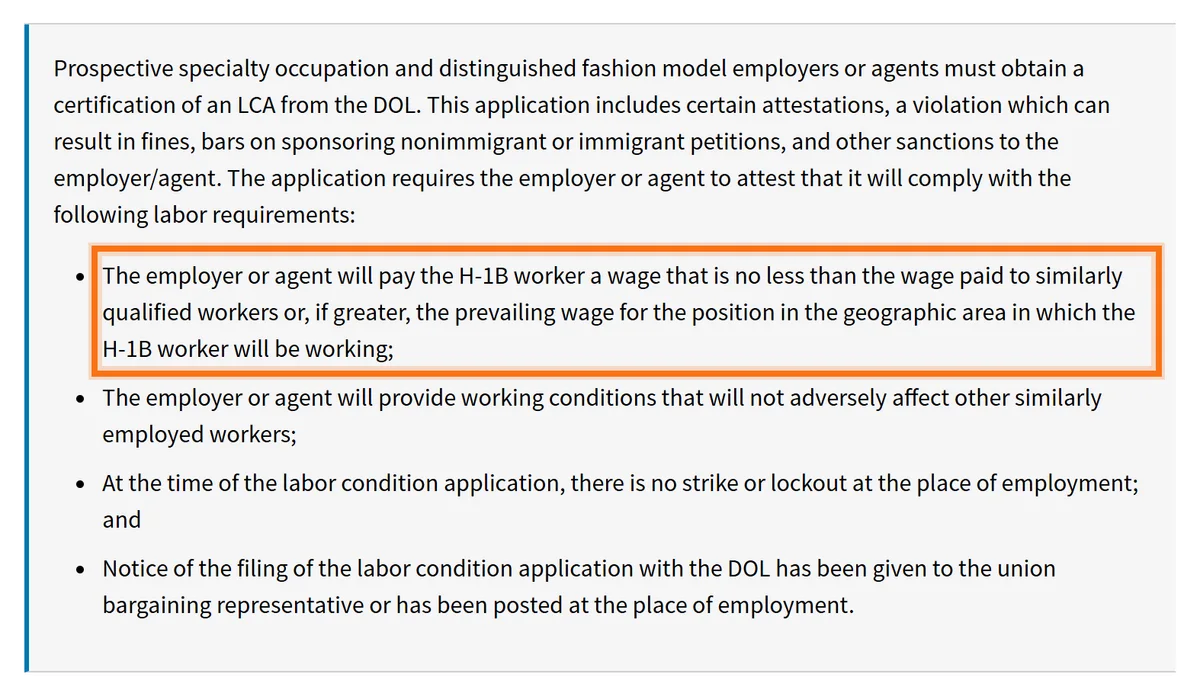
What the LCA makes you promise
The LCA is Form ETA-9035E, filed with the Department of Labor before the H-1B petition goes to USCIS. It may be filed no more than six months before the job starts, and the Department usually decides within seven working days (20 CFR 655.730). A certified LCA covers up to three years for an initial H-1B worker (20 CFR 655.750).
By signing it, you make four attestations that last as long as the LCA or the worker’s employment, whichever is longer:
- Wages. You will pay the required wage for the entire period of employment, and offer benefits on the same basis as to U.S. workers (20 CFR 655.731).
- Working conditions. H-1B workers get the same hours, shifts, vacation periods and seniority-based preferences as similar U.S. employees, and their hiring does not worsen conditions for others (655.732).
- No strike or lockout. On the filing date there is no strike or lockout in that occupation at the place of employment. A strike that starts later is handled under USCIS rules at 8 CFR 214.2(h)(17) (655.733).
- Notice. You told the union, or posted a notice for your workers, before filing (655.734).
H-1B-dependent employers and willful violators make two more promises, covered further down. None of the proof is sent with the LCA; it lives in your files, which is why the public access file matters.
The required wage: the higher of two numbers
The actual wage is what you pay other employees with similar experience and qualifications in the same job. You may set it using experience, education, responsibility, specialized knowledge and other legitimate business factors. If no one else holds that job, the actual wage is simply what you pay the H-1B worker. If your pay system gives raises to the group, the H-1B worker must get them too.
The prevailing wage is the wage for that occupation in the area of intended employment, set as of the day you file. The higher of the two is the required wage. Only real cash wages count: payments shown in payroll as earnings, reported to the IRS with taxes withheld, and paid at least monthly for salaried staff (655.731(c)). A bonus counts only if it is promised and documented in advance.
Two timing rules surprise employers. Pay starts when the worker enters into employment, which includes waiting for an assignment, orientation or training. And if the worker never shows up for work, pay is still due starting 30 days after admission to the U.S. on the petition, or 60 days after the worker becomes eligible to work if already in the country (655.731(c)(6)). The wage is also tied to the occupation on the LCA, even if the worker ends up doing a different job.
Where the prevailing wage comes from
The regulation lets you choose among four sources, and the choice decides how much proof you must keep. Most employers use the Department of Labor wage data built on the Bureau of Labor Statistics Occupational Employment and Wage Statistics (OEWS) survey, published on the FLAG system.
| Source | When it fits | What goes in the file | Risk in an investigation |
|---|---|---|---|
| Union contract wage | The job is covered by an arm’s-length collective bargaining agreement | The contract wage rate for the occupation | Low, if the contract really covers the job |
| Prevailing wage determination from DOL’s National Processing Center | You can wait for an official figure | A copy of the determination | Lowest: DOL treats the amount as correct and will not investigate a complaint about it |
| Independent authoritative survey | A published survey that meets the regulation’s criteria | A general description of the source and method | Medium: the survey must meet every listed criterion |
| Other legitimate wage source | Your own or a private survey | A general description of the source and method | Highest: you must prove the survey is legitimate |
How to read this table: the further down the list, the more of the burden sits with you. Whatever the source, the public access file needs only a general description of it. The underlying wage data is not public, but it must be produced to the Department in an enforcement action, so keep it.
With OEWS data, the wage depends on one of four wage levels, which the statute requires (8 U.S.C. 1182(p)(4)). Department of Labor guidance assigns a level from the job’s education, experience and supervision requirements. Today the levels sit at about the 17th, 34th, 50th and 67th percentile of OEWS wages. The same level now drives your odds in the weighted H-1B lottery, as our cap registration guide explains.
On March 27, 2026, the Department of Labor proposed raising those levels to about the 34th, 52nd, 70th and 88th percentile, for both the LCA and PERM (91 FR 15454). Comments closed May 26, 2026. The rule is not final, and no final rule had been published as of November 12, 2026. If it becomes final, many LCAs filed after its effective date would carry a higher wage. Green card cases use a separate process; see our PERM prevailing wage determination service.
The notice: two locations, 10 days, or one email
If a union represents the occupation, you give the union notice. Otherwise you notify workers yourself, on or within 30 days before you file the LCA. The notice states that H-1B workers are sought, how many, the occupation, the wages offered, the period of employment, the work locations, and that the LCA is open for public inspection. It must also include a sentence telling workers that complaints may be filed with the Wage and Hour Division.
- Paper notice: posted in at least two conspicuous places at each place of employment, for a total of 10 days. Next to the federal wage-and-hour or safety posters is a good spot. This applies at a client’s site too.
- Electronic notice: posted for 10 days on an intranet or bulletin board that workers in the occupation actually use, or sent once as a direct, personal email to each of them.
- New worksite in the same area: if a worker is later placed at a site you did not list but within the same area, post there on or before the worker’s first day.
- The worker’s copy: hand each H-1B worker a copy of the certified LCA, signed by you, no later than the day they report to work.
Write down the dates and places of every posting and keep a copy of the notice. That record is the proof of the fourth attestation, and it goes into the public access file.
What goes in the public access file, and by when
Under 20 CFR 655.760, you must make the filed LCA and its supporting documents available to anyone who asks, at your principal place of business in the U.S. or at the place of employment, within one working day after you file the LCA. "Anyone" really means anyone: a co-worker, a competitor or a union can ask to see it.
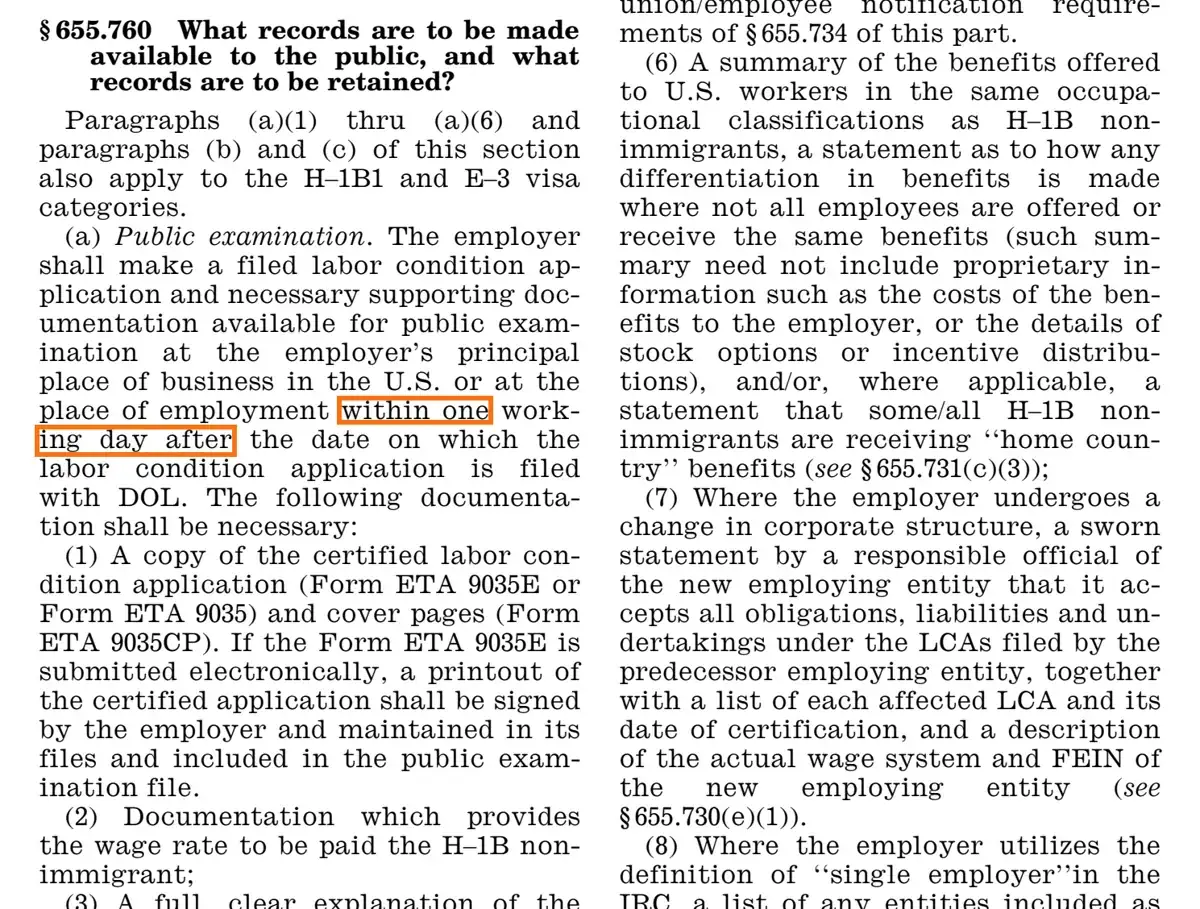
| Document | Required for | Practical tip |
|---|---|---|
| Certified LCA with cover pages, signed by the employer | Every LCA | Print the certified version and sign it; an unsigned download does not meet the rule |
| Documentation of the wage rate paid to the H-1B worker | Every LCA | The offer letter or a pay memo with the salary and pay frequency |
| Explanation of your actual wage system | Every LCA | A one-page memo on how you set pay for the job and how raises work; payroll is not required here |
| Prevailing wage source and method | Every LCA | The FLAG wage printout or determination, with the occupation code, area and level |
| Copy of the notice, with dates and places posted | Every LCA | Photos of both postings, or the email and its distribution list |
| Summary of benefits offered to U.S. workers in the occupation | Every LCA | Explain any differences in eligibility; costs and stock option details may stay private |
| Sworn statement of the successor entity, list of LCAs, wage system and FEIN | Successors after a merger or acquisition | Add it before the new entity employs the workers |
| List of entities counted as a single employer | Employers that use the tax-code single-employer rule for the dependency count | Update it when the corporate group changes |
| List of exempt H-1B workers | H-1B-dependent employers or willful violators filing exempt-only LCAs | Record the $60,000 wage or related master’s degree for each |
| Summary of U.S. worker recruitment and its time frames | H-1B-dependent employers or willful violators on non-exempt LCAs | Keep copies of ads and dates; DOJ handles complaints on this attestation |
How to read this table: the first six rows apply to every LCA; the last four apply only if the second column describes you. A missing item is a violation in itself, and an incomplete file invites a closer look at the promises behind it.
Benching, nonproductive time and deductions
If an H-1B worker is not working because of your decision, such as no assigned project, a lost client or a missing license, you still owe the full salary, or 40 hours a week at the required wage for hourly staff (655.731(c)(7)). For a part-time LCA, the minimum is the hours stated on the petition. This is the rule behind most "benching" back wage cases.
Pay may stop only when the worker is away at their own request and for their own reasons, such as a family trip, or cannot work, such as after an accident, and no benefit plan or law such as the FMLA requires pay. It also stops after a bona fide termination: notice to USCIS, withdrawal of the LCA, and an offer of return transportation if you dismissed the worker. Our H-1B layoff guide covers what the worker faces after that.
Deductions may not recover your business expenses, including attorney fees and LCA and petition costs; see business immigration costs for employers for who may pay what.
Need an LCA and public access file built right?
Request a free 20-minute consultation. We review the job, the wage level and your existing files, and quote a flat fee in writing before any work starts.
Worksite changes and short-term placements
The LCA covers a place of employment and its area of intended employment, which always includes the whole metropolitan area. For a Dallas employer, a move to Plano, Frisco, Irving or Fort Worth stays inside the Dallas-Fort Worth-Arlington metro area and needs only a fresh notice at the new site; a move to Austin needs a new LCA and an amended petition first. Short trips outside the area are allowed for up to 30 workdays a year (20 CFR 655.735), and a remote worker’s home is a worksite. Our guide on when an H-1B amendment is required covers the gray areas.
Extra rules for H-1B-dependent employers and willful violators
An employer is H-1B-dependent if H-1B workers make up a large share of its workforce: more than 7 H-1B workers with 25 or fewer full-time equivalent employees, more than 12 with 26 to 50, or at least 15 percent with 51 or more (655.736). A willful violator is an employer the Department found to have willfully violated its H-1B obligations within the past five years.
Both groups attest that they will not displace a similarly employed U.S. worker within 90 days before or after a petition, and that they recruited U.S. workers in good faith first; the notice must state both. These promises do not apply to an LCA used only for exempt workers, paid at least $60,000 in the calendar year or holding a related master’s degree (655.737).
How long to keep the records
Keep the public access file for one year after the last day any H-1B worker is employed under that LCA. If no one ever worked under it, keep it for one year after the LCA expired or was withdrawn. Payroll records for the H-1B workers and for everyone else in the same occupation stay for three years from the date they were created. If an investigation starts, keep all payroll records until it ends (655.760(c)).
You may withdraw an unused LCA only if no H-1B worker is employed under it and no investigation has started (655.750). To track these dates across many workers, see our guide to an immigration compliance program for HR teams.
Complaints, investigations and penalties
Any aggrieved party can file a complaint with the Wage and Hour Division: an affected worker, a union, a competitor or a government agency (655.715, 655.806). No form is required. The Division decides within 10 days whether there is reasonable cause to investigate, and then aims to finish within 30 calendar days, which can be extended. A complaint must come within 12 months of the latest violation, but back wages can reach further back.
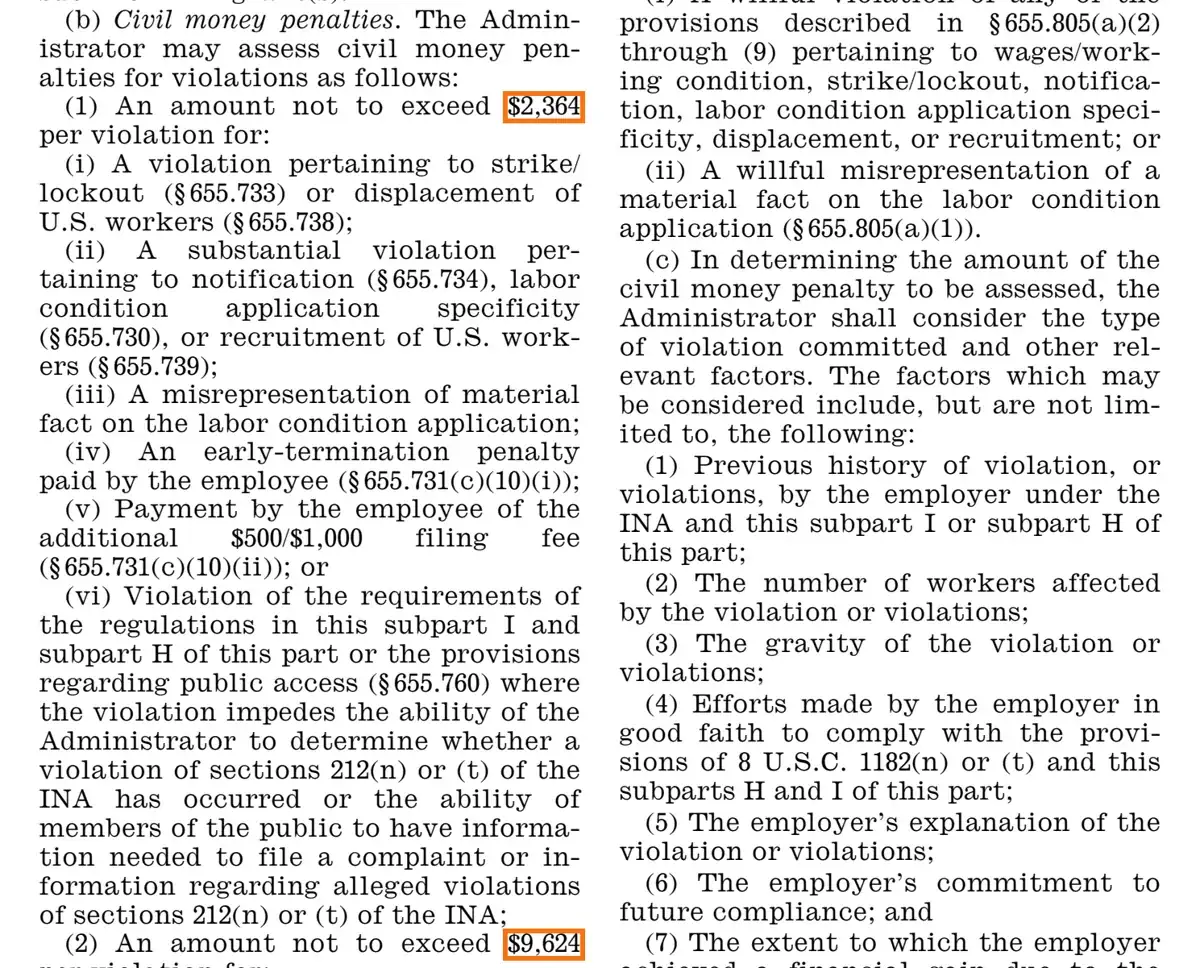
Besides back wages, the Administrator may assess penalties per violation: up to $2,364 for non-willful violations such as a substantial notice failure; up to $9,624 for willful failures or retaliation against a worker who complains; and up to $67,367 when a willful violation comes with displacing a U.S. worker within 90 days of a petition (20 CFR 655.810). The Department announced no inflation adjustment for 2026, so these 2025 amounts still apply (91 FR 31358).
The penalty that hurts most is not money. The Department notifies DHS, which then bars your company from approval of new H-1B and green card petitions for at least one, two or three years, by tier. A worker who complains is protected from retaliation (655.801), so the right response to a request for the file is to produce it, not to ask who wants it.
A public access file checklist for Dallas employers
The rules are federal, so a file for a Dallas office and a file for a remote engineer in another state follow the same steps. Here is the order we use, from job offer to filing:
- Step 1. Define the job. Write the duties, the minimum education and experience, and every work location, including client sites and home offices.
- Step 2. Set the actual wage. Compare pay with similar employees and write the one-page memo on how you set pay for the job.
- Step 3. Choose the prevailing wage. Pick the occupation code and wage level, print the wage source for the work location, and confirm the offer meets it.
- Step 4. Post the notice. Post at two spots at each worksite for 10 days, or send the direct email, within the 30 days before filing; photograph or save it.
- Step 5. File the LCA. Within one working day, open the file with the items in the table above.
- Step 6. Complete it on certification. Print and sign the certified LCA, add it, and give the worker a copy by day one.
- Step 7. Keep it alive. Add new-site postings, match raises, rerun the dependency count, and set the retention date when the last worker leaves.
| Question | If the answer is no |
|---|---|
| Was the file ready one working day after the LCA was filed? | Assemble it now and note the date; a late file is better than none |
| Does the H-1B worker earn at least the LCA wage, paid at least monthly? | Pay the difference as back wages and fix payroll before the next run |
| Was the worker paid during every idle period you caused? | Calculate and pay the missed wages |
| Is every current worksite, including a home office, inside the LCA area? | Talk to counsel about a new LCA and an amendment |
| Did the worker get a signed copy of the certified LCA? | Give it now and keep a receipt |
How to read this table: one "no" is a reason to fix the gap this week, not a reason to panic. Investigators weigh good-faith efforts and the steps an employer took on its own, so a dated fix and a written record count in your favor.
How Atlas Immigration Law helps
Who can advise an employer on H-1B prevailing wages and public access files? Any licensed immigration attorney who handles H-1B cases. Our H-1B practice handles the LCA, the prevailing-wage analysis and the public access file as part of each petition, and we review existing files for employers who are not sure theirs would hold up.
Every engagement is a flat fee quoted in writing at the consultation and billed at milestones, with a dedicated paralegal reachable by call, email or text, same-business-day responses, and case tracking in the Atlas Vision client portal. Founder and managing attorney Jordan Weinberg is licensed in Texas and is a member of AILA and the Dallas Bar Association.
We work from 1920 McKinney Ave in Dallas with employers across Dallas-Fort Worth and in all 50 states, in English and Spanish. For the wider picture of sponsorship, start with our Dallas H-1B attorney guide. To have your LCA or file reviewed, request a free 20-minute consultation or call (945) 219-5599.
Frequently asked questions
Who can advise an employer about H-1B prevailing wages and public access files?
A licensed immigration attorney who handles H-1B petitions can choose the occupation code and wage level, prepare the LCA and notice, and build or review the public access file. The legal duty stays with the employer, and the Department of Labor’s Wage and Hour Division enforces it.
What must be in an H-1B public access file?
The signed certified LCA and cover pages, documentation of the wage paid, an explanation of your actual wage system, the prevailing wage source, a copy of the notice with dates and locations, and a summary of benefits for U.S. workers in the occupation. Successors, H-1B-dependent employers and willful violators add further items.
When does the public access file have to be ready?
Within one working day after the LCA is filed with the Department of Labor, not after it is certified. It must be available at your principal place of business in the U.S. or at the place of employment.
Who is allowed to see the public access file?
Any member of the public, including co-workers, competitors and unions. Payroll records and the underlying wage survey data are not part of the public file, but they must be produced to the Department of Labor in an investigation.
How is the H-1B prevailing wage determined?
From one of four sources: a union contract wage, a prevailing wage determination from the Department of Labor’s National Processing Center, an independent authoritative survey, or another legitimate wage source. Most employers use OEWS data at one of four wage levels based on the job’s requirements. A proposed rule would raise those levels; it is not final.
Do we have to pay an H-1B worker who has no project?
Yes. If the worker is idle because of your decision, the full required wage is still due. Pay may stop only for time the worker takes off voluntarily, time they cannot work and no benefit plan or law requires pay, or after a bona fide termination.
How long do we keep H-1B LCA records?
Keep the public access file for one year after the last H-1B worker under that LCA leaves, or one year after the LCA expires or is withdrawn if no one worked under it. Keep payroll records for three years from creation, and all of them until any investigation ends.
What are the penalties for H-1B LCA violations?
Back wages, plus civil money penalties of up to $2,364, $9,624 or $67,367 per violation depending on the violation and whether it was willful, and a bar of at least one, two or three years on new petitions. The Department of Labor made no inflation adjustment for 2026.
This guide is part of our work visa services for employers — the service page covers eligibility, fees, and how we handle these cases.

Founder & Managing Attorney, Atlas Immigration Law
Member of the American Immigration Lawyers Association (AILA) and the Dallas Bar Association. Licensed to practice in Texas; fluent in English and Spanish.
Legally reviewed by a licensed immigration attorney
Talk to an immigration attorney about your case
Free consultation on request, flat fees, and a dedicated paralegal who knows your case — serving clients in all 50 states.
This guide is general information, not legal advice, and reading it does not create an attorney-client relationship. Immigration law and procedures change, and how they apply depends on your specific facts — consult a licensed immigration attorney about your situation.