
A Dallas employer with more than 25 employees pays USCIS $3,380 in required fees for a typical new H-1B petition filed on paper in 2026, and a company with 25 or fewer employees pays $2,010. An L-1 petition runs $2,485 and an I-140 runs $1,315. Legal fees come on top, and the law makes several of these costs yours, not the worker’s. This guide breaks down each line so you can budget a hire before you make the offer.
Key takeaways
Every sponsorship has two bills: government fees, which are the same at every law firm, and legal fees, which are not. Government fees depend on the visa type, the kind of filing, and whether you have 25 or fewer full-time equivalent employees. The employer must pay the H-1B ACWIA fee and all PERM labor certification costs; the worker may never reimburse them. A flat fee billed at milestones fixes the legal side in advance, as long as the quote says what happens with an RFE, an amendment and premium processing. The $100,000 H-1B payment is blocked by a court order for now, so check it before every filing.
The two bills in every sponsorship: government fees and legal fees
Government fees go to U.S. Citizenship and Immigration Services (USCIS) with each petition. They are published on the USCIS fee schedule, Form G-1055, and every figure in this guide comes from the edition dated October 26, 2026. No law firm can discount them, so they tell you nothing about which firm is cheaper.
Legal fees pay for the work: the job analysis, the wage level, the Labor Condition Application, the petition and its evidence, and the answers to anything the government asks later. This is the part that differs between firms, and the part a flat fee makes predictable. Our guide to what immigration lawyers cost in Dallas covers family and individual cases; this one stays with employer sponsorship.
One number decides which column of the fee schedule you read. USCIS defines a small employer as a firm with 25 or fewer full-time equivalent employees in the United States, counting affiliates and subsidiaries (8 CFR 106.1). Small employers pay a lower petition fee, half the Asylum Program Fee, and half the ACWIA fee. Count your headcount before you budget, and count again before each filing.
What the government charges per case type in 2026
The fee schedule lists each fee on its own line, which makes it hard to see what one filing costs. The table below adds the required lines for the filings employers make most often. Totals are for paper filing and leave out optional premium processing.
| Filing | Fee lines that apply | 26 or more employees | 25 or fewer employees |
|---|---|---|---|
| New H-1B, cap-subject | Registration $215, I-129, Asylum Program Fee, fraud fee, ACWIA fee | $3,595 | $2,225 |
| H-1B transfer from another employer | I-129, Asylum Program Fee, fraud fee, ACWIA fee | $3,380 | $2,010 |
| H-1B first extension, same employer | I-129, Asylum Program Fee, ACWIA fee | $2,880 | $1,510 |
| H-1B second or later extension, same employer | I-129, Asylum Program Fee | $1,380 | $760 |
| H-1B amendment with no extension request | I-129, Asylum Program Fee | $1,380 | $760 |
| New L-1A or L-1B | I-129, Asylum Program Fee, fraud fee | $2,485 | $1,495 |
| L-1 extension, same employer | I-129, Asylum Program Fee | $1,985 | $995 |
| O-1 | I-129, Asylum Program Fee | $1,655 | $830 |
| TN or E-2 filed with USCIS | I-129, Asylum Program Fee | $1,615 | $810 |
| I-140 immigrant petition | I-140, Asylum Program Fee | $1,315 | $1,015 |
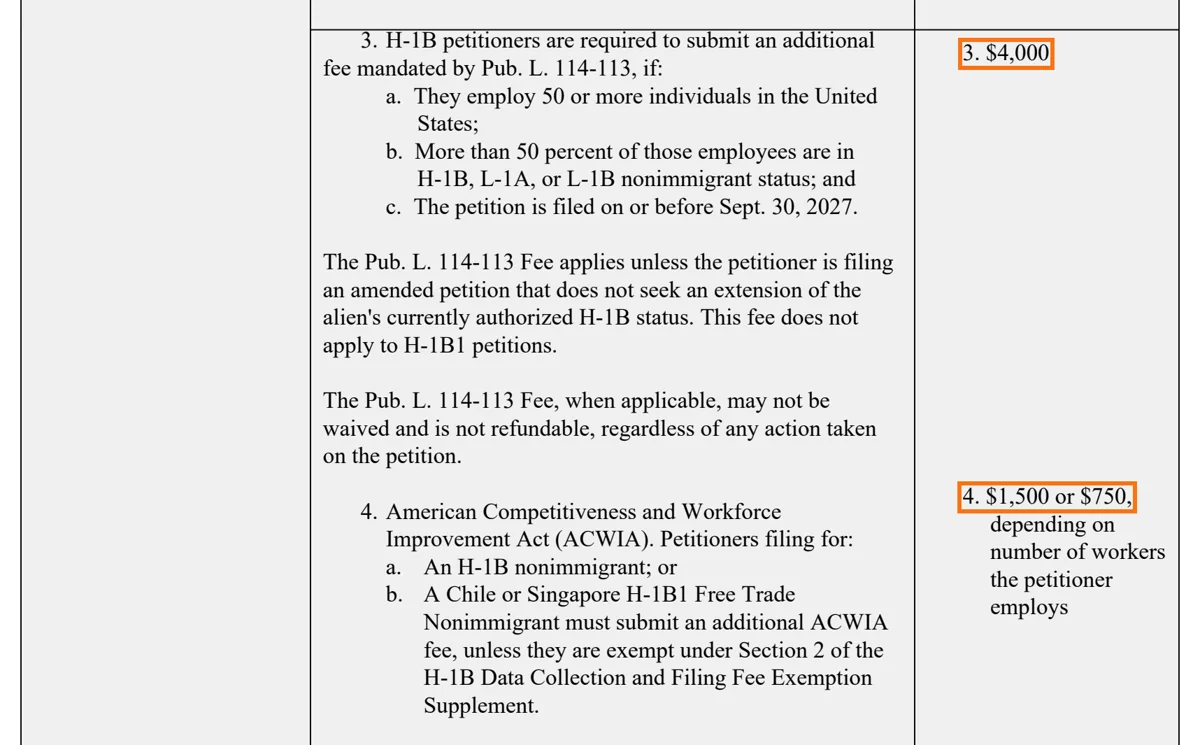
How to read this table: find the row for your filing, then the column for your headcount. The H-1B rows use the $780 paper fee for larger employers and $460 for small ones; filing online takes $50 off the $780. Nonprofits pay the small-employer petition fee and no Asylum Program Fee. If your company has 50 or more U.S. employees and more than half hold H-1B or L-1 status, add $4,000 to an H-1B row or $4,500 to an L-1 row.
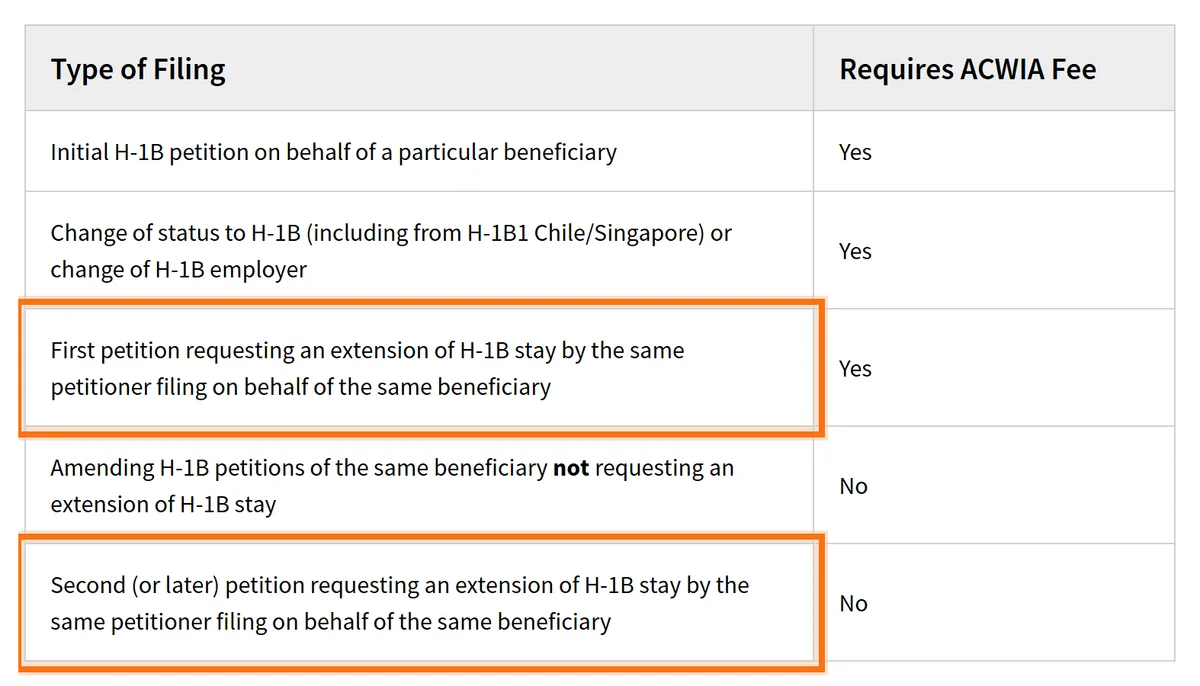
Three rules explain why the H-1B rows differ. The $500 Fraud Prevention and Detection Fee is due on an initial petition and on a change of employer, not on later filings by the same employer for the same worker. The ACWIA fee is due on the initial petition, a change of employer, and the first extension you file, then stops. And since September 9, 2026, covered employers owe the Public Law 114-113 fee on extensions too (91 FR 51360).
Some organizations never pay the ACWIA fee: colleges and universities, nonprofits affiliated with them, nonprofit and government research organizations, and primary and secondary schools. Being a 501(c)(3) alone is not on that list. A Dallas charity that is not tied to a university still pays ACWIA, even though it pays no Asylum Program Fee.
L-1, O-1 and TN petitions: which lines change
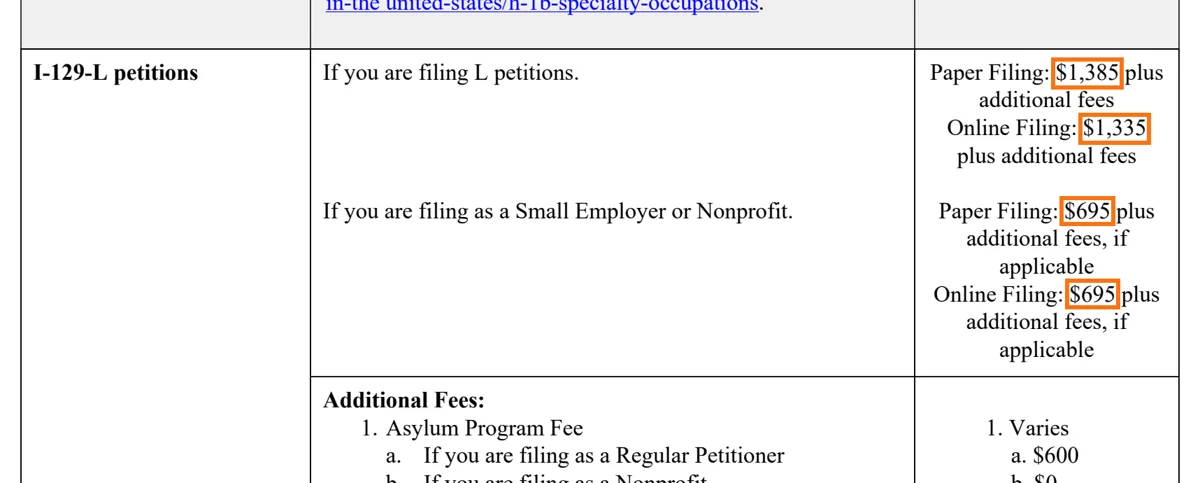
The L-1 has the highest base fee on Form I-129: $1,385 on paper, $1,335 online, or $695 for a small employer or nonprofit. It carries the same $500 fraud fee as the H-1B on an initial petition, but no ACWIA fee and no lottery registration. For a Dallas subsidiary bringing in a manager from the parent company abroad, the required total is $2,485.
O-1, TN and E-2 petitions filed with USCIS carry only the base fee and the Asylum Program Fee. Canadians applying for TN status at the border, and E-2 or L-1 blanket applicants at a consulate, pay Customs and Border Protection or the State Department instead; confirm those amounts on the agency’s own page before you budget. Our guides to the L-1 visa and the O-1 visa explain when each one fits.
PERM and the I-140: what the green card stage costs
An employer-sponsored green card usually has three stages, and each is budgeted differently. PERM labor certification comes first. The Department of Labor rules at 20 CFR part 656 set no government filing fee for the application, so the PERM budget is recruitment advertising plus legal work. Ad prices depend on the newspaper and job sites used, so ask for an estimate with the quote.
The I-140 petition follows: $715 on paper or $665 online, plus the Asylum Program Fee of $600, $300 for a small employer, or $0 for a nonprofit. The last stage is the worker’s own application for the green card, with fees per family member. Our guide to running green card sponsorship at scale lists those later fees and shows how to write them into a sponsorship policy.
Which costs the employer must pay by law
Who pays is not only a policy choice. Two Department of Labor rules and one statute take some costs off the table, and getting this wrong turns a budget shortcut into a wage violation.
| Cost | Who may pay | Rule |
|---|---|---|
| H-1B ACWIA fee ($1,500 or $750) | Employer only. The worker may not pay or reimburse any part, directly or through a third party. | 8 U.S.C. 1182(n)(2)(C)(vi); 20 CFR 655.731(c)(10)(ii) |
| H-1B attorney fees and costs of preparing and filing the LCA and petition | Treat as employer costs. They are the employer’s business expenses and may not be recouped in a way that takes pay below the required wage. | 20 CFR 655.731(c)(9) and (c)(12) |
| Penalty for leaving before an agreed date | Not allowed. Real liquidated damages under state law are permitted, but may not include the ACWIA fee. | 20 CFR 655.731(c)(10)(i) |
| PERM costs: recruitment, preparation, filing, the employer’s attorney fees | Employer only. No payment or reimbursement from the worker in any form, including wage deductions. | 20 CFR 656.12(b) |
| I-140, green card application, dependents’ filings | Company policy. No Department of Labor rule assigns these to the employer. | No equivalent rule |
How to read this table: the first and fourth rows are absolute, so no agreement with the employee can change them. The second row is the one employers misjudge. A deduction for H-1B legal fees does not have to appear on a pay stub to count; if the worker ends up below the required wage after covering your expense, the regulation treats the gap as unpaid wages.
PERM has one narrow opening. Under 20 CFR 656.12(b), a worker may pay for an attorney who represents only the worker. Where the same attorney represents both the company and the worker, which is the usual setup, the costs stay with the employer. Repayment agreements that claw back "immigration costs" after a resignation need a review for the same reason: they may not reach PERM costs or the ACWIA fee.
Premium processing sits in a gray area. When your business needs the fast answer, the $2,965 is a business expense like the rest of the petition. Employers that let a worker pay it for personal reasons, such as travel plans, should document that reason and confirm with counsel that the worker’s pay stays above the required wage.
The $100,000 H-1B payment and the proposed new fee
A September 19, 2025 proclamation requires a $100,000 payment for certain new H-1B petitions for workers outside the U.S. without a valid H-1B visa. On June 8, 2026 a federal court in Massachusetts vacated the USCIS guidance putting it into effect (State of California v. Mullin), and on July 24, 2026 the First Circuit denied the government’s request to pause that order. USCIS says it is complying while DHS considers next steps, and still plans to collect the payment if the order is lifted.
The fee schedule still lists the $100,000 line. Separately, DHS has proposed a $103,265 fee for every cap-subject H-1B petition (91 FR 54817, August 25, 2026). It is a proposal, not a final rule, and nothing is owed under it today. For budgeting, treat both as risks to check on the filing date, not as line items. Our Dallas H-1B attorney guide tracks the status.
How flat legal fees with milestone billing work
A flat fee is one agreed amount for a defined piece of work, such as "H-1B transfer petition, from job analysis through decision." Hourly billing charges for time as it is spent, so the total is unknown until the case ends. For an employer, the flat fee turns the legal side of a hire into a number that can go into an offer approval or a department budget.
Milestone billing splits that same fixed total into parts tied to events in the case, for example at engagement, at filing, and at decision. You pay for work as it is delivered instead of all at once, and if a hire falls through before filing, the engagement letter should say what is owed for the stages completed. Our guide to how flat fees work compares the two models in detail.
A flat fee is only as good as its scope. Before you sign, the quote should answer in writing: which filings are included, whether the Labor Condition Application and public access file are part of it, how a Request for Evidence is priced, and what dependents cost. The checklist for choosing a corporate immigration firm lists the questions to ask.
Budgeting a sponsorship in Dallas or anywhere in the U.S.?
Request a free 20-minute consultation. You get the government fees for your filing and headcount, and a flat legal fee with its milestones, in writing before any work starts.
What makes a case cost more than planned
Most budget overruns come from five events. None is a surprise if you plan for it when the case opens.
- A Request for Evidence (RFE). USCIS charges nothing to answer one, but the response takes legal work. Ask whether your flat fee includes it. Our RFE and NOID response guide shows what a response involves.
- An amendment. A move outside the commuting area on the Labor Condition Application, or a material job change, needs a new filing: $1,380 in USCIS fees for a larger employer, plus legal fees. A move from Dallas to Plano does not; a move to Austin does. See when an H-1B needs an amendment.
- Premium processing. $2,965 buys USCIS action within 15 business days on most I-129 and I-140 filings, or 45 business days for EB-1C and national interest waiver petitions. It buys speed, not approval. The premium processing guide covers when it pays off.
- Extensions. H-1B status is granted for up to three years at a time, so a worker you keep will need the first-extension row of the table above, and often a second.
- Family members. A spouse and children changing or extending status inside the U.S. file Form I-539: $470 on paper or $420 online. Decide in your policy whether the company covers it.
A per-hire budget worksheet for a Dallas employer
Use the worksheet below once per candidate. It takes ten minutes with the offer letter, your headcount and a written quote in hand, and it gives finance one figure for the first year and one for the years after.
| Line | What to enter | Where the number comes from |
|---|---|---|
| 1. Required USCIS fees | The total for your filing type and headcount | The first table in this guide; confirm on the USCIS fee schedule on the filing date |
| 2. Premium processing | $2,965, or $0 | Add it when the start date or an expiring status cannot wait for regular processing |
| 3. Flat legal fee | The figure in your written quote | The engagement letter, with the milestone dates so finance knows when each part is due |
| 4. Items outside the flat fee | RFE response, amendment, dependents, as quoted | The scope section of the quote; if it is silent, ask before signing |
| 5. Family filings | $470 per Form I-539 on paper, if the company pays | Your sponsorship policy |
| 6. Later years | First extension: $2,880 or $1,510 for an H-1B, plus legal fees | The first table; enter it in the budget year the current approval ends |
| 7. Green card stage, if promised | PERM recruitment and legal fees, then $1,315 or $1,015 for the I-140 | Your policy on when sponsorship starts, and the quote |
How to read this table: lines 1 to 5 are the first-year cost of the hire, and lines 6 and 7 are commitments that land in later budget years. A worker hired from abroad may also pay a visa fee to the State Department at the consulate; that amount is on travel.state.gov, not on the USCIS schedule.
Take one example. A Dallas software company with 40 employees hires an engineer who already holds H-1B status with another employer. Line 1 is $3,380. The start date is flexible, so line 2 is $0. Line 3 is the flat fee from the quote. Three years later the first extension costs $2,880 in USCIS fees. If the same company had 20 employees, line 1 would be $2,010 and the extension $1,510.
If this is your first sponsored hire, read the first-time H-1B sponsor guide next. It covers the calendar and the commitments behind the numbers. The fees themselves are federal and identical in every state, so the worksheet works the same for a Dallas headquarters and a remote team in another city.
How Atlas Immigration Law helps
We handle employer immigration for companies in Dallas-Fort Worth and in all 50 states: H-1B petitions, L-1, O-1 and TN filings, PERM labor certification and I-140 petitions. Every case is quoted as a flat fee, agreed before we start and billed at milestones, with no hourly billing. The quote lists the government fees for your filing and headcount next to the legal fee, so the whole budget is on one page.
That is our honest answer for a small employer looking for flat-fee H-1B support, or any employer that wants predictable pricing: ask us, and any other firm you consider, for the fee and its scope in writing, then compare. Each client has a dedicated paralegal reachable by call, email or text, same-business-day responses, and case tracking in the Atlas Vision client portal.
Founder and managing attorney Jordan Weinberg is licensed in Texas and is a member of AILA and the Dallas Bar Association. Our office is at 1920 McKinney Ave in Dallas, and we work in English and Spanish. For a broader view of what outside counsel does, see our guide to employer immigration in Dallas. To get a quote, request a free 20-minute consultation or call (945) 219-5599.
Frequently asked questions
How much does it cost an employer to sponsor an H-1B in 2026?
In required USCIS fees on the schedule dated October 26, 2026, a new H-1B petition filed on paper costs $3,380 for an employer with more than 25 employees and $2,010 for one with 25 or fewer, plus $215 for registration in a cap case. Premium processing is optional at $2,965. Legal fees are separate.
Can the employee pay the H-1B fees?
Not the ACWIA fee, under any arrangement. Attorney fees and the costs of preparing and filing the Labor Condition Application and petition are the employer’s business expenses under 20 CFR 655.731, and recovering them from the worker counts as unpaid wages if pay falls below the required wage. In practice the employer pays the petition costs.
Who pays for PERM labor certification?
The employer. Under 20 CFR 656.12, an employer may not seek or receive payment of any kind for labor certification costs, including its attorney fees and recruitment, and wage deductions count as payment. A worker may pay only for an attorney who represents the worker alone.
What counts as a small employer for USCIS fees?
A firm or individual with 25 or fewer full-time equivalent employees in the United States, including affiliates and subsidiaries. Small employers pay $460 instead of $780 for an H-1B petition, a $300 Asylum Program Fee instead of $600, and a $750 ACWIA fee instead of $1,500.
Is a flat fee or hourly billing better for an employer?
A flat fee is easier to budget because the total is known before work starts, and milestone billing spreads it across the stages of the case. Hourly billing can suit open-ended advice with no defined end. With either model, get the scope in writing, including how an RFE and an amendment are priced.
Does an H-1B extension cost the same as the first petition?
No. The $500 fraud fee is not due on an extension with the same employer, and the ACWIA fee is due on the first extension only. A larger employer pays $2,880 in required fees for the first extension and $1,380 for a later one; a small employer pays $1,510 and then $760.
Do we have to pay the $100,000 H-1B fee?
Not today. A federal court vacated the USCIS guidance for the $100,000 payment on June 8, 2026, and USCIS says it is complying with that order while DHS considers next steps. USCIS also says it still plans to collect the payment if the order is lifted, so check the status before each filing for a worker abroad.
This guide is part of our business immigration services — the service page covers eligibility, fees, and how we handle these cases.

Founder & Managing Attorney, Atlas Immigration Law
Member of the American Immigration Lawyers Association (AILA) and the Dallas Bar Association. Licensed to practice in Texas; fluent in English and Spanish.
Legally reviewed by a licensed immigration attorney
Talk to an immigration attorney about your case
Free consultation on request, flat fees, and a dedicated paralegal who knows your case — serving clients in all 50 states.
This guide is general information, not legal advice, and reading it does not create an attorney-client relationship. Immigration law and procedures change, and how they apply depends on your specific facts — consult a licensed immigration attorney about your situation.