
The U.S. company that filed the L-1 answers the RFE, usually through its immigration attorney, and Atlas Immigration Law prepares these responses for employers in Dallas, North Texas and nationwide. The request asks for proof that the U.S. and foreign companies are parent, branch, subsidiary or affiliate through ownership and control, and that both are doing business. You have until the date printed on the notice, at most 12 weeks.
Key takeaways
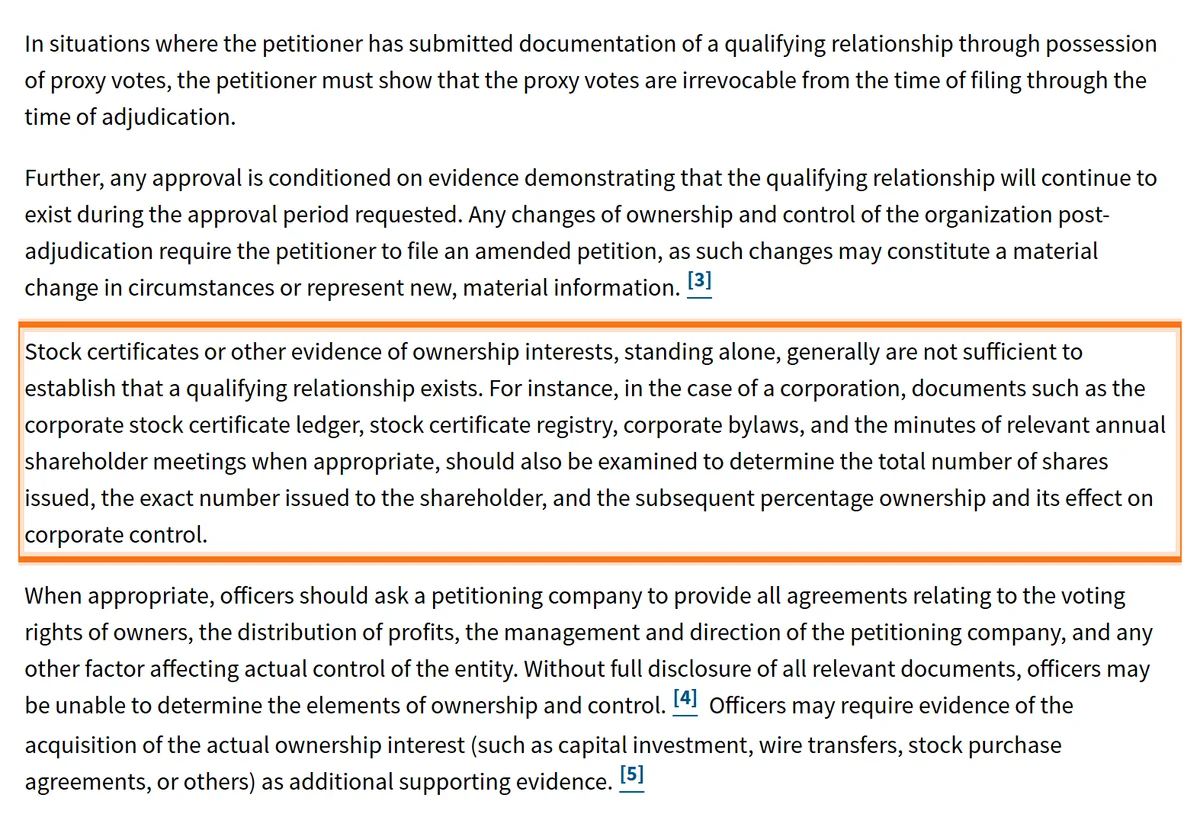
USCIS says stock certificates alone are generally not enough: it wants the share ledger or register, bylaws or operating agreement, minutes, and every agreement on voting and control. Contracts, licenses and franchises never create a qualifying relationship, and neither does a joint venture under 50-50. Affiliates owned by the same people must be owned in about the same shares. The relationship had to exist on the filing date; a share transfer finished later cannot fix the petition. Both companies must be actively doing business for the whole L-1 stay.
What "qualifying relationship" means: ownership and control
Under 8 CFR 214.2(l)(1)(ii), the U.S. petitioner and the foreign employer must be qualifying organizations: each meets exactly one of four relationships and is doing business in the U.S. and in at least one other country for the whole time the employee is here. The four relationships are:
- Branch: an operating division or office of the same organization in a different location. One legal entity, two places.
- Parent: an entity that has subsidiaries.
- Subsidiary: an entity the parent owns, directly or indirectly, (1) more than half of and controls, (2) exactly half of and controls, (3) as a 50-50 joint venture with equal control and veto power, or (4) less than half of but in fact controls.
- Affiliate: one of two subsidiaries owned and controlled by the same parent or individual, or one of two entities owned and controlled by the same group of individuals, each owning about the same share of each. A special rule covers international accounting partnerships.
USCIS defines ownership as the legal right of possession with full power and authority to control, and control as the right and authority to direct the management and operations of the business. Owning more than 50% is treated as control (USCIS calls it de jure control). An owner of 50% or less can still have de facto control, but that has to be proven with documents, not asserted.
The same two tests apply whether the transfer is an L-1A manager or an L-1B specialist; our guide to L-1A vs L-1B transfers covers the role questions that come after this one.
50-50 joint ventures, minority stakes and affiliates through common owners
The harder cases sit at exactly 50%, below 50%, or with individuals rather than a parent company at the top. The Policy Manual sets out each test:
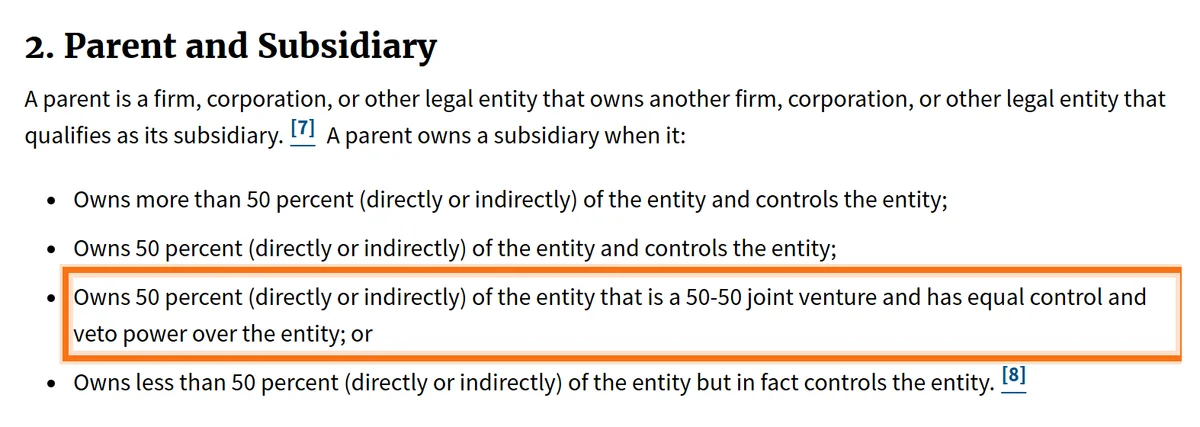
- A real 50-50 joint venture. Two companies form a separate entity, each owns 50%, and each has equal control and a veto. USCIS says this is an equity joint venture and can qualify. A contract to cooperate with no new entity, a non-equity joint venture, cannot, and neither can a joint venture where your side owns less than half.
- Exactly 50% without a veto. Owning half qualifies only with control. Show the board seats, voting rules or agreements that give it.
- Less than 50%. Possible only with proof of actual control, such as voting agreements or proxies. If control rests on proxy votes, USCIS says they must be irrevocable from the filing date through the decision.
- Contracts, licenses and franchises. USCIS lists these as the most common non-qualifying relationships. A franchise or license can be ended; common ownership cannot.
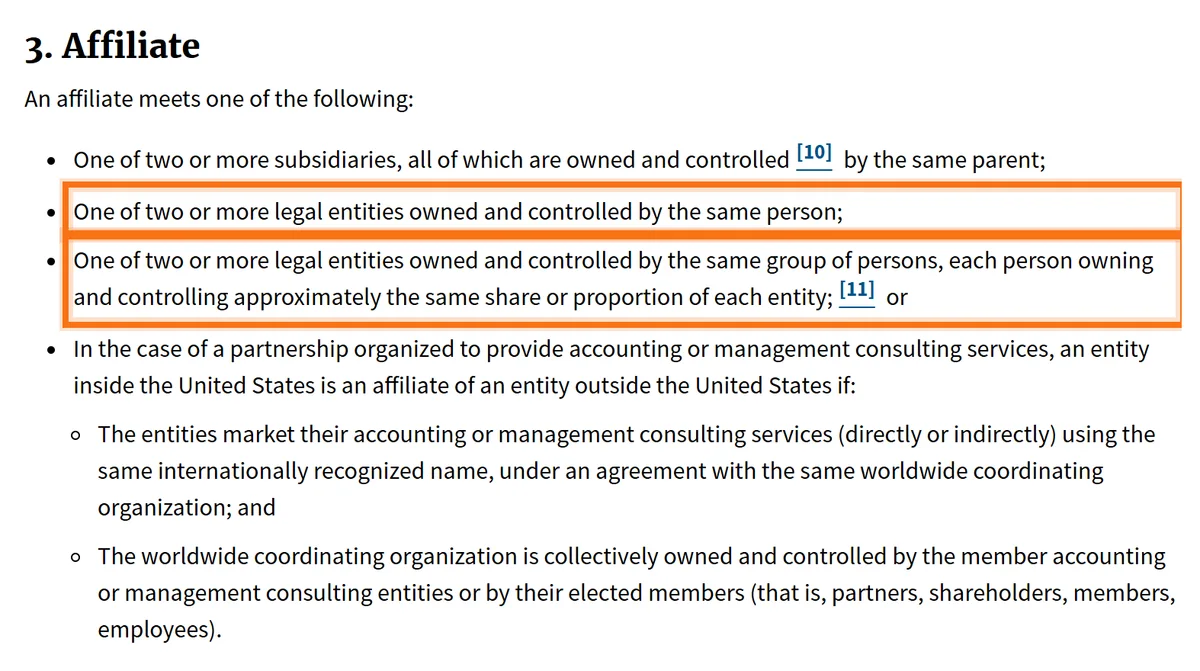
Affiliates through common individual owners are common in small groups: a founder who owns a company abroad forms a Texas company and owns it too. If one person owns both, show it for both. If a group owns both, the shares must line up: partners who split the foreign company 60/40 should split the U.S. company about 60/40. A U.S. company owned by a different mix of people, or by only some of them, is where affiliate RFEs come from.
Two structure rules catch small businesses. A sole proprietorship cannot file an L-1 for its own owner, because it is not a separate legal entity, although it may file for an employee. A corporation or LLC with a single owner can file for that owner. And when the transferee is an owner or major stockholder, 8 CFR 214.2(l)(3)(vii) also requires evidence that the U.S. assignment is temporary and that the person will be transferred abroad afterward.
"Doing business" in the U.S. and abroad
A relationship between two shells does not qualify. Doing business means the regular, systematic and continuous provision of goods or services, not the mere presence of an agent or an office. Both the U.S. employer and at least one related company abroad must be doing business for the entire L-1 stay. The foreign side does not have to be the company that employed the person, but USCIS says a dormant corporation, an agent or a holding company abroad is not enough.
There is no minimum revenue or headcount. The business must, however, be active enough to need a manager, an executive or a specialized-knowledge employee in the role you filed for. The Policy Manual names annual reports, audited or reviewed financial statements and federal tax returns as primary evidence, and accepts a descriptive letter backed by records. A U.S. office doing business for less than a year files as a new office instead, with secured premises and a plan; see our guide to the L-1 new office investment amount.
What to prove for each relationship type, and with which documents
USCIS says the regulations do not demand extensive evidence and that an authorized official’s statement may be enough in simple cases. An RFE means the officer found the case doubtful, so the response has to close every gap with records. This table follows the documents the Policy Manual names for each structure.
| Relationship | What to prove | Documents |
|---|---|---|
| Branch | The U.S. office is the same legal entity as the foreign company | State registration of the foreign company to do business, IRS Form 1120-F, Forms 941 and W-2 naming the branch, U.S. office lease |
| Subsidiary, more than 50% | The parent owns over half and controls it | Stock ledger or share register, stock certificates, articles and bylaws or operating agreement, board minutes, proof the parent paid for the shares (wire, capital contribution) |
| Subsidiary, exactly 50% | Half ownership plus control | Everything above, plus the voting or shareholder agreement and board records that give the parent control |
| 50-50 joint venture | Each owner holds 50% with equal control and a veto | Joint venture agreement, articles or bylaws with the veto, share register, both parties’ capital contributions |
| Subsidiary, under 50% | Actual control despite a minority stake | Voting agreements, irrevocable proxies, board appointment rights, minutes showing the parent directs management |
| Affiliate, same parent | One parent owns and controls both companies | Share registers of both subsidiaries, the parent’s annual report or group chart listing them |
| Affiliate, same person or group | The same owners hold about the same shares of each company | Share registers or operating agreements of both companies, a side-by-side ownership chart, proof each owner paid in capital |
| Publicly traded group | The listed company owns or controls both | Annual report listing subsidiaries, SEC Forms 10-K and 10-Q, statement of an authorized officer |
How to read this table: find your structure, then send every document in the right column for both companies, foreign and U.S. Add proof that both are doing business: tax returns, financial statements, invoices, payroll. Foreign-language records need full English translations with the translator’s certification under 8 CFR 103.2(b)(3).
Got an L-1 RFE about the corporate relationship?
Send us the notice and the petition as filed. In a free 20-minute consultation we map the ownership of both companies against the regulation, list the records that close each gap, and quote a flat fee in writing for the response.
Common gaps that trigger the RFE, and which ones can be fixed
Some gaps are missing paper, which a response can supply. Others are missing facts on the filing date, which no response can create. Under 8 CFR 103.2(b)(1) and (b)(12), the petitioner must have been eligible when it filed.
- A share transfer that was planned, not finished. If the parent had signed a term sheet but the shares were not issued or paid for on the filing date, the relationship did not exist yet. A response cannot fix that; a new petition after closing usually can.
- Shares issued, capital never paid. Certificates without a wire or capital record invite the question whether the owner really holds the stake. Send the bank records.
- Nominee or trust holdings. Where shares sit in another person’s name, USCIS cannot see who really owns and controls them. Disclose the nominee or trust agreement and every agreement on voting and profits; the Policy Manual says officers may be unable to decide without full disclosure.
- Owners who do not match. Affiliates need the same owners in about the same shares. A new investor on one side only can break the affiliate link.
- Ownership changed after filing or approval. USCIS conditions approval on the relationship continuing. Under 8 CFR 214.2(l)(7)(i)(C), a change in approved relationships requires an amended petition, with fee, and a merger, spin-off or acquisition is reviewed through its deal documents. See immigration obligations after a merger or acquisition for the full deal checklist.
- A dormant or holding company abroad. If the foreign side stopped trading, the relationship fails for lack of doing business, whatever the share register says.
- Names that do not match. Trade names, old names and the legal names on certificates should be tied together with formation and name-change records.
The deadline, and how to build one complete response
Under 8 CFR 103.2(b)(8)(iv), an RFE allows at most 12 weeks and a NOID at most 30 days, and USCIS grants no extra time. Use the due date printed on the notice. For a mailed notice, 3 days are added, but USCIS must receive your response by the deadline, not just have it postmarked. Our guide to answering an RFE or NOID before the deadline explains how to find the real date.
- Answer once, completely. Under 8 CFR 103.2(b)(11), everything goes in together with the notice on top; a partial response is a request to decide on the record.
- Start with a one-page ownership chart. Every entity, every owner, every percentage, foreign and U.S., as of the filing date. Then point each line to the exhibit that proves it.
- Write the control story, not just the ownership story. Who appoints the board, who signs, who decides. This is where 50% and minority cases are won.
- Prove doing business on both sides with records for the period the officer asked about.
- Check every name, date and percentage across the share register, tax returns and minutes before it goes out.
With premium processing, USCIS must act on an L-1 within 15 business days, but an RFE stops that clock and a new 15-day period starts when USCIS receives your response. See our premium processing guide.
USCIS fees if you amend or refile the L-1
Responding to an RFE has no USCIS fee. Filing an amended petition after an ownership change, or a new petition after a denial, does. These amounts are from the fee schedule dated October 26, 2026:
- Form I-129, L petition: $1,385 on paper or $1,335 online; $695 for a small employer (25 or fewer full-time equivalent employees) or nonprofit.
- Asylum Program Fee: $600 for a regular petitioner, $300 for a small employer, $0 for a nonprofit.
- Fraud Prevention and Detection Fee: $500 for an initial L approval or a new employer. USCIS says an amended petition needs the base filing fee but may not need certain additional fees.
- Pub. L. 114-113 fee: $4,500 only for employers with 50 or more U.S. employees, more than half in H-1B or L status, on petitions filed by September 30, 2027. It does not apply to an amended petition that does not extend L-1 status.
- Premium processing (Form I-907): $2,965.
A standard employer refiling a new paper L-1 pays $1,385 + $600 + $500 = $2,485 before premium processing. If the petition is denied, a motion or appeal on Form I-290B is the other option; get advice on which path fits the reason for the denial. The fee tables for every L filing are in our L-1 visa guide for Dallas employers.
How Atlas Immigration Law helps
Our L-1 practice starts with the corporate relationship: we document ownership and structure so the relationship is clear before USCIS asks, and we respond fully and on time when an RFE comes. For a relationship RFE, we read the notice against the petition as filed, chart the ownership of both companies on the filing date, tell you which gaps paperwork can close and which need a new or amended filing, and assemble the response around the regulation. See our L-1 visa services for employers.
The firm is led by founder and managing attorney Jordan Weinberg, licensed in Texas and a member of AILA and the Dallas Bar Association. Each matter has a flat fee quoted in writing and billed by milestone, a dedicated paralegal reachable by call, email or text, same-business-day responses, and a client portal. We work from 1920 McKinney Ave in Dallas with companies in all 50 states. Call (945) 219-5599 for a free 20-minute consultation.
Frequently asked questions
Who can respond to an L-1 RFE about the qualifying relationship between two companies?
The petitioner, the U.S. company that filed the L-1, responds, usually through its immigration attorney. Atlas Immigration Law prepares these responses for employers in Dallas and nationwide: we chart the ownership of both companies on the filing date and send the records that prove ownership, control and doing business by the date on the notice.
Are stock certificates enough to prove an L-1 qualifying relationship?
Generally not. USCIS says stock certificates standing alone are generally not sufficient. Officers look at the stock ledger or registry, bylaws or operating agreement, minutes, and agreements on voting and control, and may ask for proof the shares were paid for, such as wire transfers or stock purchase agreements.
Does a 50-50 joint venture qualify for an L-1?
Yes, if it is a separate entity in which each owner holds 50% and has equal control and veto power. A contractual cooperation with no new entity, or a joint venture where your side owns less than half, does not qualify.
Can two companies owned by the same person be affiliates for an L-1?
Yes. Two entities owned and controlled by the same person are affiliates. If a group of people owns them, each person must own and control about the same share of each company.
What if the share transfer was completed after we filed the L-1?
The petitioner must have been eligible on the filing date, so a relationship created afterward cannot save that petition. The usual fix is a new petition once the transfer is complete and documented.
How long do we have to respond to an L-1 RFE?
Use the due date printed on the notice. Under 8 CFR 103.2(b)(8)(iv), an RFE allows at most 12 weeks and a NOID at most 30 days, and USCIS grants no extensions. USCIS must receive the full response by the deadline.
Do we need to file again if our ownership changes after the L-1 is approved?
Yes. USCIS conditions approval on the relationship continuing, and 8 CFR 214.2(l)(7)(i)(C) requires an amended petition, with fee, to reflect changes in approved relationships.
This guide is part of our work visa services for employers — the service page covers eligibility, fees, and how we handle these cases.

Founder & Managing Attorney, Atlas Immigration Law
Member of the American Immigration Lawyers Association (AILA) and the Dallas Bar Association. Licensed to practice in Texas; fluent in English and Spanish.
Legally reviewed by a licensed immigration attorney
Talk to an immigration attorney about your case
Free consultation on request, flat fees, and a dedicated paralegal who knows your case — serving clients in all 50 states.
This guide is general information, not legal advice, and reading it does not create an attorney-client relationship. Immigration law and procedures change, and how they apply depends on your specific facts — consult a licensed immigration attorney about your situation.