
A business immigration lawyer advises the buyer or seller on what a deal does to sponsored workers. A merger or acquisition can require amended H-1B or L-1 petitions, a sworn successor statement for each LCA, amended I-140s to keep green card cases alive, and a choice on Form I-9s for every acquired employee. Atlas Immigration Law advises Dallas and North Texas employers on these obligations, ideally before closing.
Key takeaways
Deal structure decides the work: in most stock purchases the employer stays the same legal entity, while an asset purchase or merger usually moves workers to a new one. H-1B workers can move without new petitions only if the successor assumes the old employer’s interests and obligations, the job terms stay the same, and a sworn statement goes into each LCA public access file. L-1 approvals require an amended petition when ownership and control change. A pending or approved PERM survives only if USCIS accepts the buyer as a successor in interest. For I-9s, the buyer either completes new forms for everyone or keeps the old ones and their errors.
Why the deal structure decides the immigration work
Immigration benefits for workers are tied to a specific employer, usually a specific legal entity with its own FEIN. So the first question is not "what did we buy" but "who employs these people the day after closing." The answer depends on how the deal is built:
| Issue | Stock purchase | Asset purchase | Merger |
|---|---|---|---|
| Who employs the workers after closing | Usually the same legal entity, with a new owner | The buyer’s entity, which hires the seller’s staff | The surviving entity |
| H-1B petitions and LCAs | Usually stay in place if the jobs do not change | Successor statement in each LCA file, or new LCAs and petitions | Successor statement in each LCA file, or new LCAs and petitions |
| L-1 petitions | Amended petition if the change in ownership and control affects the approved relationship | Review whether the buyer has a qualifying relationship with the foreign employer | Review the relationship after the merger; amend if it changed |
| PERM and I-140 | Same employer; confirm nothing in the job changed | Buyer must prove successor-in-interest status | Survivor must prove successor-in-interest status |
| Form I-9 | Records stay with the same employer | Option A (new forms) or Option B (keep old forms) | Option A or Option B |
How to read this table: the stock column is the quiet one, but not a free pass. A new owner can still break an L-1 relationship, and integration plans often change job sites, duties or pay, which are the triggers for amended H-1B filings. The asset and merger columns are where most of the paperwork lives, and where it has to be ready before the workers start on the new payroll.
H-1B workers: the successor-in-interest rule and the LCA statement
The statute gives buyers a shortcut. Under INA 214(c)(10), no amended H-1B petition is needed when an employer goes through a corporate restructuring, such as a merger, acquisition or consolidation, in which a new entity succeeds to the interests and obligations of the original petitioner and the terms and conditions of employment stay the same except for the employer’s identity.
The Department of Labor adds the paperwork in 20 CFR 655.730(e). The new employer can keep using the old Labor Condition Applications, even if its FEIN is different, only if it keeps a list of the H-1B workers it took on and places in the public access file:
- Each affected LCA number and its date of certification.
- A description of the new employer’s actual wage system for those workers.
- The new employer’s FEIN.
- A sworn statement by an authorized representative accepting all obligations, liabilities and undertakings under each predecessor LCA, and agreeing to follow the DOL H-1B rules, keep the statement in the file, and show it to the public or DOL on request.
Without that statement, the new employer may not employ the predecessor’s H-1B workers until it files new LCAs and petitions. Our guide to the H-1B public access file shows what else the file must hold.
When an amended H-1B petition is still needed
The shortcut covers the change of employer, nothing more. An amended or new petition, with a new LCA, must be filed before any material change takes effect, for example a move to a worksite outside the area covered by the LCA, or new duties that change the occupation or wage level. The successor also cannot use the old LCAs for extensions or new H-1B hires, which need fresh LCAs, and a change in H-1B-dependent status matters for those new filings. Integration plans that move teams to a new Dallas or Austin office belong in this review. Our guide on when an H-1B amendment is required covers each trigger.
Two smaller groups are easy to miss. STEM OPT employees need a modified Form I-983 when a restructuring gives the employer a new EIN. And if integration leads to dismissals, the employer owes an H-1B worker it dismisses early the reasonable cost of return transportation; see our guide to H-1B layoffs.
L-1 transferees: does the qualifying relationship survive the deal?
An L-1 depends on a qualifying relationship between the U.S. employer and the foreign company where the worker was employed abroad: parent and subsidiary, affiliates, or branches of the same company. The rules count ownership and control, usually more than half, or exactly half with control. A deal can create that link, change it, or end it, for example when the U.S. unit is sold to a buyer with no tie to the foreign office.
USCIS is direct about it. The Policy Manual says any change of ownership and control after approval requires an amended petition, because it may be a material change. When a merger, spin-off or acquisition is underway, officers look at the deal documents themselves: the letter of intent, shareholder minutes, any Hart-Scott-Rodino antitrust filing and the merger agreement. A company with a blanket L approval must also amend it to add organizations or reflect changed relationships. Our guide to an L-1 RFE on the qualifying relationship explains the evidence USCIS wants.
PERM and I-140 cases: proving the buyer is a successor in interest
Green card cases are the most valuable and the most fragile part of a deal. A labor certification is valid only for the specific job, the named worker and the area of intended employment, and an approved certification expires if it is not filed with an I-140 within 180 days. A buyer that wants to keep a seller’s PERM or I-140 alive must show USCIS that it is a successor in interest, usually by filing an amended I-140 within the certification’s validity.
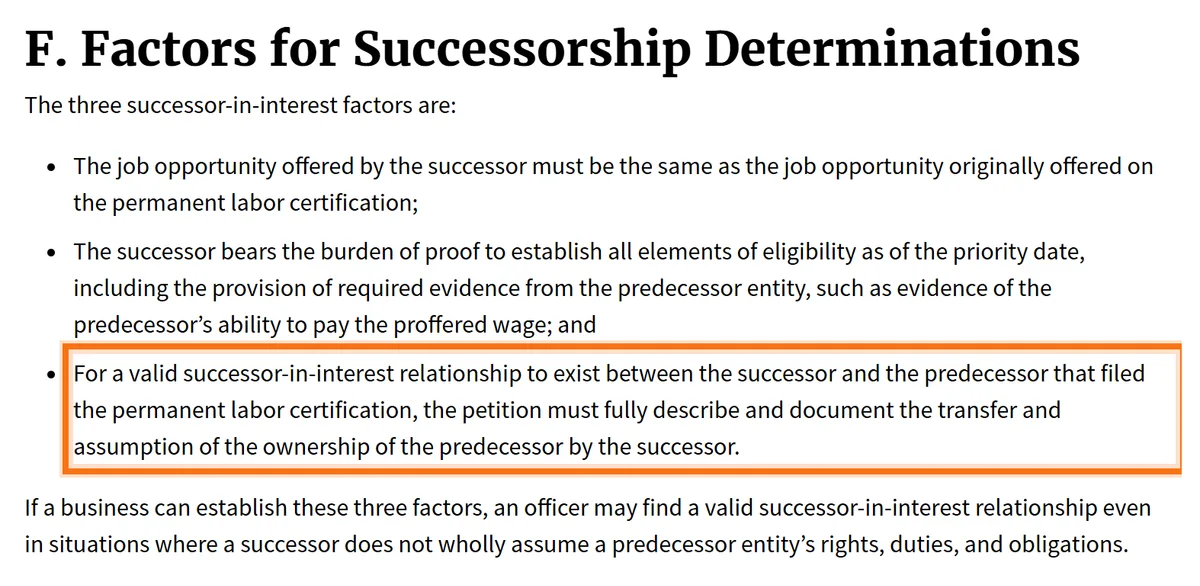
- Same job. Pay, metropolitan area, job description and requirements must match the certification. A raise that comes only from time passing is fine. A closure or a long pause in operations after the transfer ends the job, and the buyer must start PERM over.
- Ability to pay. The seller must have been able to pay the offered wage from the PERM filing date until the transfer, and the buyer from the transfer onward. An insolvent seller can sink this test.
- Transfer of ownership. The petition must fully describe and document how the buyer took over the seller or the relevant business: the purchase or merger agreement, SEC filings, audited financial statements, and proof of the transfer of assets, licenses and other interests. The buyer must carry on the same type of business in substantially the same way.
A contract to provide services, an outsourcing deal or a joint marketing arrangement is not a successorship. On the other hand, a name change with the same ownership and legal structure, or a move within the same metropolitan area, does not need a new I-140. When one deal affects many cases, USCIS may accept one set of shared evidence and coordinate the filings. Whether a PERM application that is still pending with DOL can carry over is more fact-specific, so review each pending case before closing. Our PERM labor certification services cover this work.
Buying or merging with a company that sponsors workers?
Send us the deal structure, the target closing date and a list of sponsored employees. In a free 20-minute consultation we will tell you which filings the deal triggers and when each one is due, and quote a flat fee in writing.
Form I-9 and E-Verify for a successor employer
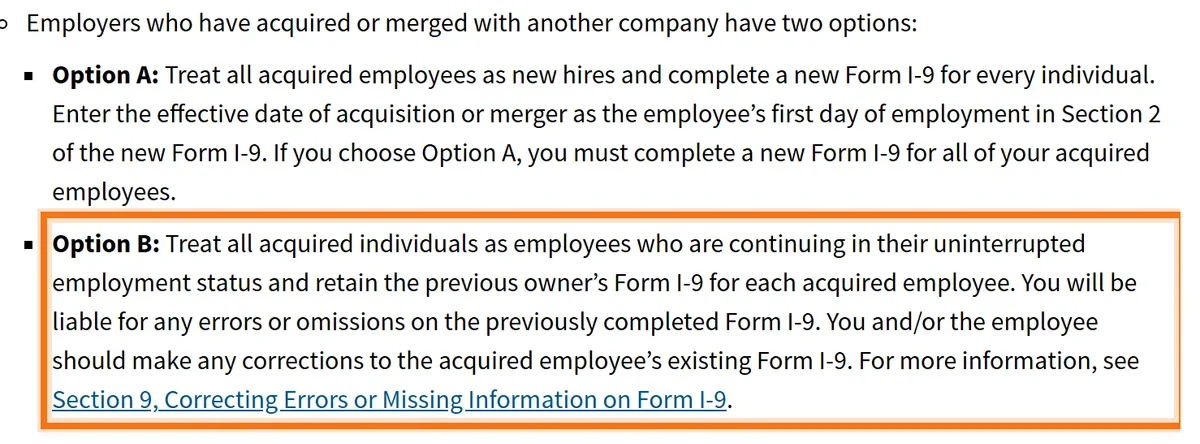
The I-9 rules treat a worker who keeps working for a related, successor or reorganized employer as continuing in employment, not as a new hire, if the new employer obtains and keeps the previous employer’s Forms I-9. The rule names corporate reorganizations, mergers, and sales of stock or assets. In practice the buyer chooses one of two options for the acquired group:
- Option A: new Forms I-9 for everyone. Treat all acquired employees as new hires and use the acquisition date as the first day of employment. It costs time at closing, but you start with a clean record.
- Option B: keep the seller’s Forms I-9. Treat the workers as continuing employees. You inherit liability for every error or omission on the old forms, so audit them and make lawful corrections early.
Whichever you pick, apply it to all acquired employees, not to selected people, and keep the forms for the required period: three years after hire or one year after the job ends, whichever is later. A due-diligence sample of the seller’s I-9s tells you which option is safer. See our Texas I-9 compliance guide for the common errors.
E-Verify confirms newly hired employees. It is voluntary for most private employers, but federal contractors with the FAR E-Verify clause, and employers covered by some state laws, must use it, and federal contractors have special rules for existing employees. Employees hired on or before November 6, 1986 who keep working are exempt from Form I-9 and cannot be run through E-Verify. If the buyer and seller use E-Verify differently, decide before closing how acquired workers will be handled.
An immigration due-diligence checklist for the deal team
| Ask for | Why it matters |
|---|---|
| A list of every worker on a visa or work permit: category, expiry date, worksite | Shows which approvals the deal can break and which deadlines fall near closing |
| Every H-1B petition, its certified LCA and its public access file | The successor statement needs each LCA number; missing files are an inherited liability |
| L-1 approvals, including any blanket L, and the ownership chart abroad | Tests whether the qualifying relationship survives the new structure |
| Pending PERM applications, approved certifications and I-140s, with priority dates | Successor-in-interest proof must be ready, and approved certifications expire in 180 days if not filed |
| STEM OPT employees and their Forms I-983 | A new EIN after closing requires a modified I-983 |
| A sample of Forms I-9, E-Verify use, and any Notice of Inspection or prior fines | Decides Option A or Option B and reveals inherited penalties |
| Planned changes: office moves, new duties, pay changes, layoffs | These trigger amended H-1B petitions, new LCAs, or return-transport costs |
How to read this table: the left column is a request list you can paste into the data room index. The right column is the reason to escalate an answer. A short list of sponsored workers with clean files may need only successor statements and an I-9 decision; a target with pending PERM cases, L-1 managers and planned office moves needs a filing plan with dates.
Timing: before closing, at closing, and after
- Before signing: run the checklist, identify which workers move to a new entity, and add immigration representations and cooperation duties to the purchase agreement, including the seller’s help with ability-to-pay evidence and I-9 records.
- Before closing: prepare the successor statements and wage-system description for each LCA, draft amended L-1 and I-140 filings, file any amended H-1B petition needed for changes that start at closing, and decide on Option A or B for Forms I-9.
- At closing: place the signed successor statements in each public access file before the new entity employs the H-1B workers, collect the seller’s Forms I-9, and, under Option A, complete new forms on the new-hire timeline.
- After closing: file amended L-1 petitions and successor I-140s, update STEM OPT training plans, and calendar extensions, which need new LCAs in the new employer’s name. Review any integration move before it happens.
Other employer-specific statuses need the same review. E-1 and E-2 treaty workers may ask USCIS whether a merger or restructuring requires new applications, and one request can cover several employees. TN and O-1 workers are also tied to an employer, so check each one before the payroll changes.
How Atlas Immigration Law helps
Our business immigration practice acts as outside immigration counsel to employers, covering work visas, green card sponsorship and compliance. In a deal, we review the target’s sponsored workers and records, map which filings the structure triggers, prepare successor statements and amended H-1B and L-1 petitions, keep green card cases on track, and help you choose and carry out an I-9 approach through our I-9 compliance work, including self-audits, lawful corrections and Notice of Inspection response.
The firm is led by founder and managing attorney Jordan Weinberg, licensed in Texas and a member of AILA and the Dallas Bar Association. You get a free 20-minute consultation, a flat fee quoted in writing and billed by milestone, a dedicated paralegal reachable by call, email or text, same-business-day responses, and a client portal to track each case. Our office is at 1920 McKinney Ave in Dallas, and we work with employers in all 50 states. Call (945) 219-5599.
Frequently asked questions
Who can advise an employer about immigration obligations after a merger or acquisition?
A business immigration lawyer can review the deal structure and the target’s sponsored workers, then tell you which H-1B, L-1, PERM, I-140 and I-9 steps the deal triggers and when. In Dallas, Atlas Immigration Law advises employers on these obligations, ideally before closing, starting with a free 20-minute consultation.
Do H-1B workers need new petitions after an acquisition?
Not if the new employer succeeds to the old employer’s interests and obligations and the terms of employment stay the same except for the employer’s identity. The new employer must still put a sworn statement and the other items required by 20 CFR 655.730(e) in each LCA public access file, and file new petitions for material job changes, extensions and new hires.
Does a stock purchase affect L-1 visas?
It can. The L-1 depends on the ownership and control link between the U.S. and foreign companies. USCIS says a change of ownership and control after approval requires an amended petition, so review each L-1 against the new structure before closing.
Can a buyer keep the seller’s PERM or I-140 case?
Yes, if USCIS accepts the buyer as a successor in interest. The job must stay the same, the seller must have been able to pay the wage until the transfer and the buyer afterward, and the transfer of ownership must be fully documented, usually in an amended I-140.
Do we have to redo Form I-9 for acquired employees?
No. You can complete new Forms I-9 for all acquired employees, using the acquisition date as the first day, or keep the seller’s forms and treat the workers as continuing employees. If you keep them, you are liable for any errors on them.
When should immigration counsel get involved in a deal?
Before signing, while the purchase agreement and the closing checklist can still cover immigration. Several steps, such as the LCA successor statement and any amended H-1B petition for a change that starts at closing, must be done before the workers start with the new employer.
This guide is part of our business immigration services — the service page covers eligibility, fees, and how we handle these cases.

Founder & Managing Attorney, Atlas Immigration Law
Member of the American Immigration Lawyers Association (AILA) and the Dallas Bar Association. Licensed to practice in Texas; fluent in English and Spanish.
Legally reviewed by a licensed immigration attorney
Talk to an immigration attorney about your case
Free consultation on request, flat fees, and a dedicated paralegal who knows your case — serving clients in all 50 states.
This guide is general information, not legal advice, and reading it does not create an attorney-client relationship. Immigration law and procedures change, and how they apply depends on your specific facts — consult a licensed immigration attorney about your situation.