
An immigration lawyer can prepare you for a difficult asylum interview and answer a notice of intent to deny. Preparation means checking your I-589 and declaration against every earlier statement, gathering proof, and practicing the questions an officer asks. For Dallas and North Texas applicants, the interview is set by the USCIS Houston Asylum Office. Atlas Immigration Law prepares asylum cases and NOID responses for clients across Texas.
Key takeaways
The officer decides mostly on credibility: whether what you say matches your I-589, your declaration, your documents and anything you told an officer before. You must bring your own interpreter if you are not fluent in English; USCIS does not provide one. No decision is made at the interview. If you have no legal status and are not granted, your case is referred to immigration court, usually the Dallas Immigration Court. If you are in valid status, you get a notice of intent to deny instead, and you have 16 days to answer it.

Where Dallas applicants are interviewed
If you filed Form I-589 with USCIS because you are not in removal proceedings, your case belongs to an asylum office. For all of Texas that is the Houston Asylum Office at 16855 Northchase Drive, Second Floor, Houston. It serves Texas, Colorado, Oklahoma, New Mexico, Utah and Wyoming, works by appointment only, and has not taken walk-in questions since April 6, 2026.
Two details matter for people in Dallas. First, USCIS opened a San Antonio Asylum Office (106 S. St. Mary’s St., 7th Floor) to add interview capacity, and since May 28, 2026 applicants in the Houston jurisdiction may be interviewed at either office. Second, USCIS says interviews can also take place at an alternate location, often a field office. Read your interview notice for the address, and do not assume it is Houston.
People who passed a credible fear screening at the border may have a different first step, an Asylum Merits Interview, and people already in court file with the judge instead. Our guide to how the asylum process works in Dallas explains the three routes. This guide is about the affirmative interview with USCIS.
What the asylum officer tests for credibility
The law gives you no head start. Under INA 208(b)(1)(B)(iii), the credibility standard added by the REAL ID Act of 2005, there is no presumption that you are telling the truth. The officer looks at the whole picture and may rely on any inaccuracy, even one that does not go to the heart of your claim. Your own testimony can be enough to win, but only if it is credible, persuasive and specific. If the officer reasonably expects a document and you could have gotten it, you are expected to provide it.
| What the law lets the officer weigh | What it looks like in the interview | How you prepare |
|---|---|---|
| Consistency between written and oral statements | Your answers are compared with your I-589 and declaration, line by line | Read your whole application again before the interview and fix errors in writing first |
| Statements made at any time, under oath or not | Border interviews, credible fear notes, visa applications, earlier filings | Collect copies of what you said before and explain any difference yourself |
| Internal consistency | Dates, names, places and order of events stay the same across the interview | Build a simple timeline and check every date against your documents |
| Consistency with other evidence | Your story is compared with country reports, including the State Department’s | Know what the reports say about your region and group, and where your story differs |
| Detail and plausibility | Officers ask follow-up questions until the answer becomes specific | Practice telling events with who, where, when and what was said |
| Demeanor, candor and responsiveness | Whether you answer the question asked, or avoid it | Practice short, direct answers; say “I don’t know” or “I don’t remember” when true |
How to read this table: the first column restates the statute in plain words. The last column is where your work goes. Most credibility problems are not lies. They are a wrong date typed by a preparer, a border statement nobody reviewed, or a nervous answer that skipped an event. All of these can be found and explained before the interview, not after it.
Your I-589 and declaration: the baseline you are measured against
Everything you wrote on Form I-589 and in your personal declaration becomes the script the officer holds while you speak. You signed it under penalty of perjury, and the law presumes you know what it says. That is why a declaration written in someone else’s words, or translated without being read back to you, is a risk.
- Read it again, in your language. If anything is wrong, prepare a written correction to hand in at the start of the interview rather than surprising the officer mid-answer.
- Check every date. Entries and exits, arrests, threats, moves, and the date you left. Match them to passports, I-94 records and documents.
- Fill the gaps. If an important event is missing, a short supplemental declaration explains it before the officer finds the gap.
- Do not exaggerate. Adding harm that did not happen can make you permanently ineligible: a knowingly frivolous application bars you from benefits under the immigration laws, after the warning on the form.
- Prepare the hard parts. A trip back home, a delay in filing, a past arrest, or a gap of years. Officers ask about these, and an honest explanation you have thought through is far better than a surprised one.
If you filed more than a year after your last arrival, the officer will also ask why. Our asylum process guide covers the one-year deadline and its exceptions.
The interpreter rule: you must bring your own
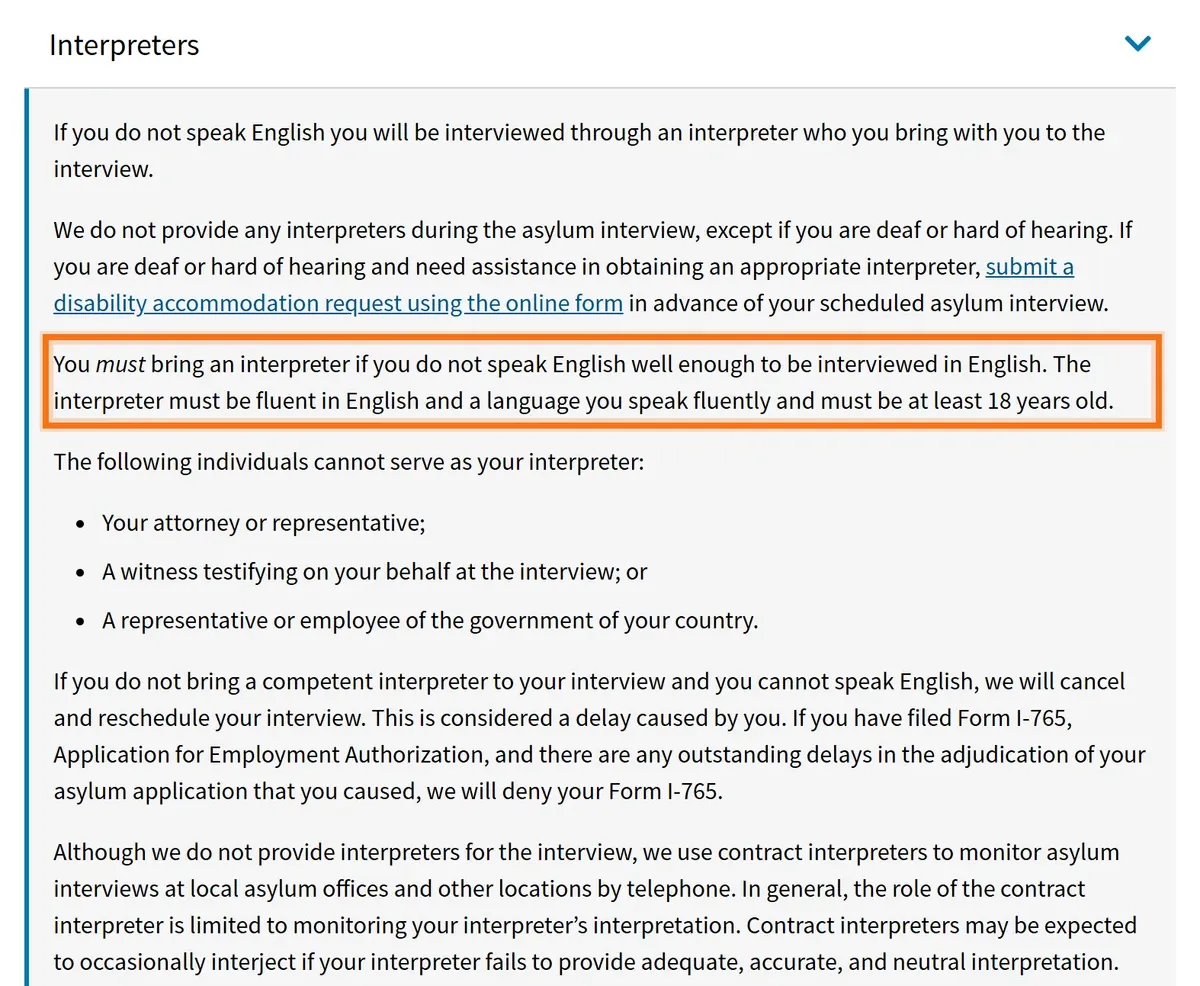
USCIS does not provide interpreters at affirmative asylum interviews, except for applicants who are deaf or hard of hearing, who can request an accommodation in advance. Everyone else who is not comfortable in English must bring an interpreter, fluent in English and in a language you speak fluently, and at least 18 years old.
- Who cannot interpret: your attorney or representative, a witness testifying for you at the interview, or anyone who represents or works for your home country’s government.
- A USCIS contract interpreter listens by phone to check that your interpreter is accurate and neutral, and may interrupt if not.
- If you arrive without a competent interpreter, USCIS cancels and reschedules the interview, counts it as a delay you caused, and can deny a pending work permit application because of it.
Choose someone careful, not just someone bilingual. A relative who softens or shortens your answers can create the inconsistencies you worked to avoid. Practice with your interpreter at least once before the interview day.
What to bring to the asylum interview
USCIS lists what to bring on its interview preparation page. Pack the night before, in a folder with copies:
- Your interview notice.
- Identification: any passports, other travel or identity documents, and your Form I-94 if you received one.
- The originals of birth certificates, marriage certificates and other documents you filed with your I-589.
- A copy of your I-589 and everything you filed with it, in case the office is missing something.
- Your interpreter, if you cannot do the interview in English.
- Your spouse and children under 21 who are included in your application as derivatives, with their own identity documents. Family members you listed but did not include do not need to come.
- A certified English translation of every document not in English. The translator certifies the translation is complete and correct and that they are competent to translate.
You may bring an attorney or accredited representative at no cost to the government; both of you sign Form G-28. You may also bring witnesses. If you cannot attend, call the USCIS Contact Center at 1-800-375-5283 before the appointment, or within 10 days after a missed one, with reasons and evidence. If 10 calendar days pass with no request, an applicant without status is referred to immigration court, and an applicant with status has the application dismissed.
Asylum interview coming up?
Send us your interview notice, your I-589 and any earlier statements. In a free 20-minute consultation we look for the inconsistencies an officer will find and explain how we prepare you for the questions.
What happens in the interview room
USCIS says the interview generally lasts at least an hour. You and your interpreter take an oath. The officer confirms your identity, goes through your biographic information, asks why you are seeking asylum, and asks questions to see whether any bar applies, such as harm you may have caused others or crimes. At the end, you and your representative can make a statement or add information. What you say is generally confidential under 8 CFR 208.6, with limited exceptions.
Officers know these events are hard to talk about. Still, the safest approach is the simplest: answer the question asked, give specific details when you have them, say so when you do not know or remember, and correct a mistake as soon as you notice it. Guessing at a date to seem helpful is how a true story starts to look inconsistent.
After the interview: grant, referral, or a notice of intent to deny
No decision is made in the room. A supervisory asylum officer reviews the decision first. In most cases you return to the office to pick up the decision about 2 weeks later; it is usually mailed instead if you are in valid status, were interviewed at a field office, have security checks pending, or your case is under headquarters review. Which result you get depends largely on whether you hold a legal status.
| Decision | Who receives it | What happens next |
|---|---|---|
| Grant of asylum | Applicants found eligible | A grant letter and Form I-94; included spouse and children in the U.S. are covered |
| Referral to immigration court | Applicants not granted who have no legal status | A Notice to Appear; a judge hears the claim again from the start. USCIS says a referral is not a denial |
| Notice of intent to deny (NOID) | Applicants found ineligible who have valid legal status | 16 days to answer in writing, with new evidence, or both |
| Final denial | NOID not answered in 16 days, or the answer did not overcome the reasons | No appeal; you may reapply only by showing changed circumstances |
| Recommended approval | No one today | USCIS stopped issuing it on August 25, 2020 |
How to read this table: find your status on the day of the decision. Without status, a weak interview leads to court, where you get a second full hearing. With status, a student or work visa holder for example, there is no court referral and no appeal, so the 16-day NOID response may be your last chance to change the officer’s mind.
How to respond to an asylum notice of intent to deny
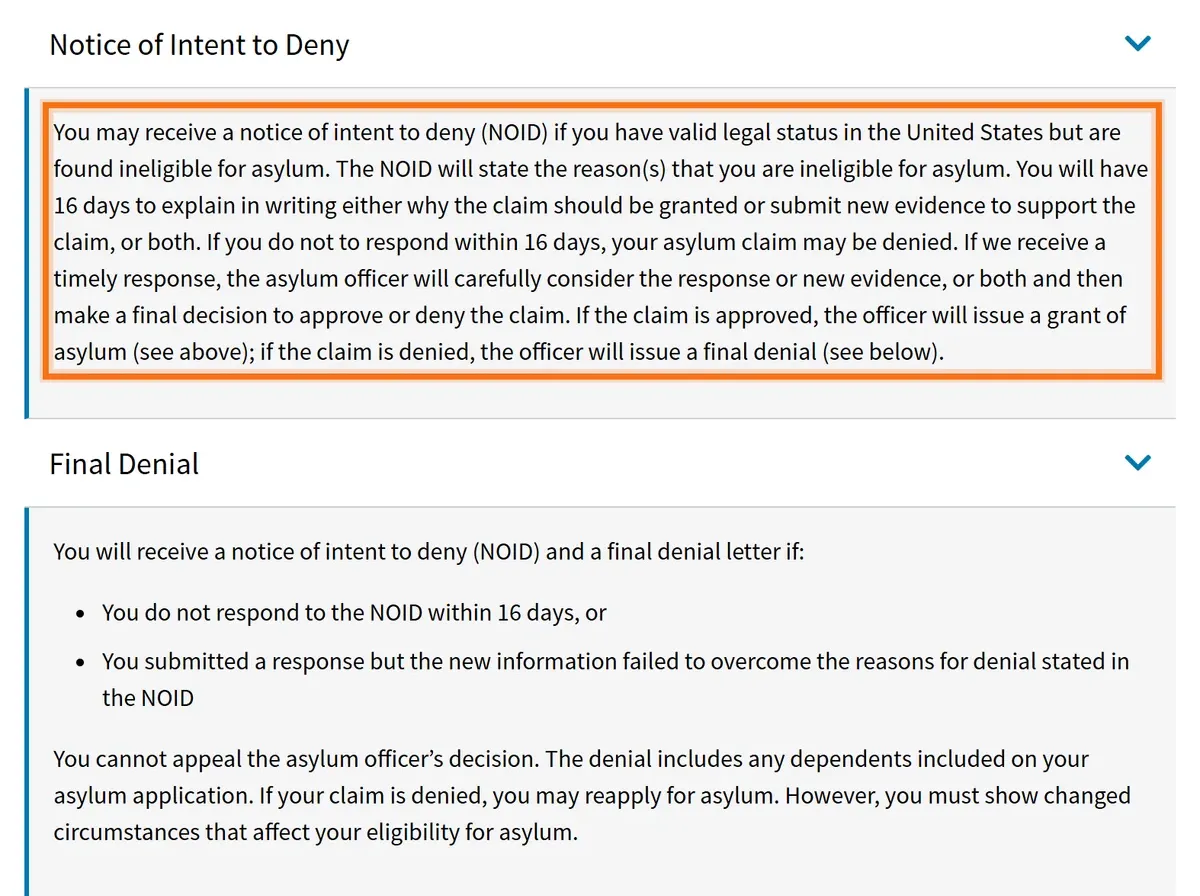
An asylum NOID is not the general USCIS notice of intent to deny that gives up to 30 days, which our RFE and NOID response guide covers. USCIS gives asylum applicants 16 days, and the notice states the reasons the officer found you ineligible. Count from the date on the notice, plan to deliver early, and follow any filing instruction printed on it.
- 1. List every reason in the NOID. Each one gets its own answer. A response that argues the strongest point and ignores the rest can still end in a final denial.
- 2. Separate credibility from law. If the officer doubted a fact, answer with evidence and a sworn explanation. If the officer found that the harm was not tied to a protected ground, answer with the legal argument and the facts that show the link.
- 3. Explain each inconsistency the officer names. Say what happened, why the earlier statement differed (an interpreter error, a typo, trauma, a question misunderstood), and attach anything that proves it.
- 4. Add evidence you did not have. Letters, medical or police records, membership records, and current country reports, each translated and certified if not in English.
- 5. Keep it in one complete package. A short cover letter, the response by reason, a supplemental declaration, and an indexed exhibit list.
If the deadline passes or the response does not work, the denial is final and cannot be appealed. You can file a new I-589 only by showing changed circumstances that affect eligibility, and since September 15, 2026 a new I-589 filed after a final USCIS action goes to the Dallas or Chicago USCIS lockbox, depending on where you live, not the asylum intake unit. Because a final denial for a status holder does not send you to court, think about your status and other options at the same time as the NOID answer.
When the case goes to the Dallas Immigration Court
If USCIS refers your case, you receive a Notice to Appear, and for most people living in Dallas and North Texas who are not detained the case is heard at the Dallas Immigration Court, 1100 Commerce Street, Suite 1060. You do not refile the I-589, and the judge is not bound by what the asylum officer decided. A government attorney now takes part and can cross-examine you. The credibility rules are the same, and anything you said at the asylum interview can be compared with what you say in court.
In court, your asylum application is also a request for withholding of removal and protection under the Convention Against Torture. Our guides to defensive asylum in immigration court and to withholding of removal and CAT protection explain the hearing and the fallbacks. If a judge later denies asylum after deciding it on the merits, an appeal to the Board of Immigration Appeals is due within 30 days; most other appeals, including a denial under the one-year deadline, are due within 10 calendar days (rule in effect since March 9, 2026).
How Atlas Immigration Law helps
We prepare asylum cases the way they will be tested. Before an interview, we compare your I-589 and declaration with every earlier statement and document, prepare corrections and a supplemental declaration where needed, organize translated evidence, and run practice sessions on the questions officers ask, including the hard ones. When a notice of intent to deny arrives, we answer each reason in writing with the evidence behind it, inside the 16 days. If your case is referred to court, we continue it in removal defense.
The firm is led by founder and managing attorney Jordan Weinberg, licensed in Texas and a member of AILA and the Dallas Bar Association. You get a flat fee quoted in writing at a free 20-minute consultation and billed by milestone, a dedicated paralegal reachable by call, email or text, same-business-day responses, and a client portal. Our office is at 1920 McKinney Ave in Dallas, and we work with clients in all 50 states. Call (945) 219-5599.
Frequently asked questions
Who can prepare an asylum applicant for a difficult credibility interview?
An immigration attorney or accredited representative can. Good preparation compares your I-589 and declaration with every earlier statement, fixes errors in writing before the interview, gathers translated evidence, and practices the questions an officer asks. Atlas Immigration Law prepares asylum applicants in Dallas and across Texas for interviews with the USCIS Houston Asylum Office.
Can an immigration lawyer respond to an asylum notice of intent to deny?
Yes. A lawyer can answer each reason in the NOID in writing, add a supplemental declaration and new evidence, and explain any inconsistency the officer relied on. USCIS gives 16 days to respond, so contact a lawyer the day the notice arrives.
How long do I have to respond to an asylum NOID?
USCIS says you have 16 days to explain in writing why the claim should be granted, submit new evidence, or both. If you do not respond in time, or the response does not overcome the reasons, USCIS issues a final denial, which cannot be appealed.
Does USCIS provide an interpreter for the asylum interview?
No, except for applicants who are deaf or hard of hearing. If you are not fluent in English you must bring an interpreter who is fluent in English and your language and at least 18. Your attorney, a witness, or a home-government employee cannot interpret.
Where are asylum interviews held for people living in Dallas?
The Houston Asylum Office handles Texas. Since May 28, 2026, applicants in its area may be interviewed in Houston or at the new San Antonio Asylum Office, and some interviews take place at a field office. Your interview notice gives the address.
What happens if the asylum officer does not grant my case?
If you have no legal status, the case is referred to immigration court with a Notice to Appear, and a judge hears it again from the start. If you have valid status, you receive a notice of intent to deny and 16 days to respond, followed by a grant or a final denial.
Do I get a decision at the end of the interview?
No. A supervisor reviews the officer’s decision first. In most cases you return to the asylum office about 2 weeks later to pick it up; it is mailed instead in some situations, such as when you are in valid status.
This guide is part of our asylum and removal defense services — the service page covers eligibility, fees, and how we handle these cases.

Founder & Managing Attorney, Atlas Immigration Law
Member of the American Immigration Lawyers Association (AILA) and the Dallas Bar Association. Licensed to practice in Texas; fluent in English and Spanish.
Legally reviewed by a licensed immigration attorney
Talk to an immigration attorney about your case
Free consultation on request, flat fees, and a dedicated paralegal who knows your case — serving clients in all 50 states.
This guide is general information, not legal advice, and reading it does not create an attorney-client relationship. Immigration law and procedures change, and how they apply depends on your specific facts — consult a licensed immigration attorney about your situation.