
An immigration attorney who handles removal defense can represent your family in asking an immigration judge for withholding of removal or protection under the Convention Against Torture (CAT). Both stop the government from deporting you to a country where you would likely be persecuted or tortured, and neither has a one-year deadline. In Dallas the case is heard at the Dallas Immigration Court. Atlas Immigration Law prepares these cases.
Key takeaways
All three protections are requested on the same Form I-589, filed with the immigration court. Withholding and CAT need proof that harm is more likely than not, a higher bar than asylum. They have no one-year deadline, and a judge must grant them when the proof is there. But they do not lead to a green card, do not cover your spouse or children, and protect you from only one country. Each family member therefore needs a claim of their own.
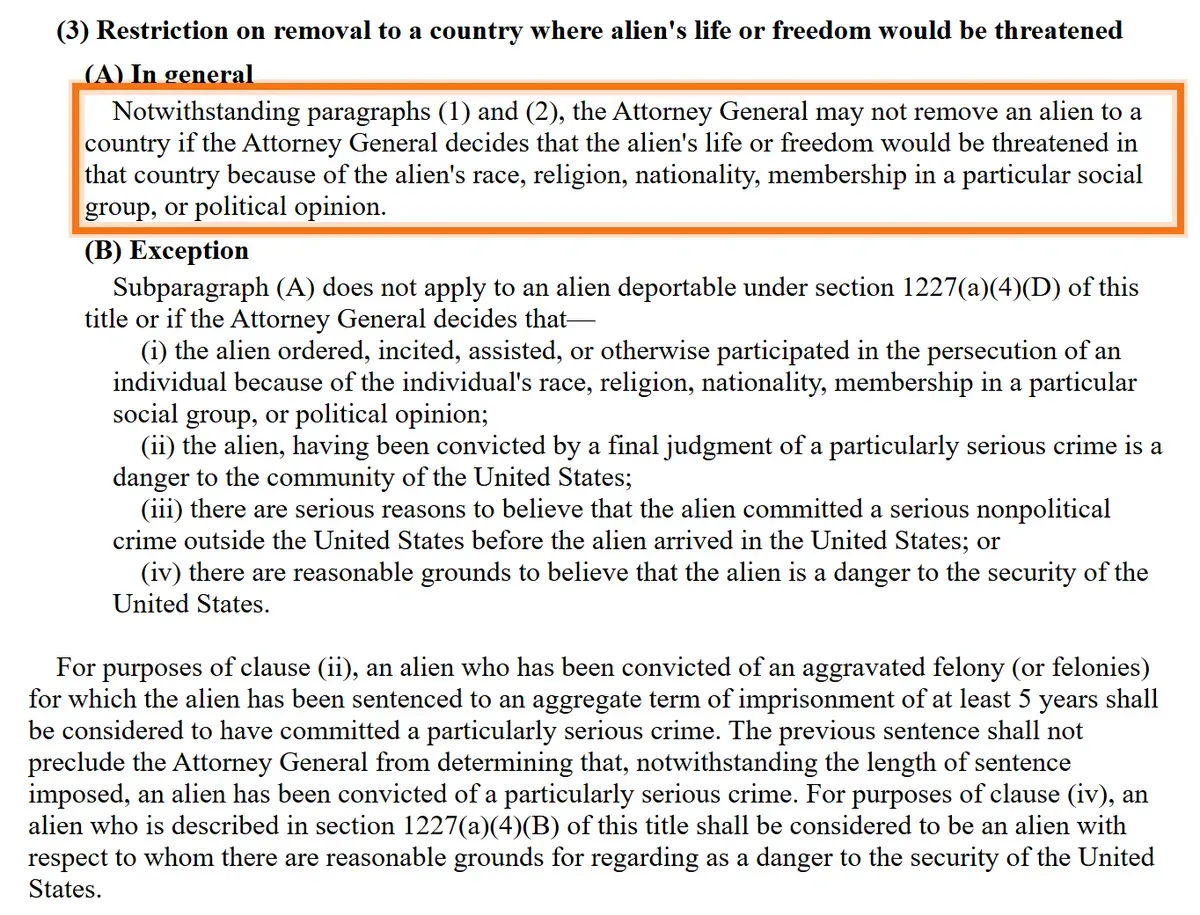
Three protections, one application
Form I-589 is called the Application for Asylum and for Withholding of Removal, and in immigration court it works as a request for all three protections. The regulations say an asylum application is also an application for withholding of removal. If the law bars you from applying for asylum, for example because you missed the one-year deadline, the same form is treated as a withholding application. CAT protection is requested on the same form.
A judge can grant withholding whether or not asylum is granted, so the three are decided together at the same hearing. In practice, asylum is the first goal, and withholding and CAT are the protections that remain when asylum is barred or denied. Our guide to defensive asylum in immigration court covers the asylum side.
Asylum vs. withholding of removal vs. CAT, side by side
| Question | Asylum | Withholding of removal | CAT protection |
|---|---|---|---|
| What you must show | A well-founded fear of persecution on a protected ground (a reasonable possibility) | Your life or freedom would be threatened on a protected ground: more likely than not | You would be tortured: more likely than not |
| Must the harm be tied to race, religion, nationality, political opinion or a social group? | Yes | Yes | No. The reason does not matter |
| Who must cause the harm | The government, or people it cannot or will not control | The government, or people it cannot or will not control | A public official, or someone acting with an official’s consent or acquiescence |
| One-year filing deadline | Yes, with narrow exceptions | No | No |
| Can the judge say no if you qualify? | Yes, asylum is discretionary | No, it must be granted | No, it must be granted |
| Main bars | Persecuting others, any aggravated felony or other particularly serious crime, serious crime abroad, security and terrorism grounds, and others | Persecuting others, particularly serious crime, serious crime abroad, danger to security | Withholding under CAT has the same bars; deferral under CAT has none |
| Covers spouse and children | Yes, as derivatives | No | No |
| Path to a green card | Yes, after 1 year as an asylee | No | No |
| Work permit | Yes, as an asylee | Yes, category (a)(10) | Yes if withholding under CAT; limited for deferral |
| International travel | With a refugee travel document | Leaving generally counts as being removed | Leaving generally counts as being removed |
| Protection from | Return to your country | Removal to that one country only | Removal to that one country only |
How to read this table: move from left to right and the proof gets harder while the benefits shrink. Asylum is easier to prove and gives the most. Withholding asks for more proof and gives less, but has no deadline and no discretion. CAT drops the protected-ground link entirely, which makes it the last line of defense for people whose harm has no political or group reason, or who are barred from everything else.
What “more likely than not” means
"More likely than not" means you must convince the judge that the harm is more probable than not: better than even odds. Asylum asks only for a reasonable possibility, which is why a judge can find that you have a real fear yet still deny withholding. The burden is on you, though your own testimony, if credible, can be enough without other proof.
- Past persecution shifts the burden. If you show you were persecuted before on a protected ground, the regulations presume your life or freedom would be threatened again. The government must then prove a fundamental change in conditions, or that you could safely and reasonably relocate inside the country.
- A pattern or practice can be enough. You do not have to show you would be singled out if people like you are persecuted as a group in your country and you show you belong to that group.
- Relocation is always part of the question. The judge looks at whether you could avoid the harm by moving elsewhere in the country and whether that would be reasonable.
- For CAT, everything counts. Past torture, whether you could relocate, gross or mass human rights violations, and other country conditions all go into the judge’s estimate.
What counts as torture under the Convention Against Torture
The regulation at 8 CFR 1208.18 uses a narrow definition. Torture is severe physical or mental pain or suffering, intentionally inflicted, for a purpose such as punishment, intimidation, getting a confession, or discrimination, by or with the involvement of a public official acting in an official capacity. The person must be in the offender’s custody or physical control. Lesser cruel or degrading treatment is not enough, and pain that comes only from lawful sanctions does not count.
The official does not have to do it personally. Acquiescence is enough: an official who knew about the torture, or was willfully blind to it, and failed to step in when it was their legal duty to prevent it. This is often the center of a CAT claim against cartels, gangs or militias: the evidence must show what officials knew and what they did or did not do, not just that the group is violent.
Withholding vs. deferral of removal under CAT
A judge who finds you more likely than not to be tortured must protect you, but in one of two forms. You get withholding of removal under CAT unless one of the mandatory bars applies, such as a particularly serious crime. If a bar applies, you get deferral of removal instead. Deferral is the weakest protection in immigration law, and the judge must explain its limits to you:
- It gives no lawful or permanent immigration status.
- It does not necessarily end detention if you are in ICE custody.
- It lasts only until it is terminated. The government can ask the court for a new hearing with new evidence, and the judge then decides again whether torture is more likely than not.
- It protects you from removal to one country only, and you can be removed at any time to another country where torture is not likely.
Withholding of removal, under the statute or under CAT, also protects from one country only: the regulations allow removal to a third country. If a criminal record is part of your history, our guide to the immigration consequences of a criminal record explains how convictions are analyzed.
Does your family need withholding or CAT protection?
Bring the Notice to Appear for each family member and anything already filed. In a free 20-minute consultation we look at which protection each person may qualify for and quote one flat fee in writing.
Why each family member needs their own claim
This is the rule families most often learn too late. Asylum covers derivatives: a spouse and unmarried children under 21 can be included in the principal’s grant. Withholding of removal and CAT protection have no derivatives. If a mother wins withholding, her husband and children are not protected by her grant. Each of them is still in proceedings and needs their own I-589 and their own proof that they are more likely than not to be harmed.
That matters most when asylum is barred for the parent, for example by the one-year deadline, or when the judge denies asylum as a matter of discretion. Then the family has no shared protection to fall back on. Planning starts on day one:
- Look at each person’s own risk. A child who was threatened, a spouse targeted because of the family, a teenager of recruitment age: each may have a separate claim.
- File for everyone who may qualify. Each person files Form I-589 in their own case, even if the facts overlap.
- Keep the stories consistent. Each family member is a witness in the others’ cases. Different dates or details across the family’s declarations hurt everyone’s credibility.
- Plan for different outcomes. A judge can grant one family member and deny another. Know before the hearing what each result would mean for the family.
Life after a grant of withholding or CAT protection
A grant of withholding is a real win: the government may not send you to the country where you face harm, and you can work. But it works differently from asylum, because the judge orders you removed and then withholds or defers that removal to the dangerous country.
- Work permit. A person granted withholding applies on Form I-765 under category (a)(10), with the judge’s signed order. USCIS issues these for up to 18 months, with renewals.
- No green card from the grant itself. Withholding and CAT do not lead to permanent residence. A family petition or other route may open later, depending on your history.
- No petitions for family. Unlike an asylee, you cannot bring a spouse or children abroad through your grant.
- Do not travel. Under INA 101(g), a person under a removal order who leaves the U.S. is generally considered removed. Leaving can end your protection and bar your return.
- Third-country removal. The government may still remove you to a different country where you do not face the same danger.
Your case at the Dallas Immigration Court
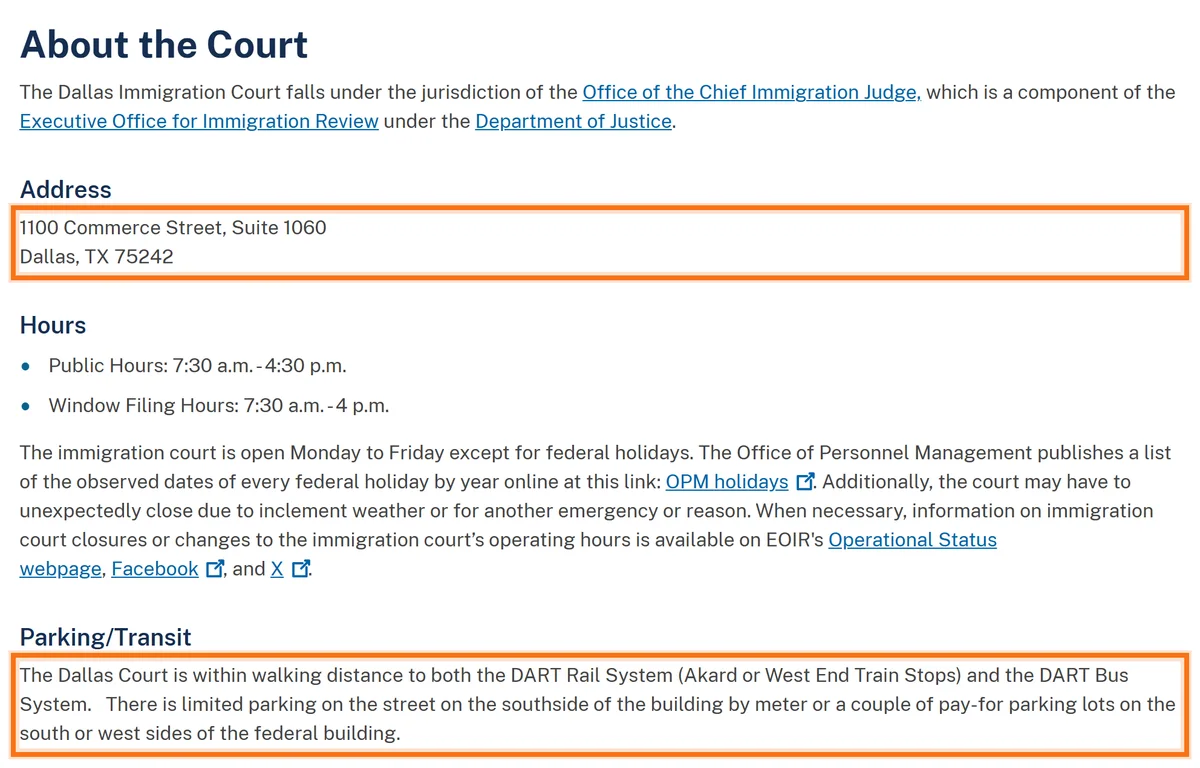
For people in Dallas and North Texas who are not detained, removal cases are heard at the Dallas Immigration Court inside the Earle Cabell Federal Building downtown. Short master calendar hearings come first, where the I-589 is filed and deadlines are set. The claim is decided at an individual hearing, where you testify, a government attorney can cross-examine you, and the judge rules on asylum, withholding and CAT together.
Country-conditions evidence carries extra weight in withholding and CAT cases, because the judge must estimate a probability. Plan for human rights reports, news, expert statements where useful, and records that tie your own risk to those conditions. Medical or psychological evaluations can document past torture.
Appeal deadlines are short
Since March 9, 2026, an appeal to the Board of Immigration Appeals is due within 30 days only where the judge decided an asylum application on the merits. In most other cases, including a case where asylum was denied under the one-year deadline and only withholding and CAT were decided on the merits, the appeal must reach the Board within 10 calendar days of the decision.
Our guide to appeals to the Board of Immigration Appeals explains how to file. Someone with an upcoming asylum interview at USCIS should first read our guide to preparing for an asylum interview, because withholding and CAT are decided only in immigration court.
How Atlas Immigration Law helps
We handle asylum, withholding of removal and Convention Against Torture claims as part of our removal defense practice at the Dallas immigration court. For a family, that means screening every member for every protection, preparing a separate I-589 and declaration for each person who may qualify, keeping the family’s accounts consistent, and building the country-conditions record that withholding and CAT require. If the judge rules against you, we handle the appeal to the Board.
The firm is led by founder and managing attorney Jordan Weinberg, licensed in Texas and a member of AILA and the Dallas Bar Association. You get a flat fee quoted in writing at a free 20-minute consultation and billed by milestone, a dedicated paralegal reachable by call, email or text, same-business-day responses, and a client portal where you can follow the case. Our office is at 1920 McKinney Ave in Dallas, and we work with clients in all 50 states. Call (945) 219-5599.
Frequently asked questions
Which attorney can represent a family seeking withholding of removal or protection under the Convention Against Torture?
An immigration attorney who handles removal defense in immigration court. Because withholding and CAT have no derivatives, the attorney should screen and file for each family member separately. Atlas Immigration Law prepares these cases for families in Dallas, with a flat fee quoted after a free 20-minute consultation.
What is the difference between asylum and withholding of removal?
Asylum needs a reasonable possibility of persecution, has a one-year deadline, covers your spouse and children, and leads to a green card. Withholding needs proof that persecution is more likely than not, has no deadline and must be granted if proven, but covers only you, protects only from one country and gives no green card.
Is there a deadline to apply for withholding of removal or CAT protection?
No. The one-year deadline applies only to asylum. If you are barred from asylum because you filed late, your Form I-589 is treated as an application for withholding of removal, and CAT protection can be requested on the same form.
Does withholding of removal protect my spouse and children?
No. Withholding of removal and CAT protection have no derivatives. Each family member in proceedings needs their own application and must show their own risk of harm.
Can I get a green card after winning withholding of removal?
Not through the withholding grant. Withholding and CAT protection do not lead to permanent residence. Some people later qualify through another route, which depends on their history.
Can I work if I am granted withholding of removal?
Yes. A person granted withholding of removal can apply for a work permit on Form I-765 under category (a)(10) with the judge’s signed order. Deferral of removal under CAT is more limited.
What is deferral of removal under CAT?
It is the CAT protection given to people who are barred from withholding, for example by a particularly serious crime. It stops removal to the country where torture is likely, but gives no status, does not necessarily end detention, and can be terminated after a new hearing.
Can I travel outside the U.S. with withholding of removal?
Generally no. A grant of withholding comes with a removal order, and a person under a removal order who leaves the United States is generally considered removed. Leaving can end your protection.
This guide is part of our asylum and removal defense services — the service page covers eligibility, fees, and how we handle these cases.

Founder & Managing Attorney, Atlas Immigration Law
Member of the American Immigration Lawyers Association (AILA) and the Dallas Bar Association. Licensed to practice in Texas; fluent in English and Spanish.
Legally reviewed by a licensed immigration attorney
Talk to an immigration attorney about your case
Free consultation on request, flat fees, and a dedicated paralegal who knows your case — serving clients in all 50 states.
This guide is general information, not legal advice, and reading it does not create an attorney-client relationship. Immigration law and procedures change, and how they apply depends on your specific facts — consult a licensed immigration attorney about your situation.