
If your citizenship interview in Dallas ended without an approval, your N-400 was most likely continued: USCIS needs documents, a second test, or more time. Answer any Form N-14 by the date printed on it. USCIS is supposed to decide within 120 days of the interview. If the answer is a denial, you have 30 days to ask for a new hearing on Form N-336.
Key takeaways
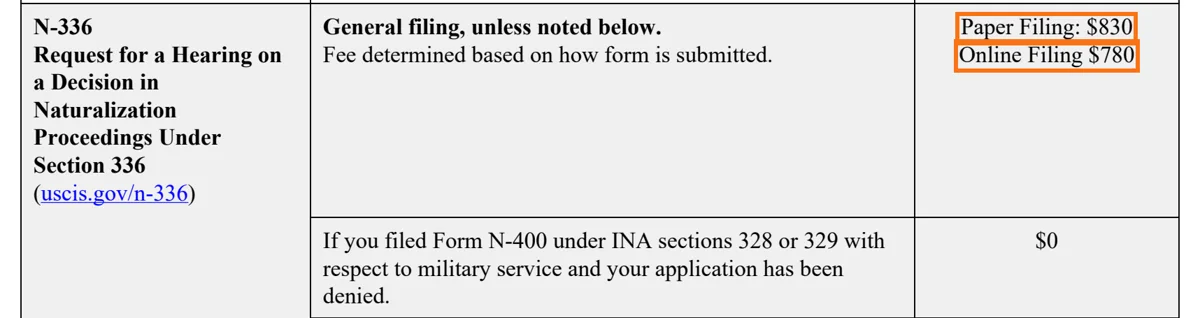
A continued case is not a denial. The officer must tell you in writing what is missing. A Form N-14 generally gives you 30 days, and if you do not answer, USCIS decides on the file as it stands. A failed test part is retested once, 60 to 90 days after the first interview. A denial can be reviewed by a different officer if you file Form N-336 within 30 days of receiving it ($780 online or $830 on paper on the USCIS fee schedule dated October 26, 2026). Sometimes a new N-400 is the cheaper and safer move.
What the paper you got at the interview means
At the end of every naturalization interview the officer hands you a notice of results, Form N-652. USCIS policy requires it whatever the outcome, and for a continued case it must explain the next steps. If the notice says, in whatever words your copy uses, that a decision cannot yet be made, you are in the "continued" group. Read it before you leave the building, because it tells you which track you are on.
| Outcome on your notice | What it means | What happens next | Your deadline |
|---|---|---|---|
| Granted (recommended for approval) | The officer found you eligible | A quality review, then the oath ceremony notice | None yet; keep your record clean until the oath |
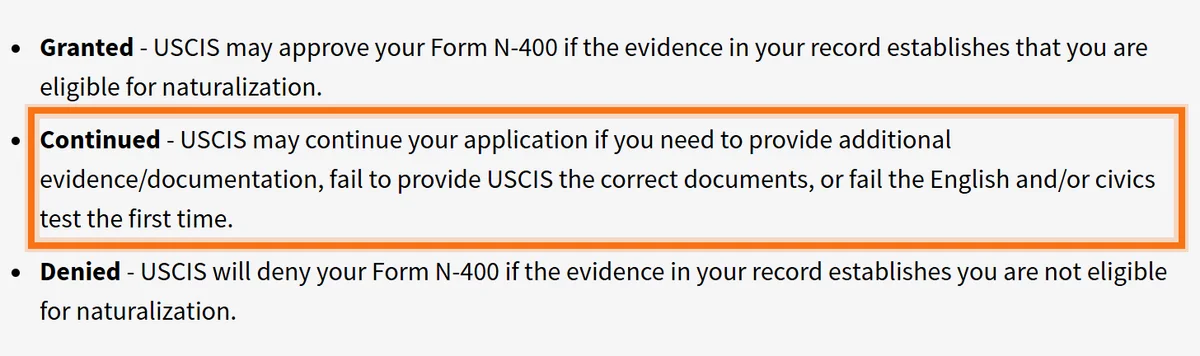
| Continued: documents needed | The officer cannot decide without more evidence | A written request, Form N-14, listing what to send | The date printed on the N-14, generally 30 days |
| Continued: test not passed | You failed English, civics, or both | One retest of the failed part only | USCIS schedules it 60 to 90 days after the first interview |
| Continued: nothing asked of you | The officer needs a further review or more checks | You wait for a decision or a new notice | USCIS has 120 days from the interview to decide |
| Denied | USCIS found you did not meet a requirement | A written decision with the reasons | 30 days from receipt to file Form N-336 |
How to read this table: find the row that matches your notice, then look at the last column first. Only two rows put a deadline on you, the N-14 and the denial, and both are short. The other rows put the deadline on USCIS. An approval at the interview is still not citizenship; our oath ceremony guide covers that last stretch.
The 120-day rule: how long USCIS has to decide
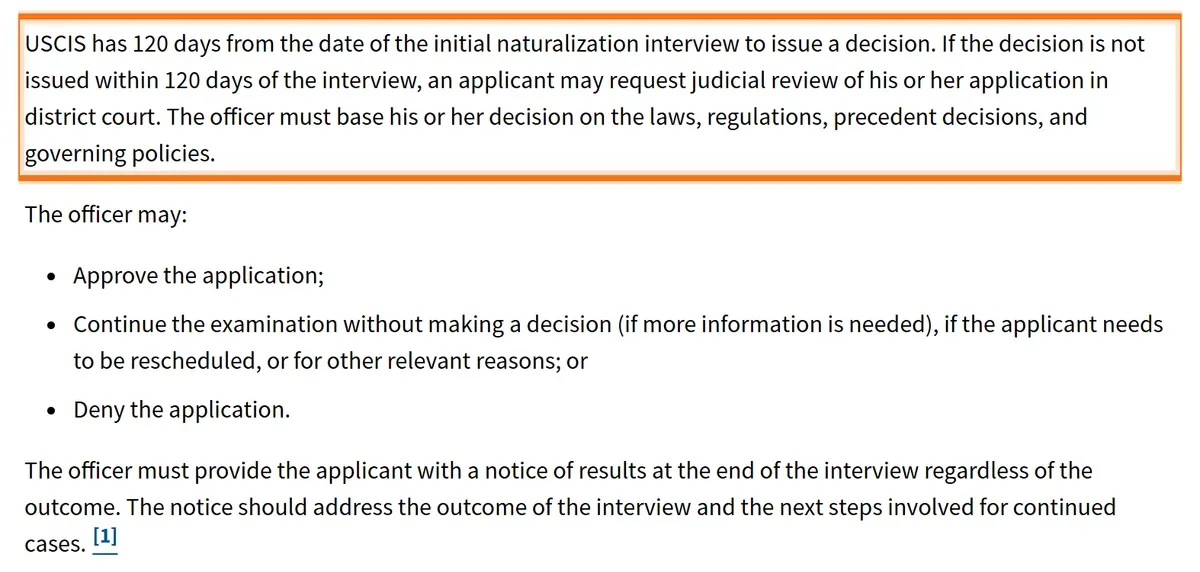
The regulation is direct. Under 8 CFR 335.3, a decision to grant or deny "shall be made at the time of the initial examination or within 120-days after the date of the initial examination." USCIS may continue the case once for a re-examination, but it must put the reason in writing, and the re-examination is supposed to fall inside the same 120 days.
Congress added a backstop. Under 8 U.S.C. 1447(b), if no decision is made within 120 days after the examination, the applicant may ask the federal district court where they live to take the case. The court may decide the application itself or send it back to USCIS with instructions.
A federal court case is a separate matter
The 1447(b) option exists in the law, but it is a lawsuit in federal court with its own rules, costs and risks, not another USCIS form. It is not part of a naturalization filing and is not among the services described on this page. Most delayed cases are resolved earlier, through the steps below.
One detail catches people. If you ask to move your second test to a date more than 90 days after the first interview, 8 CFR 312.5(b) makes you agree in writing that the 120 days will run from the second interview instead. Do not sign a postponement without understanding that trade.
Why a citizenship case is held after the interview
A hold almost always traces back to one of the eligibility rules in our naturalization eligibility guide. The common ones, each tied to a USCIS rule:
- Missing court records. Form N-400 makes you list every arrest or citation, even one that was dismissed or expunged, and the officer will want the certified final disposition for each.
- Taxes. Unfiled returns, a balance owed, or a return that does not match your N-400. USCIS policy accepts a letter from the tax authority showing that you filed and paid, or that you are on a payment plan and keeping to it.
- Selective Service. Men who lived in the U.S. between 18 and 26 may be asked for a status information letter. The issue matters most for applicants between 26 and 31.
- Travel. Trips that may have broken continuous residence, where the officer wants proof that your home, job and family stayed here.
- Checks and reviews you cannot see. USCIS requests FBI name checks on every applicant, and its policy lets an officer order a neighborhood investigation before or after the interview.
- The green card itself. Questions about how you became a permanent resident, such as an answer that differs from your old file.
Even an approval can pause. USCIS policy describes a "re-verification" of approved applications before the oath is scheduled, and the agency will not schedule a ceremony if it finds possibly disqualifying information after approval. That is why a new arrest or a long trip between the interview and the oath needs advice before you answer the ceremony questionnaire.
Form N-14: how to answer a request for more documents
Form N-14 is the naturalization version of a Request for Evidence. USCIS policy says it should state three things: the specific documents or information the officer wants, the ways you may respond, and the date by which you must reply. USCIS generally allows 30 days. The date on your own form is the one that counts.
The consequence of silence is written into 8 CFR 335.7: if you do not respond within 30 days of the notice, USCIS decides the application on the merits with what it has. Without the proof the officer asked for, that decision is rarely an approval. Work in this order:
- Day 1: copy the N-14 and mark the due date. Use the date printed on the form, not the day you opened the envelope.
- Days 1 to 3: order the slow records. Certified court dispositions, IRS tax transcripts and a Selective Service status letter all take time. Our criminal record guide explains how to get Dallas County court records.
- Answer every item, in the order listed. If a record does not exist, ask the court or agency for a letter saying so instead of leaving a gap.
- Add a short cover letter that lists each item and where it is in the packet.
- Respond the way the form tells you to, and keep proof of delivery and a full copy of what you sent.
- Send one complete response. The officer may decide on whatever is in the file when the deadline passes.
If a record cannot arrive in time, say so in writing before the due date and attach proof that you ordered it. The same habits that work for other USCIS requests apply here; see our guide to responding to a USCIS RFE or NOID. If the request touches an arrest, a tax debt or how you got your green card, get legal advice before you answer, because the response becomes part of your file.
The second test appointment, 60 to 90 days later
If you failed English or civics, you get one more try at the part you failed. The re-examination cannot be earlier than 60 days after the first interview and should be within 90 days. Missing that appointment without good cause and without telling USCIS first counts as failing it. Our citizenship test guide has the study plan and the age and disability exceptions.
USCIS policy also uses the re-examination to settle any eligibility question left open the first time. Bring the documents you were asked for, even if you already sent them.
No decision yet: what to do, and when
| Time since the interview | What to do | Why |
|---|---|---|
| Same day | Read the results notice and copy it. Note any N-14 due date. | It is the written record of what the officer needs. |
| Days 1 to 30 | Answer the N-14 in full. Check your USCIS online account weekly. | An unanswered N-14 is decided on the existing file. |
| Days 30 to 90 | Attend any retest or second interview. Report an address change right away. | Notices go to the address on file, and a missed retest counts as a failed one. |
| Days 90 to 120 | If the case is silent, send an online case inquiry or call the USCIS Contact Center. | It creates a dated record that you asked. |
| After day 120 | Ask again in writing, and get legal advice on the options, including the court option in 8 U.S.C. 1447(b). | The decision period in the regulation has passed. |
How to read this table: the left column counts from your interview date, so write that date at the top of your file. The first three rows are in your hands. The last two are about getting USCIS to act, and each inquiry should be saved with its confirmation number.
For inquiries, USCIS points applicants to its online tools first, then to an online case inquiry at uscis.gov/e-request or the Contact Center at 800-375-5283. Field offices do not take walk-ins, so going to the office without an appointment will not help. Keep the inquiry short and factual: the receipt number, the interview date, and what you already sent.
Holding an N-14 or a denial with a deadline?
Book a free 20-minute consultation. We read the notice with you, tell you what USCIS is asking for, and say whether to respond, request a hearing, or file again.
If the N-400 is denied: the Form N-336 hearing
A denial must come in writing, with the facts, the requirement you did not meet, and how to ask for a hearing. Under 8 CFR 336.2 you have 30 days after you receive the notice to file Form N-336. USCIS policy counts 33 days when the notice was mailed. A late request is rejected and the fee is kept, unless it qualifies as a motion to reopen or reconsider.
- Who hears it. An officer other than the one who interviewed you or denied the case, at the same or a higher grade.
- When. USCIS must schedule the hearing within 180 days of the filing.
- What the officer can do. Review the whole application again, question you, and accept new evidence and testimony.
- Tests. If the denial was for English or civics, you get one more chance at the failed part during the hearing.
- Possible results. The denial is reversed and the N-400 approved, the denial is upheld, or the case is denied on a new ground the second officer found.
That last result is the reason to prepare a hearing as a full new review and not as a complaint about the first officer. Form N-336 can be filed online or on paper; paper filings from Texas currently go to the USCIS Phoenix lockbox, and the form page lists the address. The fee is $0 for applicants who filed under the military naturalization sections.
N-336 hearing or a new N-400: which is better?
| Why the N-400 was denied | Usually the better move | Reason |
|---|---|---|
| You have proof the officer did not consider, or the officer misread the record | N-336 hearing | New evidence is allowed and a different officer decides |
| Failed the English or civics test twice | Either: one more test at the hearing, or refile once you are ready | The hearing gives a single attempt; a new N-400 gives two more and costs less |
| Did not answer the N-14 in time | N-336 if you now have the records and are inside the 30 days | The missing proof can be given at the hearing |
| Continuous residence or physical presence fell short | New N-400 after your new eligibility date | A hearing cannot change the calendar |
| Good moral character within the look-back period | Often wait, then a new N-400, after legal advice | Time may cure the problem; a hearing will not |
| A problem with the green card, a false claim to citizenship, or a removable offense | Legal advice before filing anything | Either filing invites another full review of your file |
How to read this table: match the reason in your denial letter to a row. The hearing is the right tool when the decision was wrong on the record or can be fixed with documents. A new application is the right tool when the facts need time to change. You can file again after a denial, but the old file stays, and the next officer will read it.
After the N-336: review in federal court
If the hearing officer upholds the denial, the law allows one more step. Under 8 U.S.C. 1421(c) and 8 CFR 336.9, you may ask the federal district court where you live to review the denial, within 120 days of the final USCIS decision. The review is "de novo": the judge makes new findings and can hold a hearing. You must go through the N-336 hearing first.
As with the 120-day delay option, this is federal litigation, a separate matter from a naturalization case, and we describe it here so you know the full map. Whether it is worth it depends on why you were denied and whether simply filing again later would get you to the same place sooner.
When the real risk is removal, not delay
Naturalization puts your whole history in front of the government. Occasionally the hold exists because the officer found something that could make a permanent resident removable: certain convictions, a false claim to U.S. citizenship, or fraud in the original green card case. If removal proceedings are pending, USCIS denies the N-400 under INA 318 and does not hold it open while the court case runs.
If your N-14 asks about an arrest, or your denial mentions how you obtained residence, stop and get advice before sending anything. Our guide to criminal records and immigration cases explains which offenses carry that risk and why a plea in Dallas County needs immigration advice first.
Dallas-area cases: the Dallas Field Office in Irving
The field office serving most of Dallas–Fort Worth is the USCIS Dallas Field Office, 6500 Campus Circle Drive East, Irving, TX 75063, according to the USCIS field office locator in November 2026. Your own interview or hearing notice controls, so check the address on it. You need an appointment to enter; USCIS field offices do not allow walk-ins.
Since May 18, 2026, USCIS no longer lets attorneys join field office interviews remotely, except in limited circumstances. If you want a lawyer beside you at a second interview or a hearing, raise it when you hire and get the answer in the fee agreement. Current Dallas N-400 processing figures are on our wait-times page.
How Atlas Immigration Law helps
Our citizenship and naturalization work includes cases that did not end at the interview. We start with the paper: the results notice, the N-14 or the denial letter, and your N-400 as filed. You hear plainly what USCIS is asking, what the risk is, and which route fits: a complete N-14 response, a Form N-336 request with new evidence, or a new N-400 at the right time. If the problem reaches beyond citizenship, you hear that first.
The firm is led by Jordan Weinberg, founder and managing attorney, licensed in Texas and a member of AILA and the Dallas Bar Association. You get a flat fee quoted in writing and billed by milestone, a dedicated paralegal reachable by call, email or text, same-business-day responses, a client portal, and service in English and Spanish. We work from 1920 McKinney Ave in Dallas for clients in all 50 states. Our N-400 process guide and our page on when you need an N-400 attorney explain the rest. Call (945) 219-5599.
Frequently asked questions
How long can USCIS take to decide after my citizenship interview?
The regulation, 8 CFR 335.3, says a decision is made at the interview or within 120 days after it. If that period passes with no decision, 8 U.S.C. 1447(b) lets an applicant ask a federal district court to decide the case or send it back to USCIS. That is a separate federal court case.
What is Form N-14?
Form N-14 is the written request for evidence USCIS uses in naturalization cases. It lists the documents or information the officer needs, how to respond, and the due date. USCIS generally allows 30 days. If you do not respond, USCIS decides your N-400 on the file as it stands.
Does a continued N-400 mean I will be denied?
No. Continued means the officer could not decide yet, usually because documents are missing or a test part was failed. USCIS decides after the N-14 is answered or the retest is taken. The avoidable risk is missing the deadline or sending a partial answer.
How long do I have to file Form N-336 after a denial?
Thirty days after you receive the denial notice, under 8 CFR 336.2; USCIS policy counts 33 days if the notice was mailed. A late N-336 is rejected without a refund unless it meets the rules for a motion to reopen or reconsider.
How much does an N-336 hearing cost?
On the USCIS fee schedule dated October 26, 2026, Form N-336 costs $780 online or $830 on paper, and $0 for applicants who filed under the military naturalization sections. Attorney fees are separate; Atlas Immigration Law quotes a flat fee in writing at the consultation.
Can I bring new evidence to an N-336 hearing?
Yes. The hearing officer may receive new evidence and take new testimony, and may review the entire application again. The officer is a different person from the one who denied the case. Because the review is complete, the officer can also find a new reason to deny.
Is it better to file a new N-400 than an N-336?
It depends on the reason for the denial. A hearing fits when the officer missed evidence or you now have the missing records. A new N-400 fits when you need more time, for example after a break in continuous residence. A new N-400 also costs less than the hearing.
Where is the USCIS office for Dallas citizenship cases?
For most of Dallas–Fort Worth it is the Dallas Field Office at 6500 Campus Circle Drive East in Irving, Texas. Check the address on your own interview or hearing notice, and do not go without an appointment: USCIS field offices do not allow walk-ins.
This guide is part of our citizenship and naturalization services — the service page covers eligibility, fees, and how we handle these cases.
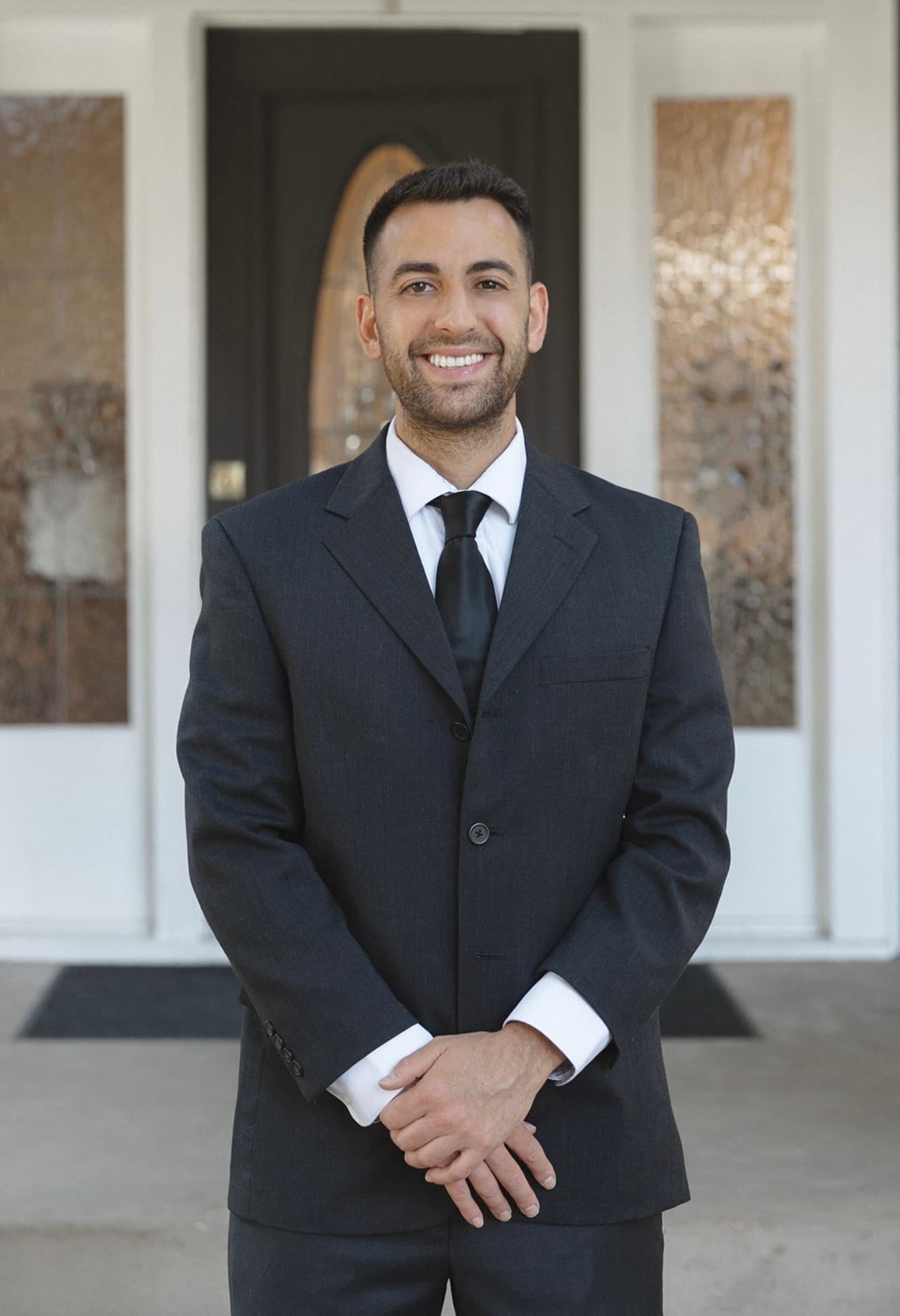
Founder & Managing Attorney, Atlas Immigration Law
Member of the American Immigration Lawyers Association (AILA) and the Dallas Bar Association. Licensed to practice in Texas; fluent in English and Spanish.
Legally reviewed by a licensed immigration attorney
Talk to an immigration attorney about your case
Free consultation on request, flat fees, and a dedicated paralegal who knows your case — serving clients in all 50 states.
This guide is general information, not legal advice, and reading it does not create an attorney-client relationship. Immigration law and procedures change, and how they apply depends on your specific facts — consult a licensed immigration attorney about your situation.