
To prove a bona fide marriage, you show USCIS that the two of you married to build a life together, not to get a green card. The rules list six kinds of proof: joint property, a shared lease, mixed finances, children, sworn affidavits, and any other relevant document. Couples in Dallas with few joint papers can still qualify by explaining why and proving the relationship in other ways.
Key takeaways
USCIS asks one question: did you intend a life together on the day you married? No rule sets a maximum age gap or a minimum courtship; those facts only mean the file must explain itself. Records made by banks, landlords and insurers over time carry more weight than papers you make yourself. Affidavits must include the writer’s full name, address, date and place of birth, and how they know about your marriage. Never create or stage evidence: a fraud finding blocks future petitions for life.
What “bona fide marriage” means in immigration law
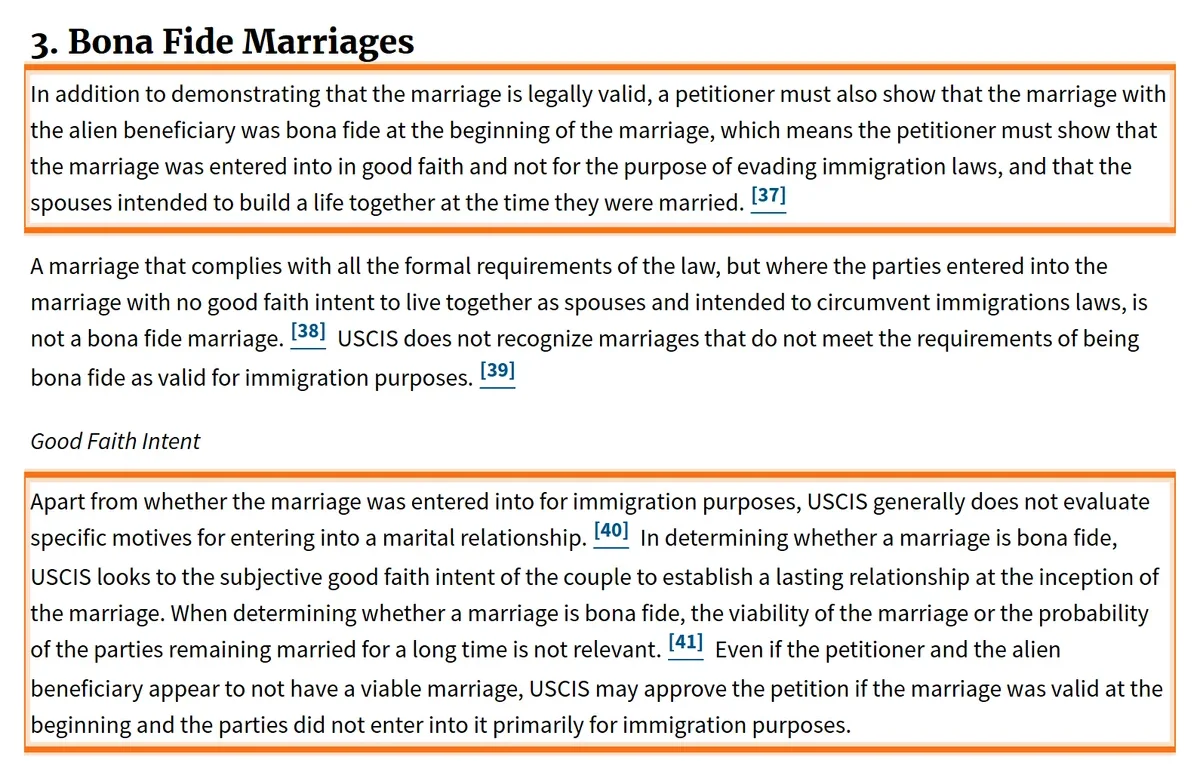
A marriage certificate proves the marriage is legal. It does not prove why you married. For immigration, the marriage must also be bona fide: entered in good faith, with both of you intending to live as a married couple, and not for the purpose of getting around immigration law.
The USCIS Policy Manual adds three points that surprise most couples. The test looks at your intent at the beginning of the marriage. USCIS generally does not judge your other motives for marrying. And failing to prove a bona fide marriage does not, by itself, mean the marriage is fraudulent; it means the file did not carry its burden.
That burden is usually a preponderance of the evidence: more likely than not. It rests on you, not on the officer. If the first filing leaves doubt, the Policy Manual says USCIS may send a Request for Evidence (RFE), send a Notice of Intent to Deny (NOID), or call you to an interview.
Where the question comes up: I-130, K-1 and I-751
You do not prove the marriage once. The same question returns at each stage of a marriage-based green card, and the standard is not always the same.
| Filing | What you must show | Level of proof | Where the rule is |
|---|---|---|---|
| Form I-130, spouse petition | The marriage was entered in good faith | Preponderance of the evidence | USCIS Policy Manual, Vol. 6, Part B, Ch. 6 |
| Form I-130, married while the foreign spouse was in removal proceedings | A written request for the bona fide marriage exemption, with evidence | Clear and convincing evidence | 8 CFR 204.2(a)(1)(iii); 8 U.S.C. 1255(e)(3) |
| Form I-129F, K-1 fiancé petition | You met in person within the 2 years before filing and both truly intend to marry | Satisfactory evidence to USCIS | 8 U.S.C. 1184(d)(1); 8 CFR 214.2(k)(2) |
| Form I-751, joint petition | The marriage was not entered to evade immigration law, shown from the wedding to today | Preponderance of the evidence | 8 CFR 216.4(a)(5) |
| Form I-751, filed alone after divorce | You entered the marriage in good faith | USCIS weighs the commitment of both spouses | 8 CFR 216.5(e)(2) |
How to read this table: find your filing in the first column. Most couples only ever meet the ordinary standard in rows one and four. Row two is the hard one: if you married after removal proceedings began, the evidence has to be much stronger, and the exemption must be requested in writing with the I-130.
The evidence USCIS accepts, in its own list
The regulations name the same six kinds of proof for the I-130 and the I-751, and the Form I-130 checklist on uscis.gov repeats them:
- Joint ownership of property: a deed, a vehicle title, a mortgage in both names.
- A lease showing you live at the same address as joint tenants.
- Combined finances: joint bank accounts, credit cards, loans, shared bills.
- Birth certificates of children born to the two of you.
- Sworn affidavits from other people who personally know the marriage.
- Any other relevant document. This is where insurance, tax returns, travel records, photos and messages go.
The list says "include, but are not limited to." Nothing on it is required, and no single item wins a case. An officer reads the whole file and asks whether it looks like two people sharing a home, money and time.
Strong vs. weak evidence: what carries weight
USCIS does not publish a point system. The pattern below follows from how the rules work: an officer trusts records that someone else created, in the ordinary course of life, over a long period, more than records a couple can produce in an afternoon.
| Evidence | How much it shows | How to make it count |
|---|---|---|
| Joint lease, deed or mortgage | Strong: a landlord or lender put both names on it | Send the full signed document, plus renewals that cover the whole marriage |
| Joint bank account | Strong if used, weak if empty | Send statements over many months that show both of you paying real expenses |
| Health, car or life insurance listing your spouse | Strong: an insurer recorded the relationship | Send the policy page that names the spouse and the date they were added |
| Tax returns filed as married | Strong: filed with the IRS under penalty of perjury | Send IRS transcripts, not only the preparer’s copy |
| Children’s birth certificates | Strong | Send the certificate that lists both parents |
| Photos together | Supporting only | A small set across the years, with dates, places and family or friends in them |
| Affidavits from friends and family | Supporting; stronger with documents behind them | Specific facts the writer saw, plus the required personal details |
| Chat logs and call records | Supporting; most useful for time spent apart | A sample from each month, not thousands of pages |
How to read this table: aim for several items from the top five rows, spread across the whole marriage, and use the bottom three to fill the gaps. A file with one strong item and 200 photos is weaker than it looks. If a top-row item is missing, say why instead of hoping nobody notices.
How to prove a bona fide marriage with few joint documents
Many real couples have thin paperwork. One spouse has no Social Security number yet, so the bank and the landlord list only the other. You live with parents and pay no rent. You married recently, or you have spent most of the marriage in different countries. None of that is a reason for denial; an unexplained gap is.
- 1. Explain the gap in writing. A signed statement from each of you saying what you lack and why, in plain facts and dates.
- 2. Prove the shared address separately. Each spouse’s own mail, pay stubs, driver’s license, car registration and medical bills going to the same home.
- 3. Show how the money really moves. Transfers between your accounts, one spouse paying the other’s phone or car insurance, money sent abroad to a spouse or in-laws.
- 4. Document time together. Boarding passes, passport stamps, hotel and event bookings, and family gatherings both attended.
- 5. Ask people who know you. Parents, a landlord, a pastor, coworkers: affidavits with the required details (next section).
- 6. Make real changes as life allows. Add your spouse to the insurance at open enrollment or to the lease at renewal because it is true, not for the file.
Do not manufacture a paper trail
Opening a joint account and never using it, backdating a lease, or posing for "evidence photos" hurts a real marriage. Officers compare dates, and a document created the week of the RFE reads as exactly that. A false document can also turn a weak file into a fraud finding.
Affidavits: what each one must contain
Under 8 CFR 204.2(a)(1)(iii)(B), an affidavit must be sworn or affirmed by someone with personal knowledge of your marriage. It must give the writer’s full name and address, date and place of birth, and relationship to you, if any. It must also explain in detail how the writer came to know about the marriage.
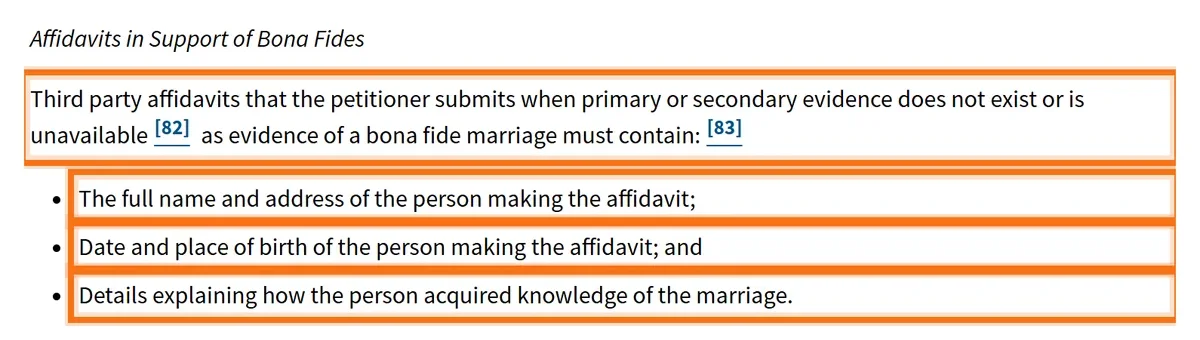
Good affidavits describe things the writer saw: the wedding, holidays at your home, the night one of you was in the hospital. "They are a loving couple" proves nothing. The regulation says affidavits should be backed by documents where possible, and that the writer may be required to testify before an officer.
Two more rules apply. When ordinary documents do not exist, the general evidence rule at 8 CFR 103.2(b)(2) expects two or more affidavits from people who are not parties to the petition. For an I-751, the regulation says the couple must arrange for the people who signed affidavits to be present at the interview, so choose people who would actually come.
Age gap, short courtship, living apart: facts that draw questions
USCIS does not publish a list of red flags, and no statute or regulation sets a maximum age difference, a minimum time dating, or a required shared language for adults. What the Policy Manual says is narrower: officers interview when the facts are inconsistent or raise doubt about the marriage. These facts tend to raise that doubt, and each has an honest answer.
- A large age difference. Tell the story of how you met and why it works: shared faith, work, children, family approval. Evidence that both families know and accept the marriage answers most of it.
- A short courtship, or a wedding soon after a status problem. Show the relationship before the wedding: messages, visits, the proposal, who attended. Be direct about the timing.
- No shared language. Show how you really communicate: a common second language, a translation app in your chat history, classes one of you is taking.
- Living apart. The Policy Manual says USCIS may not deny only because spouses live separately. It looks at when the separation began, how long it has lasted, and whether you still support each other. Prove the reason (a job, school, a sick parent) and the visits.
- Earlier marriages or petitions. USCIS interviews when the petitioner filed for a different spouse before, or when an earlier spousal petition was denied or withdrawn. Bring the divorce records and expect questions about the earlier marriage.
- Married during removal proceedings. The higher clear-and-convincing standard applies, and the exemption must be requested in writing.
The rule for all of them is the same: raise the fact yourself, in the first filing, with a short explanation and proof. If your case involves a past marriage that USCIS questioned, read our guide to second interviews and marriage fraud concerns before you file anything.
Got a request for more relationship evidence?
Send us the notice and what you filed. In a free 20-minute consultation we tell you what USCIS is really asking for and what your marriage can honestly show.
Answering a marriage green card RFE for more relationship evidence
An RFE on an I-130 or a green card application means the officer has not decided yet. Under 8 CFR 103.2(b)(8), an RFE allows at most twelve weeks and a NOID at most thirty days, and USCIS does not extend either. Use the date printed on your notice; our RFE and NOID guide explains how the deadline is counted.
- Read what was asked. "Evidence of a shared residence" and "evidence of commingled finances" are two requests, and each needs its own answer.
- Organize by time, not by type. Courtship, wedding, first home, today. An officer should see a marriage that keeps going.
- Add a statement from each spouse covering anything the documents cannot explain, including the weak spots.
- Send one complete package. A partial answer is treated as a request to decide on what USCIS has.
- Do not pad it. Forty well-chosen pages with a clear index beat four hundred.
If the notice is a NOID, or it mentions an inconsistency, a prior marriage or "derogatory information," treat it as more serious than a document request. That is the point where a marriage green card lawyer earns the fee.
K-1 RFEs: meeting in person and proving the relationship
A K-1 petition has its own rule. The law requires that you and your fiancé met in person within the two years before filing the I-129F, and that both of you truly intend to marry within 90 days of arrival. Video calls do not count as meeting. An RFE on this point wants proof of the same trip from two sides: passport stamps, boarding passes, hotel records, and dated photos together.
USCIS may excuse the meeting in only two situations under 8 CFR 214.2(k)(2): meeting would cause extreme hardship to the U.S. citizen petitioner, or it would violate strict and long-established customs of the fiancé’s culture, as where parents arrange the marriage and the couple may not meet before the wedding. For the custom exemption, you must also show that every other part of the traditional arrangement is being followed.
The exemption is discretionary, and cost or inconvenience alone is a hard argument. If you simply have not met within the window, the regulation gives a cleaner fix: a denial is without prejudice, so you can meet and file again. Our K-1 requirements checklist and the K-1 fiancé visa page cover the rest of the process.
I-751: more evidence of a real marriage, two years later
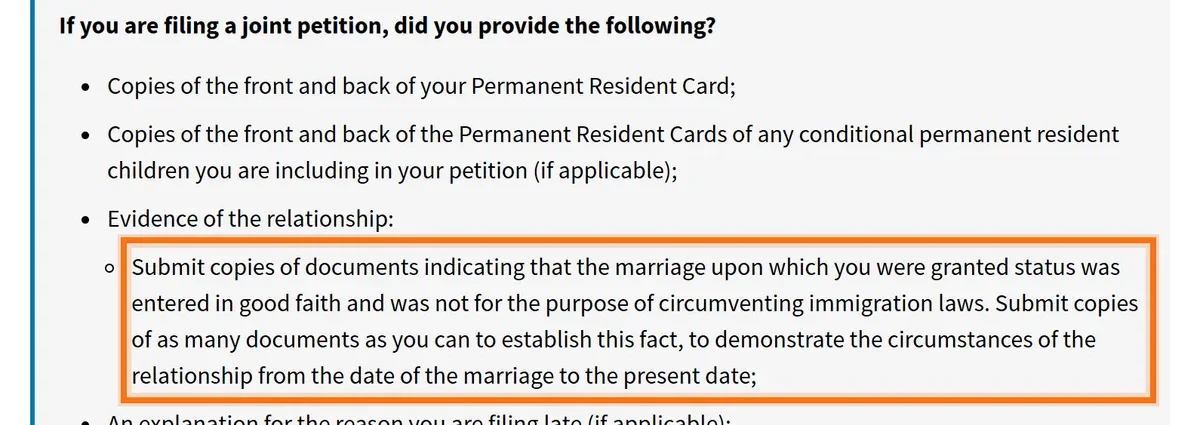
The I-751 asks the same question about a later period. USCIS wants documents covering the time from the wedding to the present, so the lease from your first filing is not enough. An RFE here usually means the file stops at some point: no recent joint statements, an address that changed for one spouse only, or nothing since the green card was approved.
If USCIS has negative information about the marriage, 8 CFR 216.4(c) requires it to give you a chance to rebut it. Take that chance seriously. A denied I-751 ends your resident status and comes with a notice to appear in immigration court, and there is no appeal; the decision is reviewed in the court case.
If the marriage has ended, you file alone with a waiver, and the question becomes whether you entered it in good faith. USCIS then looks at how far your finances were combined, how long you lived together, and any children. Our I-751 guide covers timing, fees and the waivers.
Where Dallas couples prove it in person
Paper is half of the proof. For couples in the Dallas area, the other half is usually an interview at the USCIS Dallas Field Office, which the USCIS office locator lists at 6500 Campus Circle Drive East in Irving. Always go to the address on your own notice. Bring originals of what you filed and anything new since.
Our green card interview guide explains what happens in the room. A strong, well-organized file is the best way to avoid a second, separate interview.
How Atlas Immigration Law helps
We build marriage files for family immigration clients and for couples filing a spouse visa petition: joint finances, shared residence, photos, communications and affidavits from people who know you as a couple. When the paperwork is thin, we work out what your real life can prove and draft the explanation for what it cannot. For an RFE or NOID, we map each request to an exhibit and send one complete answer before the deadline.
The firm is led by Jordan Weinberg, founder and managing attorney, licensed in Texas and a member of AILA and the Dallas Bar Association. You get a flat fee quoted in writing at the consultation and billed by milestone, a dedicated paralegal reachable by call, email or text, same-business-day responses, and service in English and Spanish. We work with couples in all 50 states from 1920 McKinney Ave in Dallas. Call (945) 219-5599.
Frequently asked questions
What counts as proof of a bona fide marriage for USCIS?
The regulations list joint ownership of property, a lease showing a shared home, combined finances, birth certificates of children born to the couple, sworn affidavits from people with personal knowledge of the marriage, and any other relevant document. No single item is required. USCIS looks at the whole file.
Can we get a marriage green card with a large age difference?
Yes. No statute or regulation sets a maximum age difference for adult spouses. An age gap may lead to more questions or an interview, so explain how you met and show that family and friends know the marriage, along with the usual shared-life documents.
What if we have no joint bank account or lease?
Explain why in a signed statement and prove the marriage another way: each spouse’s own mail and ID at the same address, transfers between your accounts, insurance listings, travel records, and detailed affidavits. Do not open accounts or sign papers only to create evidence.
How long do we have to answer an RFE asking for more relationship evidence?
Use the date printed on the notice. Under 8 CFR 103.2(b)(8), an RFE allows at most twelve weeks and a Notice of Intent to Deny at most thirty days. USCIS does not grant extra time, and the answer must go in as one complete package.
What must a marriage affidavit say?
It must be sworn or affirmed by someone with personal knowledge of the marriage and give that person’s full name, address, date and place of birth, relationship to the spouses, and details of how they know about the marriage. The writer may be required to testify.
Can the K-1 requirement to meet in person be waived?
Only in two situations: meeting would cause extreme hardship to the U.S. citizen petitioner, or it would violate strict and long-established customs of the fiancé’s culture. The exemption is discretionary. If the petition is denied on this point, you can file again after meeting in person.
What happens if USCIS denies our I-751 for lack of evidence?
The conditional resident’s status ends on the date of the decision and USCIS issues a notice to appear in immigration court. There is no appeal, but the decision can be reviewed in the removal case, where the government must show the denial was proper.
Does Atlas Immigration Law handle relationship RFEs for couples outside Dallas?
Yes. We work with clients in all 50 states. Send the complete notice and the full filing it concerns, and in a free 20-minute consultation we tell you what the response needs and quote a flat fee in writing.
This guide is part of our family immigration services — the service page covers eligibility, fees, and how we handle these cases.

Founder & Managing Attorney, Atlas Immigration Law
Member of the American Immigration Lawyers Association (AILA) and the Dallas Bar Association. Licensed to practice in Texas; fluent in English and Spanish.
Legally reviewed by a licensed immigration attorney
Talk to an immigration attorney about your case
Free consultation on request, flat fees, and a dedicated paralegal who knows your case — serving clients in all 50 states.
This guide is general information, not legal advice, and reading it does not create an attorney-client relationship. Immigration law and procedures change, and how they apply depends on your specific facts — consult a licensed immigration attorney about your situation.