
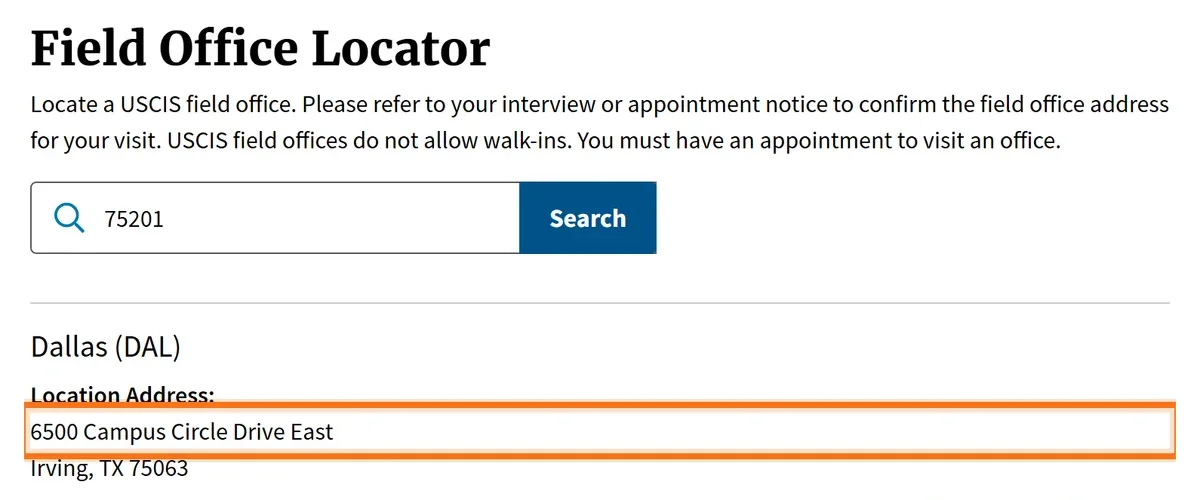
A second marriage interview means the USCIS officer still has doubts after the first one. It is not a denial. Each spouse is usually questioned alone, under oath, and the answers are compared. Prepare by rereading everything you filed, bringing new proof of your shared life, and telling the truth, including "I don’t remember." For Dallas-area couples it takes place at the USCIS Dallas Field Office in Irving.
Key takeaways
"Stokes interview" is a New York term; in Dallas it simply means a separate interview of each spouse. Different answers on small details do not sink a real marriage; guesses and lies do. If a Notice of Intent to Deny follows, you have at most 30 days and no extension. A finding that an earlier marriage was a sham blocks every later petition under INA 204(c), with no time limit, so answer it with evidence. A denied I-130 can be appealed to the Board of Immigration Appeals within 30 days.
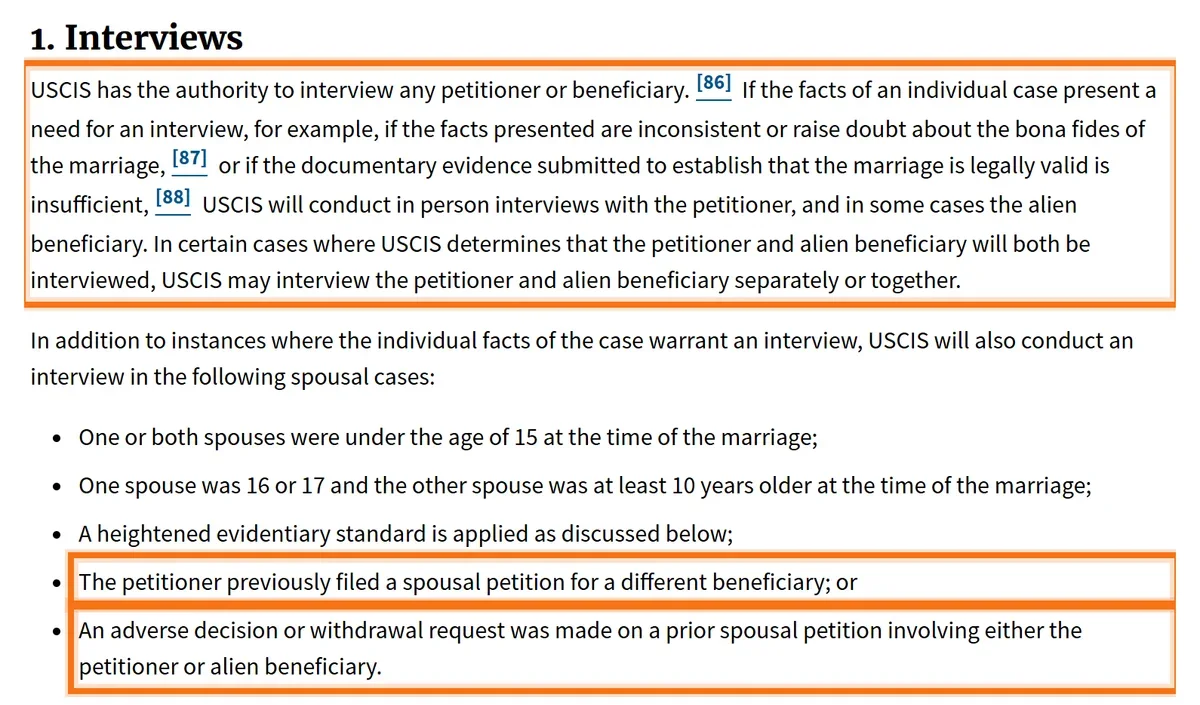
Why USCIS schedules a second interview
The notice rarely gives a reason. The USCIS Policy Manual does: an officer interviews when the facts are inconsistent, when they raise doubt about whether the marriage is real, or when the documents are not enough. After a first interview, that usually means one of three things.
- Your answers did not match each other or the forms: addresses, dates, who lives in the home, how you met.
- The file is thin. Few joint documents, or documents that stop months ago. Our guide to proving a bona fide marriage covers how to fix that.
- Something in the history. An earlier marriage or petition, a prior denial or withdrawal, or information USCIS received from someone else.
A second interview is not a finding of fraud. The Policy Manual says that failing to prove a real marriage does not, by itself, mean the marriage is fraudulent. The officer is still deciding, and what you bring and say next counts.
What a “Stokes interview” means at the Dallas Field Office
The name comes from Stokes v. INS, a federal court case in New York in the 1970s about how the immigration office there ran marriage interviews. The procedures that came out of that case were written for New York. Lawyers and online forums now use "Stokes interview" for any interview where spouses are questioned apart.
So there is no formal Stokes procedure in Dallas, and your notice will not use the word. What applies here is the general rule: USCIS may require any applicant or petitioner to appear, may take testimony under oath, and may interview spouses separately or together. Your protections come from the regulations, not from the New York case:
- A lawyer. Under 8 CFR 292.5(b), you have the right to be represented at the examination.
- A copy of what you sign. If the officer takes a signed statement from you, 8 CFR 103.2(b)(7) says you get a copy on request, without a fee.
- A chance to answer. Under 8 CFR 103.2(b)(16), if USCIS plans to deny based on negative information you do not know about, it must tell you and let you rebut it before it decides.
What happens when spouses are interviewed separately
Each of you is placed under oath and questioned alone, usually one right after the other. The officer asks both of you the same questions and compares the answers. The questions are about ordinary shared life, because that is what two people who live together know without studying.
- Your home: the layout, who sleeps where, who has keys, what is in the refrigerator.
- Your routine: work schedules, who cooks, what you did last weekend, the last holiday.
- Your money: who pays rent and bills, which accounts, large purchases.
- Your history: how you met, the proposal, the wedding, each other’s families.
- The paperwork: anything on the forms that changed or looked inconsistent.
Some answers will differ. Real spouses remember dinners and dates differently, and officers know that. If the officer points out a difference, explain it calmly; do not change your answer to match your spouse. If you are asked to sign a written statement, read every line first and ask for corrections to anything that is not what you said.
How to prepare: truthful, consistent, documented
- 1. Get the whole file. Every form, exhibit and USCIS notice. If someone else prepared it, ask for the complete filed copy.
- 2. Both of you reread it. Dates, addresses, jobs, prior marriages. If something on a form is wrong, plan to correct it at the start of the interview.
- 3. Write a timeline from documents, not memory: when you met, moved in, traveled, changed jobs.
- 4. Bring what is new. Statements, lease renewals, insurance, tax transcripts, and photos since the first interview, plus originals.
- 5. Talk through your daily life together, but do not write or memorize a script. Matching wording sounds rehearsed.
- 6. Agree on one rule: answer what you know, and say "I don’t know" or "I don’t remember" for the rest.
- 7. Have the hard facts reviewed first. A past marriage, an old petition, an arrest, or a period living apart should be discussed with a lawyer before the interview.
| What happened | What it means | What to do | Deadline |
|---|---|---|---|
| You received a second interview notice | The officer has open questions; no decision yet | Review the file, update the evidence, consider counsel | The date on the notice |
| You were separated at the first interview | The officer compared your answers | Write down what you were asked while it is fresh; gather proof on any point of difference | None yet; watch for a notice |
| A Notice of Intent to Deny arrived | USCIS plans to deny and has listed its reasons | Answer every reason with statements and documents | At most 30 days |
| The I-130 was denied | The petition failed; the green card application usually falls with it | Appeal to the BIA, file a motion, or file a new petition | 30 days for an appeal or motion |
| The denial cites section 204(c) | USCIS found a sham marriage, past or present | Get the denial reviewed right away; the finding follows the file | 30 days for an appeal or motion |
How to read this table: find the row that matches the last paper you received. The further down you are, the shorter the time and the more the outcome depends on a written answer, not on another conversation with the officer.
A NOID after the interview: 30 days to answer
A Notice of Intent to Deny (NOID) lists the reasons USCIS plans to deny: the answers that did not match, the documents it found lacking, and any outside information. Under 8 CFR 103.2(b)(8), the response time is at most 30 days, and USCIS grants no extra time. Use the date printed on the notice.
A good answer takes the notice one point at a time. For each difference in your answers, each spouse gives a sworn statement of what is true and why you answered as you did, with a document if one exists. Then add the shared-life evidence the file was missing. Our RFE and NOID guide explains how the deadline is counted and why everything must go in one package.
Second interview notice or a NOID?
Send us the notice and your filing. In a free 20-minute consultation we tell you what USCIS is likely asking about and what to do before the date.
When USCIS questions a previous marriage: the INA 204(c) bar
Section 204(c) of the Immigration and Nationality Act (8 U.S.C. 1154(c)) says no petition may be approved for a person who entered, or attempted or conspired to enter, a marriage to evade the immigration laws. It reaches forward: a finding about a past marriage blocks a later petition from a new spouse, a parent, a child or an employer. The statute sets no time limit and contains no waiver.
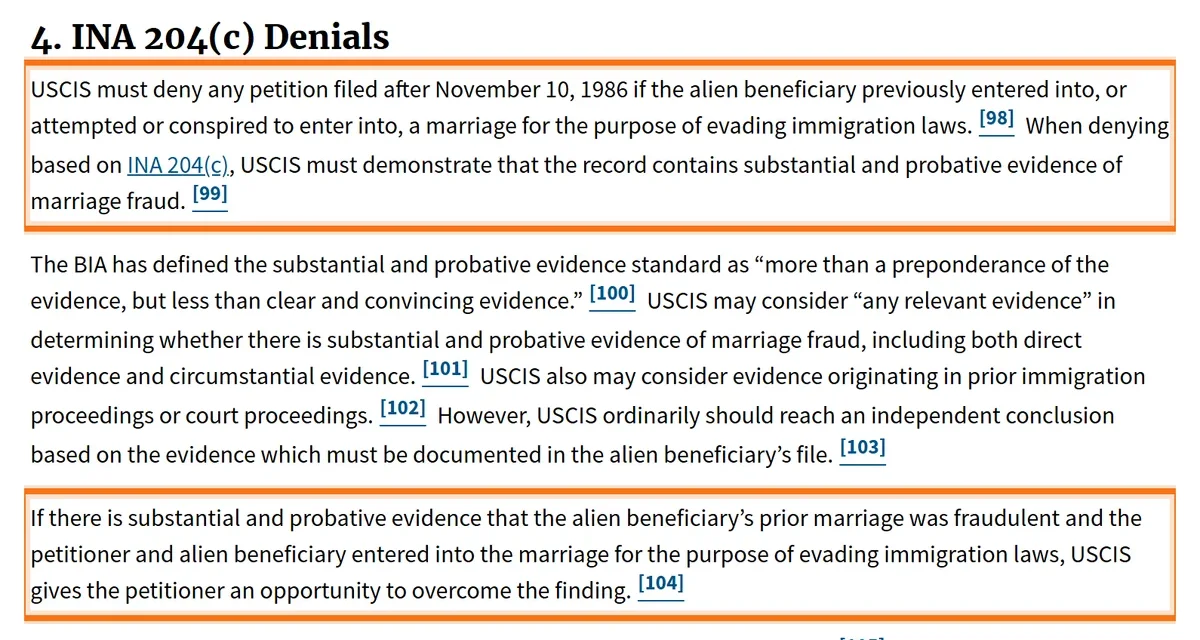
The bar is heavy, so the proof must be real. Under 8 CFR 204.2(a)(1)(ii), there must be substantial and probative evidence of the fraud, and it must be in the person’s file. The Policy Manual describes that standard as more than a preponderance of the evidence but less than clear and convincing. No conviction or prosecution is needed.
- A weak old file is not fraud. An earlier petition denied for lack of evidence does not trigger the bar by itself.
- USCIS must reach its own conclusion on the evidence, not simply repeat an old decision.
- You see what USCIS relied on. The Policy Manual says it discloses the information it directly relied on, such as a former spouse’s statement.
- The same couple can file again. The bar does not apply when the same petitioner files a new petition for the same spouse, though the old evidence stays in the record.
To answer a 204(c) concern, you prove the earlier marriage was real when it began: the lease and bills from that time, joint accounts, photos, affidavits from people who knew that couple, the divorce record and why it ended. A truthful statement from the former spouse can help a great deal. A short or failed marriage is not a fraudulent one.
The five-year rule for petitioners who got their own card through marriage
A different rule applies when the petitioner is the one with a past marriage. Under INA 204(a)(2)(A), a green card holder who became a resident through an earlier marriage cannot have a petition for a new spouse approved within five years of getting that status. There are two exceptions: the earlier marriage ended through death, or the petitioner proves by clear and convincing evidence that it was genuine.
The regulation asks for documents covering the period of the earlier marriage, the same kinds used to prove any marriage. If the proof falls short, the petition is denied, but 8 CFR 204.2(a)(1)(i)(C) says the denial is without prejudice to a new petition once the petitioner has been a resident for five years. The statute’s wording covers petitions by permanent residents.
| Situation | Who carries the burden | Standard | Source |
|---|---|---|---|
| Ordinary spouse petition | The petitioner | Preponderance of the evidence (more likely than not) | USCIS Policy Manual, Vol. 6, Part B, Ch. 6 |
| USCIS says a prior marriage was a sham (204(c)) | The record must contain the evidence; the petitioner may rebut it | Substantial and probative evidence | 8 CFR 204.2(a)(1)(ii) |
| Resident petitioner within 5 years of a card gained through an earlier marriage | The petitioner | Clear and convincing evidence | 8 U.S.C. 1154(a)(2)(A) |
| Married while in removal proceedings | The petitioner | Clear and convincing evidence | 8 U.S.C. 1255(e)(3) |
| Denied I-751 reviewed in immigration court | The government | Preponderance of the evidence | 8 CFR 216.4(d)(2) |
How to read this table: the further a standard is from "more likely than not," the more documents and sworn statements the file needs. Rows three and four put a heavier burden on you. Row two puts it on what is in the government’s file, which is why you should ask what USCIS is relying on.
Marriage fraud is also a federal crime
Under 8 U.S.C. 1325(c), a person who knowingly enters a marriage to evade the immigration laws faces up to five years in prison, a fine of up to $250,000, or both. That applies to either spouse, including a U.S. citizen. Prosecutions are a separate matter from the immigration case, but statements made under oath at an interview can matter in both.
Two practical rules follow. Never lie or guess to make answers match; a false statement under oath is its own problem and can turn doubt into a finding. And if there is anything in either spouse’s past that worries you, speak with a lawyer privately before the interview, not after.
Options after a denial
- Appeal the I-130 to the Board of Immigration Appeals (BIA). The form is EOIR-29, due within 30 days of service of the decision, and it is filed with USCIS, not with the Board. The fee is $1,060 under 8 CFR 1103.7 and the USCIS fee schedule dated October 26, 2026. USCIS says to include a copy of the denial letter.
- Ask the same office to reopen or reconsider on Form I-290B, within 30 days. The USCIS fee is $800.
- File a new I-130 ($675 on paper, $625 online) with a stronger record. A 204(c) finding stays in the file, so a new petition must answer it directly.
- Defend the case in immigration court. A denied green card application cannot be appealed, and USCIS may start removal proceedings. There, the application can be renewed before a judge.
Which one fits depends on what the denial says and what new evidence exists. Our guides to why green card applications get denied, immigration appeals and deportation defense in Dallas cover each path. If another preparer handled the case so far, an immigration second opinion is a reasonable first step.
Your right to a lawyer at the interview
You may bring an attorney. Under 8 CFR 292.5(b), a person being examined has the right to a representative, who may introduce evidence, make objections for the record and submit briefs. The lawyer cannot answer for you. Their job in the room is to make sure the questions are fair, the record is accurate, and your documents get into the file.
One 2026 change affects planning. Since May 18, 2026, USCIS no longer lets attorneys join field office interviews remotely, except in limited circumstances. If you want counsel in the room in Irving, or at any other field office, settle that when you hire the lawyer. Our green card interview guide covers the rest of the interview day.
How Atlas Immigration Law helps
For family immigration clients with a second interview notice, we read the whole file with both spouses, find the points an officer is likely to press, and update the evidence. For a NOID or a 204(c) concern, we build the written answer: statements, records from the earlier marriage, and a point-by-point response filed before the deadline. If the case is denied or moves to court, our removal defense practice handles the appeal or the hearing.
The firm is led by Jordan Weinberg, founder and managing attorney, licensed in Texas and a member of AILA and the Dallas Bar Association. You get a flat fee quoted in writing at the consultation and billed by milestone, a dedicated paralegal reachable by call, email or text, same-business-day responses, and service in English and Spanish. We work with clients in all 50 states from 1920 McKinney Ave in Dallas. Call (945) 219-5599. The full process is in our marriage green card guide.
Frequently asked questions
What is a Stokes interview?
It is a common name for a marriage interview where USCIS questions each spouse separately and compares the answers. The term comes from Stokes v. INS, a 1970s federal court case about the New York office. Outside New York, including Dallas, it is simply a separate or second interview.
Does a second interview mean USCIS thinks our marriage is fake?
Not necessarily. It means the officer still has questions, usually because answers differed, the documents were thin, or there is an earlier marriage or petition in the history. No decision has been made, and new evidence and clear answers can still lead to approval.
What if my spouse and I give different answers?
Small differences are normal. Explain yours calmly and do not change a true answer to match your spouse. Problems come from patterns of different answers on facts a couple living together would share, and from guessing. Saying "I don’t remember" is an acceptable answer.
How long do we have to respond to a NOID after a marriage interview?
At most 30 days under 8 CFR 103.2(b)(8), and USCIS does not grant extensions. Use the date printed on the notice. The response should answer every stated reason with sworn statements and documents, sent together in one package.
What is the INA 204(c) marriage fraud bar?
It is the rule in 8 U.S.C. 1154(c) that no petition may be approved for a person who entered, or attempted or conspired to enter, a marriage to evade the immigration laws. It has no time limit and applies to later family and employment petitions. USCIS needs substantial and probative evidence to apply it.
Can we appeal if the I-130 is denied for marriage fraud?
Yes. A denied I-130 can be appealed to the Board of Immigration Appeals on Form EOIR-29 within 30 days of service of the decision. The appeal is filed with USCIS and the fee is $1,060. A motion on Form I-290B or a new petition are the other options.
Can a lawyer come to a second marriage interview in Dallas?
Yes. You have the right to be represented at a USCIS interview. Since May 18, 2026, attorneys must attend field office interviews in person, except in limited circumstances, so arrange attendance when you hire the lawyer. You still answer the questions yourself.
I got my green card through my first marriage. Can I petition for my new spouse?
Yes, but if you are a permanent resident and fewer than five years have passed since you got that status, you must prove by clear and convincing evidence that the first marriage was genuine, unless it ended through death. Otherwise the petition can be filed again after five years.
This guide is part of our family immigration services — the service page covers eligibility, fees, and how we handle these cases.

Founder & Managing Attorney, Atlas Immigration Law
Member of the American Immigration Lawyers Association (AILA) and the Dallas Bar Association. Licensed to practice in Texas; fluent in English and Spanish.
Legally reviewed by a licensed immigration attorney
Talk to an immigration attorney about your case
Free consultation on request, flat fees, and a dedicated paralegal who knows your case — serving clients in all 50 states.
This guide is general information, not legal advice, and reading it does not create an attorney-client relationship. Immigration law and procedures change, and how they apply depends on your specific facts — consult a licensed immigration attorney about your situation.