
Most I-130 "wrong category" problems are not filing mistakes. A family event moved the case: the petitioner naturalized, the beneficiary married or divorced, or a child turned 21. Federal rules convert many petitions to the right category automatically, keeping the original priority date, but USCIS or the National Visa Center has to be told. Where no category fits, only a new petition helps. Atlas Immigration Law reviews these cases for families in Dallas and North Texas.
Key takeaways
When a petitioner naturalizes, F2A spouses and children under 21 become immediate relatives and F2B sons and daughters move to F1, with the same priority date. An F2B son or daughter can opt out and stay in F2B with a signed letter. A marriage or divorce can move a citizen’s son or daughter between F1 and F3. When no category fits, such as a married child of a green card holder, the petition is denied or revoked and a new one is needed. Tell USCIS while the I-130 is there, and NVC once it has moved.
The family categories, and why the right one matters
On Form I-130 you state who you are (citizen or green card holder) and how the relative is related to you, and USCIS decides which family classification fits those facts. That classification decides whether your relative waits in the Visa Bulletin line, and for how long.
| Category | Who it covers | Waits in the visa line? |
|---|---|---|
| Immediate relative (IR) | Spouse of a U.S. citizen; unmarried child under 21 of a citizen; parent of a citizen who is 21 or older | No. Immediate relatives have no annual limit |
| F1 | Unmarried son or daughter, 21 or older, of a U.S. citizen | Yes |
| F2A | Spouse or unmarried child under 21 of a green card holder | Yes |
| F2B | Unmarried son or daughter, 21 or older, of a green card holder | Yes |
| F3 | Married son or daughter of a U.S. citizen | Yes |
| F4 | Brother or sister of a U.S. citizen who is 21 or older | Yes |
How to read this table: the category follows two facts, the petitioner’s status and the beneficiary’s age and marital status. When either fact changes, the category can change with it. A green card holder has no category for a married son or daughter, a parent or a sibling, which is why some changes end a petition instead of converting it. The Visa Bulletin guide explains how each preference line moves.
The relationship must exist when the petition is filed and continue through the decision. The filing date of a properly filed I-130 becomes its priority date, your place in line. Keeping that date is the whole point of conversion, because a new petition starts a new date.
Which changes convert an I-130 automatically
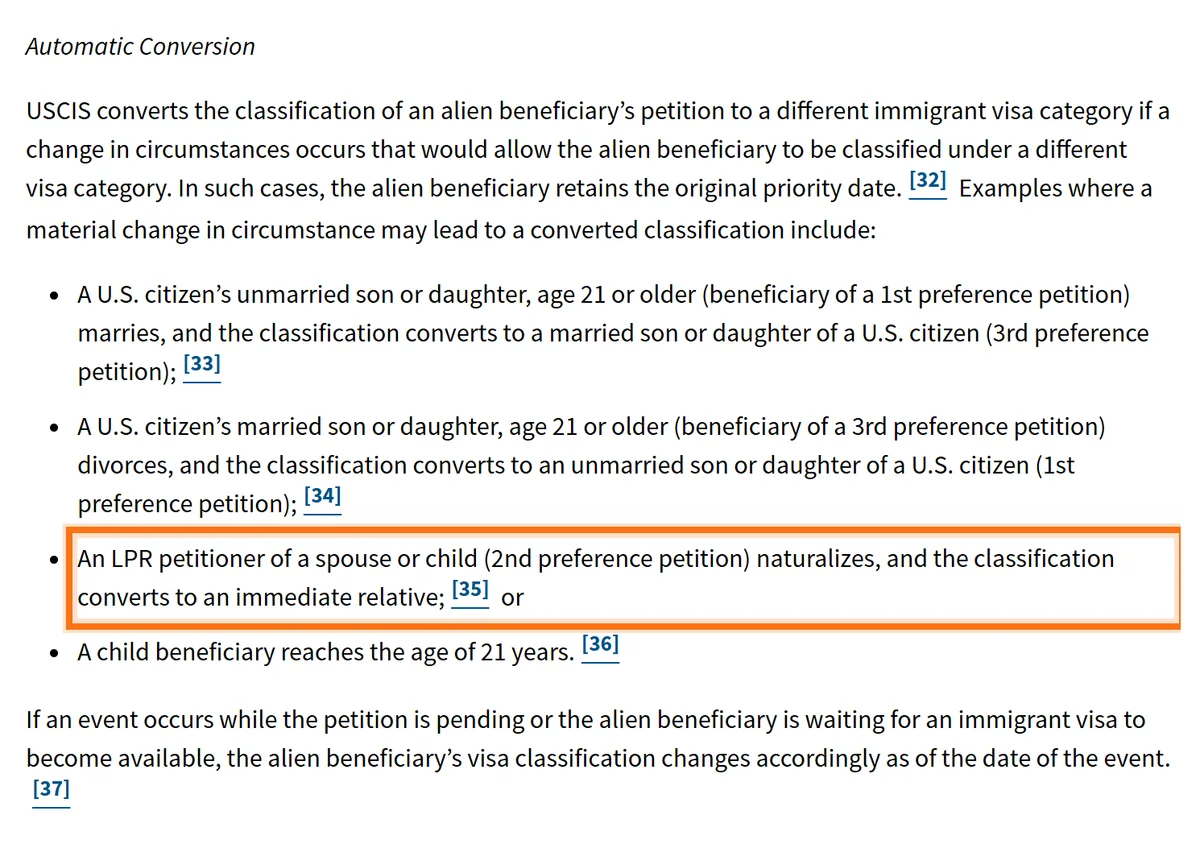
Under 8 CFR 204.2(i), a "currently valid" petition is treated as approved in the new category as of the date of the event. Nobody files a new I-130, and the beneficiary keeps the original priority date. The conversions the rule lists are:
- The petitioner naturalizes. A green card holder’s petition for a spouse or a child under 21 (F2A) becomes an immediate relative petition on the day of the oath. A petition for an unmarried son or daughter 21 or older (F2B) becomes F1.
- A citizen’s unmarried son or daughter marries. F1 converts to F3. A citizen’s child under 21 who marries also moves from immediate relative to F3.
- A citizen’s married son or daughter divorces. When the marriage legally ends, F3 converts to F1 if the beneficiary is 21 or older, or to immediate relative if under 21.
- A citizen’s child turns 21. The rule converts an immediate relative petition to F1. In practice the Child Status Protection Act (CSPA) locks an immediate relative child’s age on the date the I-130 was filed, so a child under 21 at filing generally does not age out while staying unmarried.
- A citizen petitioner dies. A spouse’s pending or approved I-130 is treated as a widow(er) petition on Form I-360 if the surviving spouse qualifies. USCIS says the widow(er) does not need to file anything for this conversion.
One exception: a VAWA self-petition filed against an abusive green card holder spouse or parent does not convert when the abuser naturalizes. The self-petitioner can file a new self-petition as an immediate relative instead, if still eligible.
Changes that end a petition instead
Conversion only works when a category exists for the new facts. When none does, USCIS denies a pending petition, and an approved petition is automatically revoked under 8 CFR 205.1 if the event happens before the green card is granted or the beneficiary travels on the immigrant visa. The common cases:
- A green card holder’s son or daughter marries. There is no category for a married child of a permanent resident. The F2A or F2B petition ends. If the parent later naturalizes, a new petition in F3 is possible, with a new priority date.
- A spousal petition’s marriage ends in divorce or annulment. The petition is revoked. Our guide to when the marriage ends while the I-485 is pending covers the options that remain.
- The petitioner withdraws in writing. A written withdrawal filed before the decision is final revokes the petition.
- The petitioner loses green card status without becoming a citizen.
For the son or daughter of a green card holder, a wedding can erase years of waiting. Get advice before the date, not after.
The petitioner naturalized: how to tell USCIS or NVC
The conversion happens by law, but the file does not update itself. USCIS says you can update your relative’s classification by notifying USCIS or the Department of State of your naturalization, and where you send it depends on where the petition is.
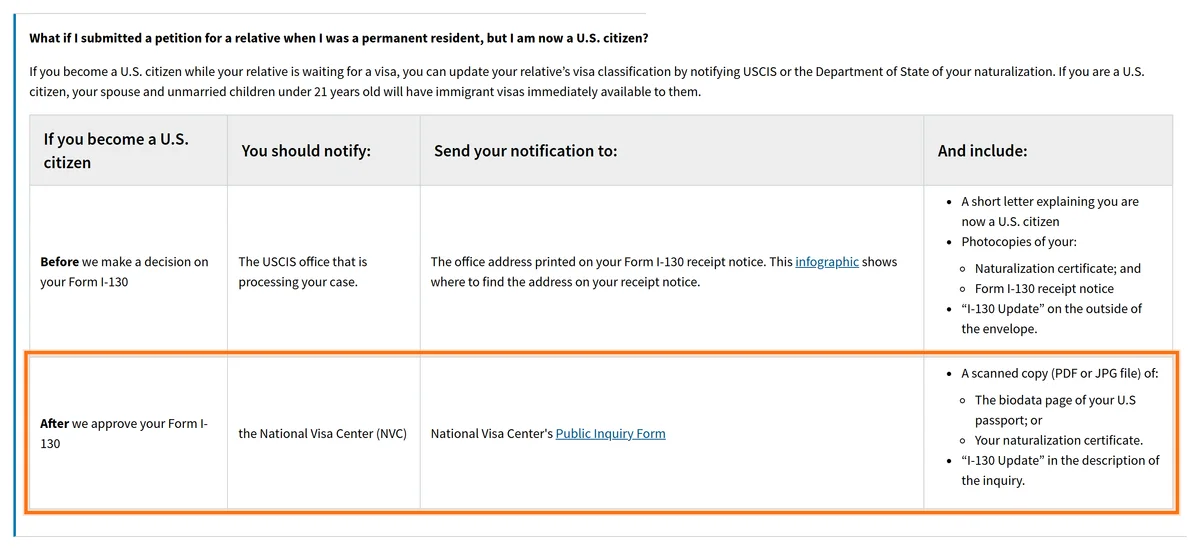
- I-130 still pending with USCIS: mail a short letter saying you are now a U.S. citizen, with photocopies of your naturalization certificate and the I-130 receipt notice, to the office address on the receipt notice. Write "I-130 Update" on the outside of the envelope.
- I-130 approved and at NVC: send a scanned copy (PDF or JPG) of your U.S. passport biodata page or your naturalization certificate through NVC’s Public Inquiry Form, with "I-130 Update" in the description.
- Green card application (I-485) already pending: the USCIS Policy Manual says the applicant or petitioner should notify, in writing, the USCIS office that issued the receipt notice or the most recent correspondence.
Check your children before the oath. On an F2A petition, a child under 21 can be listed as a derivative on the spouse’s petition. Immediate relatives have no derivatives, so after you naturalize, USCIS says each child who was only a derivative needs a new I-130 of their own. A child’s age freezes on the date the parent becomes a citizen, so a child under 21 that day stays an immediate relative. Our guide to sponsoring a spouse as a green card holder covers the F2A side in more detail.
Did your family’s I-130 change category?
Tell us who filed, when, and what changed: a naturalization, a marriage, a divorce or a birthday. In a free 20-minute consultation we will tell you whether the petition converted, what to send to USCIS or NVC, and whether a new petition is needed.
The F2B opt-out: staying in the faster line
Conversion is not always good news. When a green card holder naturalizes, an F2B son or daughter moves to F1. For some countries the F1 line is longer than the F2B line. INA 204(k) lets the beneficiary refuse the conversion and stay in F2B, and USCIS says to check the Visa Bulletin to see which line is shorter.
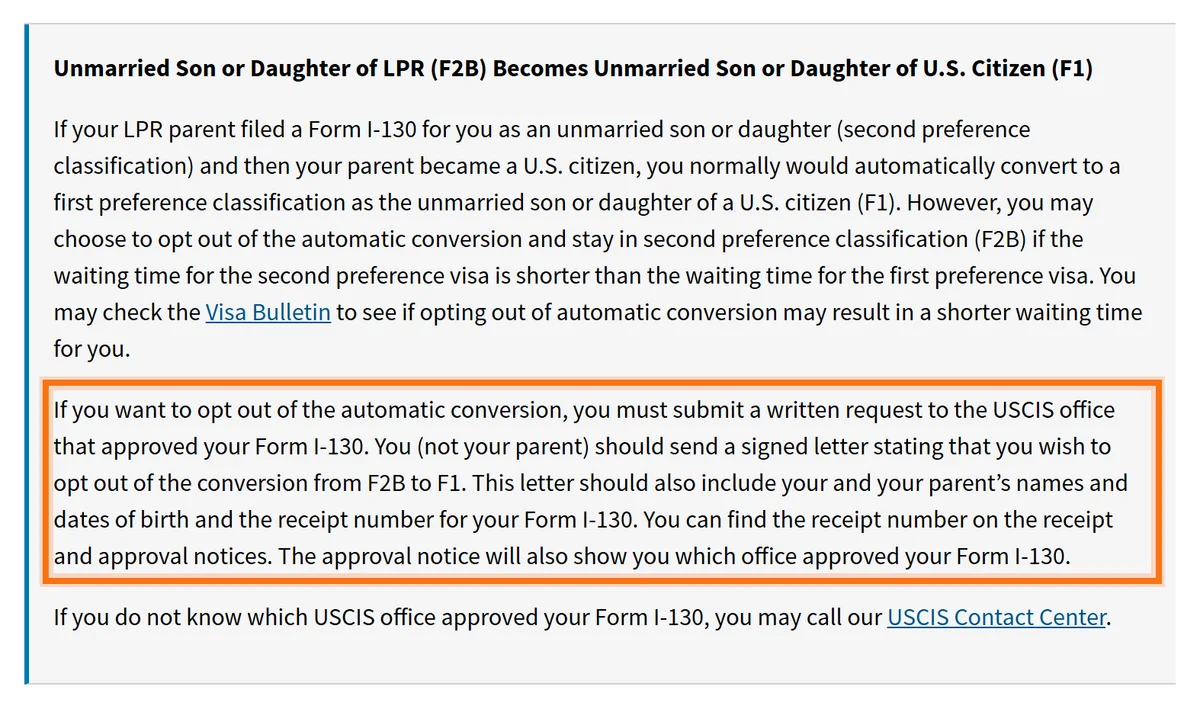
Three points matter. The letter comes from the beneficiary, not the petitioner. It goes to the USCIS office shown on the approval notice; if you cannot tell which office that is, USCIS points you to its Contact Center. And the opt-out only exists for petitions filed for an unmarried son or daughter of a green card holder. Compare the current Visa Bulletin for your country before deciding, because the faster line can change.
Life event, new category and what to send: a quick reference
| Change | New category | Priority date kept? | What to send |
|---|---|---|---|
| Green card holder petitioner naturalizes (F2A spouse or child under 21) | Immediate relative | Not needed: immediate relatives do not wait in line | Letter, naturalization certificate and receipt notice to USCIS; or NVC Public Inquiry Form with passport page or certificate |
| Green card holder petitioner naturalizes (F2B son or daughter 21+) | F1, unless the beneficiary opts out | Yes | Same notice; for F2B instead, a signed opt-out letter from the beneficiary to the approving USCIS office |
| Derivative child on an F2A spouse petition, parent naturalizes | None as a derivative | Not needed if the child is an immediate relative | A new I-130 for each child |
| Citizen’s unmarried son or daughter (F1) marries | F3 | Yes | Written notice with the marriage certificate to USCIS, or to NVC if the case is there |
| Citizen’s married son or daughter (F3) divorces | F1 if 21+, immediate relative if under 21 | Yes | Written notice with the final divorce decree |
| Citizen’s child under 21 marries | F3 | Yes | Written notice with the marriage certificate |
| Green card holder’s son or daughter (F2A or F2B) marries | None: denied or revoked | No | Nothing saves it; a new F3 petition after the parent naturalizes |
| Spouse petition, couple divorces before the green card | None: revoked | No | Review other bases with a lawyer |
| Citizen spouse petitioner dies | Widow(er), Form I-360 | Not needed: immediate relative | Nothing to convert the petition; the I-485 continues if filed |
How to read this table: the first column is the event, the last column is your action. "Yes" in the third column means the beneficiary keeps the original filing date in the new line, which can be worth years. Where the third column says "No", a new petition starts a fresh date, so the timing of a marriage or a naturalization should be planned, not discovered. Where a case sits matters too: our guide to the NVC stage after I-130 approval explains what happens once USCIS sends an approved petition on.
When the category on the petition is simply wrong
Sometimes nothing changed and the paperwork is still wrong. The approval notice may show the wrong section of law or a wrong priority date, or the petition may describe the petitioner or the beneficiary inaccurately. The USCIS Policy Manual covers this in "Correcting Errors in a Notice of Approval":
- USCIS error on the notice. The petitioner may ask USCIS for a corrected approval notice when the notice is missing information, such as the correct priority date or classification, or contains a mistake made by USCIS.
- Caught later in the process. A consular officer can return the petition to USCIS for corrective action, and an officer deciding a green card application can review the petition. USCIS warns this may delay the visa or the adjustment.
- Mistakes you made. USCIS asks petitioners to give correct information and to notify it of any changes or corrections needed. Send the correction in writing, with proof, to the office handling the case, or to NVC once it has the petition.
Not every error can be corrected. If the petitioner had no right to file for that relative on the filing date, for example a green card holder who filed for a parent, a sibling or a married child, there is nothing to convert and the petition fails. The fix is a new I-130 once the petitioner qualifies, usually after naturalizing, with a new priority date. The I-130 filing fee on the USCIS fee schedule dated October 26, 2026 is $675 on paper or $625 online.
When only a new petition will do
File a new I-130, rather than waiting for a conversion, when:
- A derivative child lost derivative status because the parent naturalized, or a derivative child on an F2A spouse petition turned 21. In the second case, 8 CFR 204.2(a)(4) lets the child keep the original priority date if the same petitioner files the new petition.
- The beneficiary’s category ended: a green card holder’s son or daughter married, or a spousal marriage ended.
- The petitioner was not eligible to file for that relationship when the petition was filed.
- The petition was withdrawn, denied or revoked for another reason.
A new petition does not erase the old history. The new filing should be consistent with what was said before, and anything that changed needs an explanation and proof. Check current processing times for the new filing, and expect the preference lines to move at their own pace.
How Atlas Immigration Law helps
Any immigration lawyer you hire can review an I-130 and send USCIS or NVC the notice, opt-out letter or new petition a case needs. What matters is reading the case before you act: which category applies today, whether the priority date survives, how close each child is to 21, and whether a naturalization or a wedding should wait. On our green card services and family immigration pages we explain how we confirm the right category before anything is filed, and for green card holders filing for a spouse or children we coordinate the petitions with your citizenship timeline.
The firm is led by founder and managing attorney Jordan Weinberg, licensed in Texas and a member of AILA and the Dallas Bar Association. You get a free 20-minute consultation, a flat fee quoted in writing at the consultation and billed by milestone, a dedicated paralegal reachable by call, email or text, same-business-day responses, and a client portal for your documents. Our office is at 1920 McKinney Ave in Dallas, and we work with families in all 50 states. Call (945) 219-5599.
Frequently asked questions
Who can fix an I-130 petition filed in the wrong family preference category?
Usually no new filing is needed: when a naturalization, marriage, divorce or 21st birthday changes the category, federal rules convert the petition and keep its priority date, and the petitioner or beneficiary tells USCIS or NVC in writing. An immigration lawyer can confirm the right category and send the notice. In Dallas, Atlas Immigration Law reviews these cases in a free consultation.
Do I need a new I-130 after I become a U.S. citizen?
Not for your spouse or for a child who is the main beneficiary: the F2A petition becomes an immediate relative petition on the day you naturalize. Send proof of citizenship to USCIS if the I-130 is pending, or to NVC through its Public Inquiry Form if it was approved. Children who were only derivatives on your spouse’s petition each need a new I-130.
Does my relative lose the priority date when the category changes?
No, not when the petition converts. Under 8 CFR 204.2(i) the beneficiary keeps the date the original petition was filed. The date is lost only when no category fits and the petition is denied or revoked, so a new petition has to start over.
Can my adult son or daughter stay in F2B after I naturalize?
Yes. Under INA 204(k), an unmarried son or daughter can opt out of the conversion to F1. USCIS asks for a signed letter from the son or daughter, not the parent, with both names and dates of birth and the I-130 receipt number, sent to the office that approved the petition.
What happens if the son or daughter of a green card holder gets married?
The petition ends. There is no category for a married son or daughter of a permanent resident, so USCIS denies a pending petition or the approval is automatically revoked. If the parent later becomes a citizen, a new F3 petition can be filed, with a new priority date.
What if the approval notice shows the wrong category or priority date?
The USCIS Policy Manual says the petitioner may ask USCIS for a corrected notice when the classification or priority date is wrong because of a USCIS error. Fix it early: a consular or adjustment officer who finds the error later may send the petition back, which delays the case.
This guide is part of our family-based green card services — the service page covers eligibility, fees, and how we handle these cases.

Founder & Managing Attorney, Atlas Immigration Law
Member of the American Immigration Lawyers Association (AILA) and the Dallas Bar Association. Licensed to practice in Texas; fluent in English and Spanish.
Legally reviewed by a licensed immigration attorney
Talk to an immigration attorney about your case
Free consultation on request, flat fees, and a dedicated paralegal who knows your case — serving clients in all 50 states.
This guide is general information, not legal advice, and reading it does not create an attorney-client relationship. Immigration law and procedures change, and how they apply depends on your specific facts — consult a licensed immigration attorney about your situation.