
Your spouse and unmarried children under 21 who are in the United States can be included in your asylum application as derivatives, so one grant covers the family. Family abroad, or anyone left off, can follow later through Form I-730, filed within two years of your grant. An asylum lawyer can set this up correctly from the start. In Dallas, Atlas Immigration Law represents asylum applicants and reviews family situations in a free consultation.
Key takeaways
List every spouse and child on Form I-589, wherever they are, even if you are not including them. Include a spouse and unmarried children under 21 who are in the U.S.; you can add them at filing or any time before a final decision. A child’s age is locked on the date USCIS receives your I-589, but the child must stay unmarried. The marriage must exist on the day asylum is granted. After a grant, file a separate Form I-730 for each family member within two years; USCIS charges no fee. Withholding of removal and CAT protection do not cover family.

Who can be included as a derivative
The law (INA 208(b)(3) and 8 CFR 208.21) lets two kinds of relatives share a principal applicant’s asylum: a spouse and a child. "Child" means unmarried and under 21. Parents, brothers and sisters, grandchildren and in-laws cannot be derivatives, even if they fled with you; each of them needs their own case.
- Stepchildren qualify only if the marriage that created the step relationship took place before the child turned 18.
- Adopted children qualify only if the adoption happened before age 16 and you have had legal custody and lived with the child for at least two years.
- A spouse must be legally married to you. USCIS will not approve an I-730 for a spouse if the two of you were not both physically present at the wedding and the marriage was never consummated.
- The bars still apply. A spouse or child who falls under one of the asylum bars, for example persecution of others or certain serious crimes, cannot receive derivative asylum.
Including someone has a cost as well as a benefit: a derivative’s case rises or falls with yours. If you are granted, they are granted. If you are not, they are not. That is why some families also file separate applications, covered below.
How to list your family on Form I-589
Form I-589 asks about family in Part A.II. Two different things happen there, and mixing them up is a common mistake. First, you must list your spouse and all of your children, including stepchildren, adopted children, adult children and children who have died, wherever they live, and whether or not you are including them. Second, you may include your spouse and any unmarried children under 21 who are in the United States, which makes them part of your request.
For each family member you include, the current I-589 instructions (edition 07/28/26) ask for:
- Proof of the relationship: your marriage certificate and proof that any earlier marriages ended, and each child’s birth certificate.
- Secondary evidence if you cannot get those documents: medical, religious or school records, or sworn affidavits from people who were there, with an explanation of why the originals are unavailable.
- Copies of identity documents: every passport or travel document, cover to cover, and any I-94 record, for you and each included family member.
- Supplement A for each child beyond the fourth.
The regulation at 8 CFR 208.3 also calls for one additional copy of your I-589 for each dependent you include. Follow the current instructions and the filing tool on uscis.gov/i-589 for how to submit, since online and mail filings differ. After filing, everyone listed for inclusion, at any age, gives biometrics. For an affirmative interview, USCIS asks you to bring your spouse and children under 21 who are included as derivatives, with their own documents. Our asylum interview preparation guide covers what happens that day.
Fees: the I-589 itself is $0 on the USCIS fee schedule dated October 26, 2026. The additional fees under Pub. L. 119-21, $100 at filing and an annual asylum fee ($105 online) when USCIS sends the notice, are charged to the principal applicant only, not to each included family member. Each included family member who wants a work permit while the case is pending files their own Form I-765.
Your child’s age: what happens at 21
Asylum cases take years, and children grow up while they wait. The Child Status Protection Act protects them. For a derivative asylee, USCIS uses the child’s age on the date it received your Form I-589. If the child was under 21 that day, the age is frozen and the child does not age out, even if the decision comes after the 21st birthday.
- List the child before the 21st birthday and before the decision. The I-730 instructions make this a condition of staying a "child."
- The child must stay unmarried. A derivative asylee must be unmarried to receive the grant and, later, the green card. Marriage ends derivative eligibility, even under the age freeze.
- A child already 21 when you file cannot be a derivative and needs their own I-589, with their own one-year filing deadline from their arrival.
Marriage timing: before the grant, not after
Under 8 CFR 208.21(b), the spouse or parent-child relationship must have existed on the date your asylum was granted and must continue afterward. A marriage while your case is pending can still count, because USCIS lets you add a spouse until a final decision. A marriage after the grant does not: that spouse cannot be added and cannot be brought through Form I-730, and would need another route, such as a family petition once you are a permanent resident or citizen.
Two related rules matter for new parents. A child who was conceived before your grant but born after it is treated as your child as of the grant date. The child’s mother, though, qualifies only if she was your spouse on that date. A child born in the United States is a U.S. citizen and needs no I-730 at all.
If you or your family are in immigration court
Family members can be included in a defensive asylum application in immigration court, just as in an affirmative one. But the I-589 instructions warn that an immigration judge may not have authority to grant asylum to an included spouse or child who is not also in proceedings. Check each family member’s own status, including whether they have their own Notice to Appear, before deciding how to file. Our guide to defensive asylum in immigration court explains the court process, and our removal defense services page covers how we approach court cases.
- After a positive credible fear finding that USCIS keeps for an Asylum Merits Interview, a spouse or child can be included only if they were part of that credible fear determination or have their own pending asylum application with USCIS.
- If USCIS refers an affirmative case to court, the referral includes the spouse and children under 21 who were included and are in the U.S. without lawful status. Nobody has to re-file; the judge decides the case fresh.
When a spouse or child should file their own I-589
Being a derivative is simple, but it puts every family member’s protection on one claim. USCIS allows a person who is already a derivative on a pending I-589 to file their own application as a principal. Spouses can also file two separate applications at the same time and list each other as derivatives. Consider it when:
- A family member has their own story of harm or threats. Their claim may be as strong as yours, or stronger, and it protects them even if yours fails.
- You may end up with withholding or CAT instead of asylum. The I-589 instructions say withholding of removal does not pass to a spouse or child; they would have to apply for it themselves. Our guide to withholding of removal and CAT explains why each person in court needs their own application.
- A child is close to marriage or already 21. A married child or one who was 21 when you filed has to file separately anyway.
- Derivative status could end. A person who loses derivative status through marriage, divorce or the principal’s death can file as a principal, with a letter explaining the earlier application.
Want your whole family protected by your asylum case?
Tell us who is in your family, where each person is, and whether anyone is in immigration court. In a free 20-minute consultation we will tell you who can be included, who should file separately, and what deadlines apply.
After a grant: bringing family with Form I-730
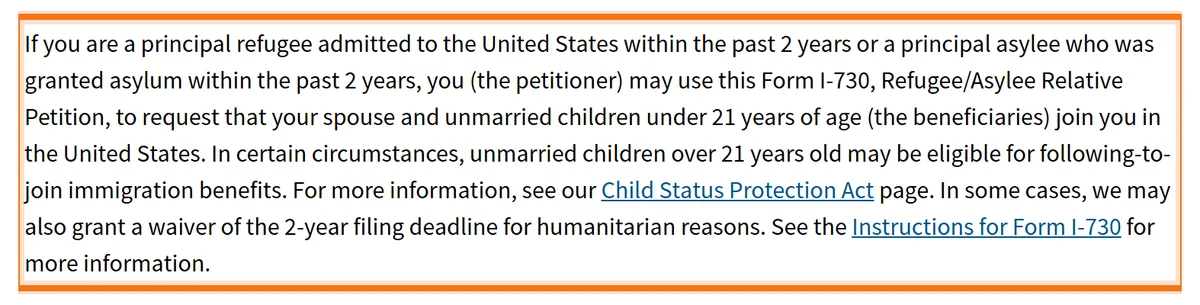
Once you are granted asylum as the principal applicant, Form I-730 lets your spouse and unmarried children under 21 join you or receive asylee status. It covers family abroad and family in the U.S. who were not included in your application. The rules from the regulation and the form instructions:
- One petition per person, each with a photo of that family member and proof of the relationship and of your asylee status.
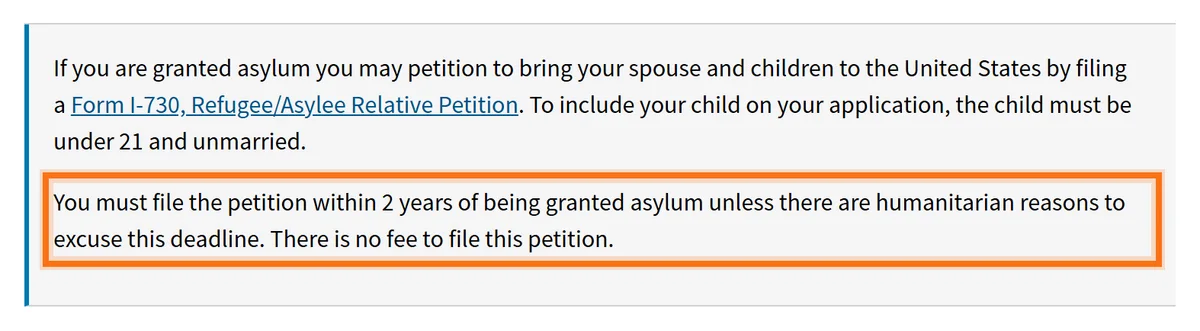
- File within two years of your grant. USCIS can extend this for humanitarian reasons, but you have to explain why you could not file on time.
- No USCIS fee. The fee schedule dated October 26, 2026 lists $0 for Form I-730.
- Only the principal can file. A person who received asylum as a derivative cannot file an I-730 for their own spouse or children.
- No appeal. If USCIS finds a family member ineligible, the regulation says no appeal lies from that decision.
What happens next depends on where the family member is. USCIS first reviews the petition in the U.S. Then a family member in the U.S. is interviewed at a USCIS field office; one abroad is interviewed at a USCIS international office, or, where USCIS has none, at a U.S. embassy or consulate through the State Department. An approval does not guarantee travel: the consulate still decides whether the person can come. The approval stays valid while the relationship lasts and, for a child, while the child is under 21 and unmarried, but it is used up once the person is admitted.
Family who arrive or are granted as derivatives can work as asylees. One year after the grant, each derivative files a separate Form I-485 for a green card. Our overview of the asylum process in Dallas covers that step.
Each family member, where they are, and the deadline
| Family member / where they are | How to include them | Deadline |
|---|---|---|
| Spouse in the U.S., married before the decision | Include on your I-589 (Part A.II), with the marriage certificate and passport and I-94 copies | Any time until the final decision on your case |
| Unmarried child under 21 in the U.S. | Include on your I-589 with the birth certificate | Before the decision and before the child turns 21; age frozen on the date USCIS received your I-589 |
| Child 21 or older, or married, in the U.S. | Their own I-589 as a principal | Their own one-year deadline from their arrival, unless an exception applies |
| Spouse or child in the U.S. who was left off | Form I-730, one per person, after your grant | Within 2 years of the grant (humanitarian extension possible) |
| Spouse or child abroad | Form I-730, then an interview abroad | Within 2 years of the grant (humanitarian extension possible) |
| Spouse married after the grant | Not eligible as a derivative or through I-730 | Another route, such as a family petition later |
| Anyone, if you receive withholding or CAT instead of asylum | No derivative protection; each person applies separately | Their own case and their own court deadlines |
How to read this table: start with where each person is today and whether you have been granted yet. Before a grant, the tool is your I-589; after a grant, it is Form I-730. The rows that need action now are the ones with a clock: a child close to 21 who is not yet listed, and an I-730 deadline counting from the grant date.
How Atlas Immigration Law helps
Getting the family part of an asylum case right means checking each person: who is listed and who is included, whose age or marriage changes the answer, who is in immigration court, and who should have a claim of their own. Our asylum services cover affirmative asylum with USCIS, defensive asylum before an immigration judge, withholding of removal and Convention Against Torture protection. If you already have a grant and family abroad, we can review your situation and the I-730 deadline in a consultation.
The firm is led by founder and managing attorney Jordan Weinberg, licensed in Texas and a member of AILA and the Dallas Bar Association. You get a free 20-minute consultation, a flat fee quoted in writing and billed by milestone, a dedicated paralegal reachable by call, email or text, same-business-day responses, and a client portal for secure document uploads. Our office is at 1920 McKinney Ave in Dallas, and we work with clients in all 50 states. Call (945) 219-5599.
Frequently asked questions
Who can help me include my spouse and children in my asylum case?
An immigration lawyer who handles asylum can list and include your spouse and unmarried children under 21 on your Form I-589, decide whether anyone should also file their own application, and track the Form I-730 deadline for family abroad. In Dallas, Atlas Immigration Law represents asylum applicants and reviews family situations in a free 20-minute consultation.
Can I add my spouse or child after I already filed for asylum?
Yes, if they are in the United States. USCIS says you can include a spouse and unmarried children under 21 at the time you file or at any time until a final decision is made on your application.
What happens if my child turns 21 while the asylum case is pending?
The child generally stays a child. For derivative asylees, USCIS uses the child’s age on the date it received your Form I-589. The child must have been listed before turning 21 and before the decision, and must stay unmarried.
How long do I have to file Form I-730 for family abroad?
Two years from the date you were granted asylum, with one petition for each family member. USCIS can extend the deadline for humanitarian reasons. The fee schedule dated October 26, 2026 lists no fee for Form I-730.
I married after I was granted asylum. Can I file an I-730 for my spouse?
No. The marriage must have existed on the date asylum was granted. A spouse married after the grant needs another route, such as a family petition once you are a permanent resident or citizen.
Does withholding of removal protect my spouse and children?
No. The Form I-589 instructions say withholding of removal does not pass to a spouse or child; each of them has to apply on their own. Withholding also gives no right to bring relatives to the United States.
Do my spouse and children have to come to the asylum interview?
For an affirmative interview with USCIS, yes for the spouse and children under 21 you included as derivatives, with their identity documents. Family members you only listed, but did not include, do not need to come.
This guide is part of our asylum and removal defense services — the service page covers eligibility, fees, and how we handle these cases.

Founder & Managing Attorney, Atlas Immigration Law
Member of the American Immigration Lawyers Association (AILA) and the Dallas Bar Association. Licensed to practice in Texas; fluent in English and Spanish.
Legally reviewed by a licensed immigration attorney
Talk to an immigration attorney about your case
Free consultation on request, flat fees, and a dedicated paralegal who knows your case — serving clients in all 50 states.
This guide is general information, not legal advice, and reading it does not create an attorney-client relationship. Immigration law and procedures change, and how they apply depends on your specific facts — consult a licensed immigration attorney about your situation.