
In immigration court, prosecutorial discretion belongs to the government’s lawyers: ICE’s Office of the Principal Legal Advisor (OPLA). Only they can move to dismiss a case for that reason. You, usually through a lawyer, can ask them in writing, and the immigration judge then rules on any motion. Either side can also ask the judge to close or pause the case. In Dallas, Atlas Immigration Law prepares these requests as part of removal defense.
Key takeaways
ICE’s lawyers decide whether to offer discretion; the judge decides the motion that follows. The written enforcement priorities behind the 2022 OPLA guidance were revoked in January 2025, so ask what ICE’s current practice is before relying on old rules. A judge can administratively close a case or terminate it on a motion, and must generally grant a joint or unopposed motion. A dismissal ends the case without giving you status or a work permit, and it can end a defense you could only raise in court. A request is never a substitute for preparing your defense.
What prosecutorial discretion means in immigration court
Every removal case has two sides. You are the respondent. The Department of Homeland Security is the other party, and in court it is represented by ICE’s Office of the Principal Legal Advisor. ICE describes OPLA as the exclusive representative of DHS in removal proceedings before the immigration courts.
Like any prosecutor, those lawyers can decide not to push a case as hard as the law allows. In practice, prosecutorial discretion in court can mean:
- Moving to dismiss the case, which ends it without a removal order.
- Agreeing to, or not opposing, your motion to administratively close or terminate the case.
- Not opposing a continuance, so you can wait for USCIS to decide a petition.
- Agreeing to facts or issues that narrow what has to be proven at trial.
None of these is a right. ICE can say no without giving reasons, and no form or fee guarantees an answer. That is why discretion works best as one track of a defense, next to the relief you can win on the law, such as asylum or cancellation of removal.
Who decides: ICE’s lawyers or the immigration judge?
Both, at different steps. ICE decides whether to file or support a motion. The judge decides whether to grant it. Even a motion from ICE to dismiss is not automatic: the regulation says the judge may enter a dismissal when DHS moves for one. The rules below come from the Code of Federal Regulations as in effect in November 2026.
| Option | Who can ask | What it does | Rule |
|---|---|---|---|
| Dismissal | Only ICE (DHS counsel), on grounds such as a notice issued improvidently or changed circumstances that make the case no longer in the government’s interest | Ends the case without prejudice: DHS can start a new one later | 8 CFR 1239.2(c), 239.2(a) |
| Termination by agreement | Either side, with the other side joining or saying it does not oppose | Ends the case; the judge must grant it unless there are unusual, clearly stated reasons not to | 8 CFR 1003.18(d)(1)(i)(G) |
| Termination over objection | Either side, in listed situations, such as prima facie eligibility for status with the filing made at USCIS, or a grant of TPS or deferred action | Ends the case; not for purely humanitarian reasons unless DHS consents | 8 CFR 1003.18(d)(1)(ii) |
| Administrative closure | Either side, by motion | Takes the case off the active calendar until someone moves to put it back | 8 CFR 1003.18(c) |
| Continuance | Either side, by motion | Postpones a hearing for good cause | 8 CFR 1003.29 |
| The same tools on appeal | Either side, at the Board of Immigration Appeals | Closure or termination while an appeal is pending | 8 CFR 1003.1(l), (m) |
How to read this table: only the first row is ICE’s alone. Every other row is a motion you can file yourself, but your odds change sharply when ICE joins it or says it does not object. A judge "shall grant" a joint or unopposed motion to close or terminate unless the judge gives unusual, clearly identified and supported reasons. That is why a request to ICE often asks for its agreement to a motion, not just for a dismissal.
Where ICE’s discretion policy stands in late 2026
Much of what you read online about prosecutorial discretion describes rules that are gone. Here is what the official record shows, as we read it on November 13, 2026:
- April 3, 2022: then-Principal Legal Advisor Kerry Doyle issued guidance to OPLA attorneys on enforcement and prosecutorial discretion, built on the DHS enforcement priorities of September 30, 2021. The memo is still posted in ICE’s document library.
- January 20, 2025: Executive Order 14159 revoked Executive Order 13993, the order behind those enforcement priorities.
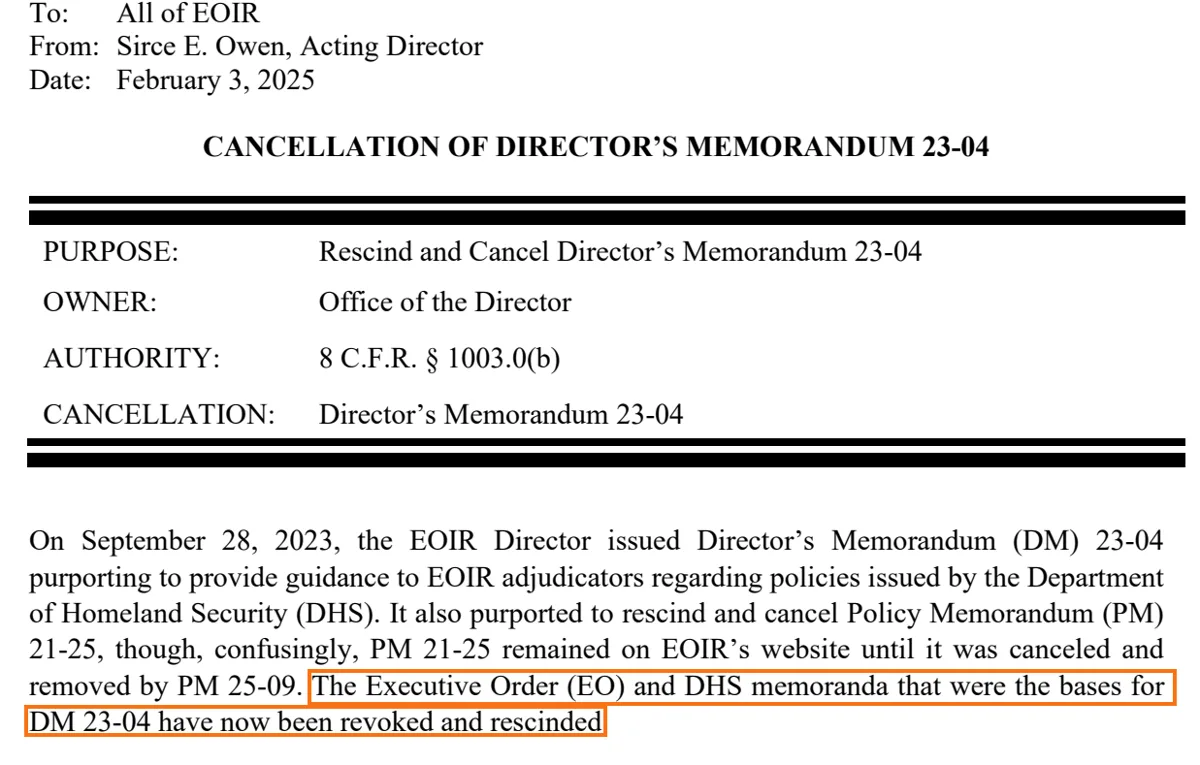
- January 29 and February 3, 2025: the immigration court system cancelled its own guidance on DHS priorities (PM 25-09 and PM 25-16), noting that the Executive Order and DHS memos behind it had been revoked and rescinded.
- November 2026: ICE’s old prosecutorial discretion web address now forwards to the general OPLA page, which does not describe how to request discretion.
Treat old guidance as history
We could not find an official ICE page that states the current status of the 2022 OPLA guidance or a current request process. ICE policy has changed and can change again without notice. Anyone who tells you a specific memo or category guarantees a dismissal should show you where ICE says so today.
What has not changed is the law. The regulations that let DHS move to dismiss, and that let a judge close or terminate a case, are in force, and ICE’s lawyers still have discretion in each case they handle. What is gone is a published list of who should get it. Requests are now judged case by case by the lawyers handling them.
How a request reaches ICE today
A request goes to the OPLA office that represents DHS in your case. For people whose cases are at the Dallas Immigration Court, that is the OPLA office for that court. A request is usually a letter or a proposed motion with evidence, asking ICE to move to dismiss, or to join or not oppose your motion to close or terminate.
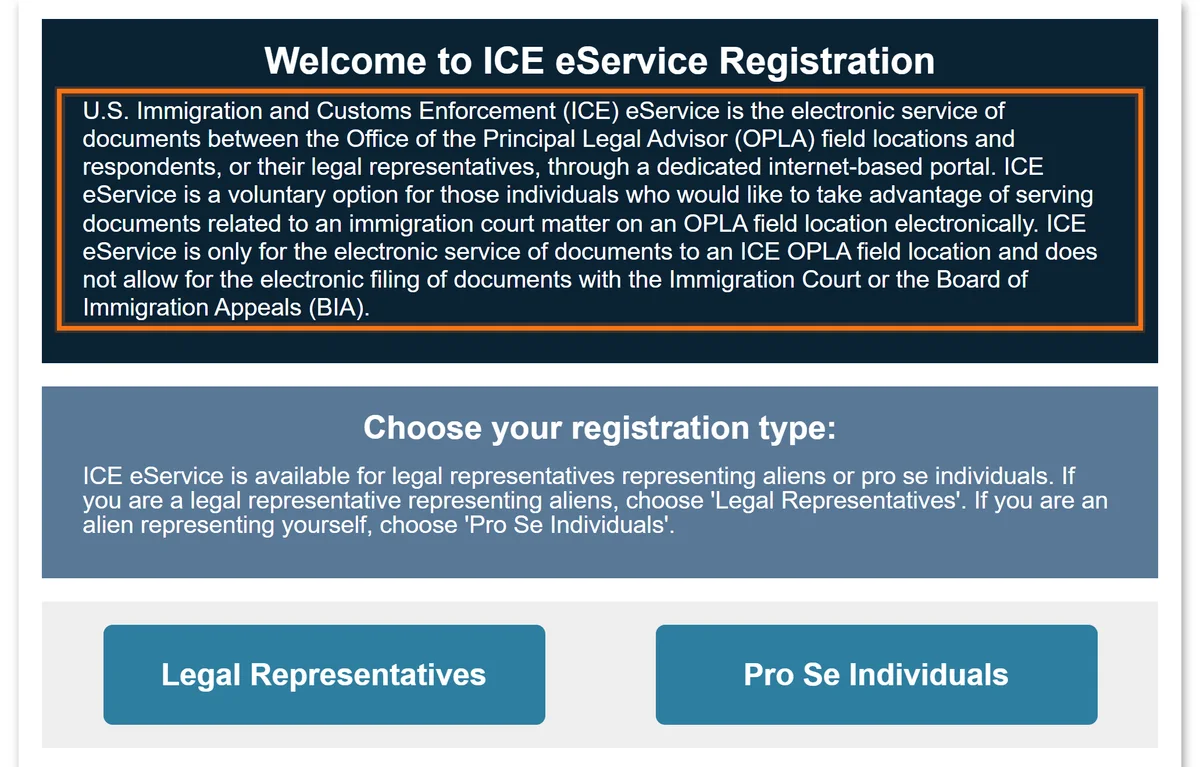
Documents can be served on OPLA electronically through ICE eService, a portal for respondents and their lawyers. It is only for sending documents to ICE’s lawyers. It does not file anything with the immigration court, so any motion still has to be filed with the court separately.
Timing matters. A request is easier to consider well before a merits hearing than in the week before trial, and asking does not move any court deadline. Keep every filing date the judge set, and keep your address current with the court on Form EOIR-33, as our guide to deportation defense in Dallas explains.
What evidence helps a request
There is no official checklist for 2026. The best guide to what a judge weighs is the rule on administrative closure, which lists the reason for the request, the basis for any opposition, the likelihood of success on a petition pending outside court, how long the closure would last, the likely final outcome, and detention status. A strong package answers those points with documents:
| Evidence | Why it matters |
|---|---|
| A pending or approved petition with USCIS (family petition, U visa, VAWA, special immigrant juvenile) | Shows the case can end in status outside court, a factor the closure and termination rules name directly |
| Proof of status already granted, such as TPS or deferred action | A listed ground for discretionary termination under 8 CFR 1003.18(d)(1)(ii)(C) |
| Years in the U.S., work and tax records, a home address | Shows ties and stability, and answers any concern about flight |
| U.S. citizen or permanent resident spouse, children or parents | Shows who would be harmed by removal |
| Court records showing no criminal history, or the final outcome of any arrest | A record is the first thing a government lawyer checks |
| Medical records, caregiving duties, military service, community letters | Humanitarian facts that support discretion, though alone they rarely end a case |
How to read this table: the first two rows carry the most weight, because they give the judge a legal reason to close or end the case, not just a sympathetic one. The judge cannot terminate a case for purely humanitarian reasons unless DHS consents. Humanitarian facts help persuade ICE to consent; they rarely work on their own.
One example is written into the regulations. When a person in removal proceedings files a U visa petition with USCIS, ICE counsel may agree, as a matter of discretion, to a joint motion to terminate the case while USCIS decides it. Our guide to the U visa in Dallas covers that petition, and our guide to U visa certification covers the police or prosecutor signature it needs.
Is your case one ICE might agree to close?
Bring your Notice to Appear, your hearing dates and anything pending with USCIS to a free 20-minute consultation. We will tell you whether a discretion request, a motion to the judge, or a full defense fits your facts, and what each one risks.
The risks of a dismissal or closure
A dismissal feels like a win, and sometimes it is. But it is not a status. Before asking for one, weigh what you lose:
- No status and no work permit. A dismissed case gives you no visa, green card or work permit. If you were undocumented before the case, you are undocumented after it.
- A pending application in court ends with the case. An asylum application or other relief before the judge is not decided. If your work permit depends on that pending application, it can be affected too.
- Some defenses exist only in court. Cancellation of removal is decided by an immigration judge. Once the case is dismissed, you cannot ask for it unless a new case is started.
- It is without prejudice. DHS can file a new Notice to Appear later, under whatever policy applies then.
- Administrative closure is temporary. Either side can move to put the case back on the calendar, and the judge weighs factors such as the time that has passed.
Travel is a separate danger. Leaving the U.S. after a dismissal or while a case is closed can have serious consequences for people without status, including bars on returning. Do not plan a trip without advice on your own history.
If ICE moves to dismiss and you do not want it
Sometimes the government moves to dismiss a case the respondent wants to keep, for example to pursue asylum or cancellation before the judge. Because the judge "may" grant the motion, you can respond to it. Talk to a lawyer the day you receive the motion, because the answer depends on what relief you are pursuing and what happens next in your case.
Prosecutorial discretion at the Dallas Immigration Court
For people living around Dallas who are not detained, cases are heard at the Dallas Immigration Court, 1100 Commerce Street, Suite 1060, in the Earle Cabell Federal Building downtown. ICE’s lawyers in that courtroom are the ones who receive a request in a Dallas case, and the Dallas immigration judges rule on the motions that follow. Detained cases move faster and leave less time for a request.
Check the court’s own Dallas Immigration Court page for current hours and contact details. If you have missed a hearing and received an order in your absence, a discretion request is the wrong tool; our guide to motions to reopen explains the deadlines that apply.
Should you ask for discretion, or fight the case?
Often both. The safest plan prepares the defense on the merits while the request is pending, because a request can be ignored or refused late in the case. A rough guide:
- Ask, and prepare anyway, when you have a strong petition pending with USCIS, a clean record and long ties.
- Think twice before asking for dismissal when your best path is relief only a judge can grant, such as cancellation of removal or asylum in immigration court. Closure may fit better than dismissal.
- Look at other tools first when a deadline is close: a continuance for good cause, or a motion to close the case while USCIS acts.
- Get advice before agreeing to any stipulation, because what you admit can follow you into a later case.
The right choice depends on your facts, your history and what is pending outside court. No lawyer can promise how ICE or a judge will respond.
How Atlas Immigration Law helps
We handle immigration court cases at the Dallas Immigration Court and, because immigration courts are federal, nationwide. In a removal case we test the charges, screen your history against every form of relief, and decide with you whether a request to ICE, a motion to the judge, or a full defense on the merits fits best. When a request makes sense, we build the evidence package, serve it on ICE’s lawyers, and file any motion with the court, while keeping the defense on schedule. Our deportation defense attorney page explains the full service.
The firm is led by founder and managing attorney Jordan Weinberg, licensed in Texas and a member of AILA and the Dallas Bar Association. You get a free 20-minute consultation, a flat fee quoted in writing and billed by milestone, a dedicated paralegal reachable by call, email or text, same-business-day responses, and a client portal for your documents. Our office is at 1920 McKinney Ave in Dallas, and we work with clients in all 50 states. Call (945) 219-5599.
Frequently asked questions
Who can ask the immigration court for prosecutorial discretion or dismissal of my case?
Only ICE’s lawyers, the Office of the Principal Legal Advisor, can move to dismiss a removal case as an exercise of prosecutorial discretion. You or your lawyer can ask them in writing to do so, or to join or not oppose your own motion to close or terminate the case. The immigration judge then decides the motion.
Can an immigration judge dismiss my case without ICE agreeing?
A dismissal under 8 CFR 1239.2(c) needs a motion from ICE. But a judge can terminate a case over ICE’s objection in listed situations, such as when you are prima facie eligible for status and have filed with USCIS, or when you have TPS or deferred action. A judge cannot terminate for purely humanitarian reasons unless DHS consents.
Is the Doyle memo still in effect in 2026?
We could not find an official ICE statement of its current status. The enforcement priorities it was built on were revoked in January 2025, and the immigration court system cancelled its related guidance in February 2025. Treat it as history and check ICE’s current practice before relying on it.
What is administrative closure?
Administrative closure is a temporary suspension of a case. It takes the case off the judge’s active calendar until either side moves to put it back. A judge must generally grant a joint or unopposed motion to close; otherwise the judge weighs factors such as the reason, any pending petition and the likely outcome.
Will I get a work permit if ICE dismisses my case?
No. A dismissal ends the court case but gives no status or work permit. If your work permit depended on an application pending in court, the dismissal can affect it. Any benefit has to come from a separate petition or application.
Can ICE bring the case back after a dismissal?
Yes. A dismissal under the regulations is without prejudice, so DHS can file a new Notice to Appear later. An administratively closed case can also be put back on the calendar on either side’s motion.
Should I stop preparing my defense while a request is pending?
No. Asking ICE does not move any court deadline, and filings made late can be treated as waived. Keep preparing the relief you can win on the law while the request is considered.
This guide is part of our asylum and removal defense services — the service page covers eligibility, fees, and how we handle these cases.

Founder & Managing Attorney, Atlas Immigration Law
Member of the American Immigration Lawyers Association (AILA) and the Dallas Bar Association. Licensed to practice in Texas; fluent in English and Spanish.
Legally reviewed by a licensed immigration attorney
Talk to an immigration attorney about your case
Free consultation on request, flat fees, and a dedicated paralegal who knows your case — serving clients in all 50 states.
This guide is general information, not legal advice, and reading it does not create an attorney-client relationship. Immigration law and procedures change, and how they apply depends on your specific facts — consult a licensed immigration attorney about your situation.