A U visa petition cannot go forward without Form I-918 Supplement B, a certification signed by an official of an agency that detected, investigated, prosecuted or sentenced the crime. In Dallas that is usually the police department that took the report, the Dallas County District Attorney’s Office, or a judge. You can ask yourself, or a U visa lawyer can ask for you. No agency is required to sign. Atlas Immigration Law prepares these requests.
Key takeaways
Supplement B is required for a U visa; USCIS says it cannot process a case without it. Police, sheriffs, prosecutors, judges and some other agencies, such as protective services and labor agencies, can certify. A signature is valid for six months, so file the petition within six months of the date it was signed. USCIS charges $0 for the I-918 and Supplement B. An agency can sign even with no arrest, charges or conviction, but federal law does not make it sign.
What Supplement B is, and why the U visa needs it
The U visa is for victims of certain serious crimes who suffered substantial physical or mental abuse and help law enforcement. You file Form I-918 with USCIS. Supplement B is the part a government official fills out. It tells USCIS, from the agency’s own records, that you were the victim of a qualifying crime and that you have been, are being, or are likely to be helpful.
It is not optional. The regulation lists a signed Supplement B as required initial evidence, and USCIS’s instructions say that without one the petitioner is not eligible for U status. It also matters long before a final decision: USCIS gives a work permit and deferred action through its bona fide determination only to petitions that include a properly completed Supplement B.
The certification is not the visa. USCIS alone decides the petition, runs background checks, and looks at the rest of your evidence, including your own statement and proof of harm. Our U visa guide for Dallas covers the whole petition; this guide covers the signature.
Who can sign a U visa certification
A certifying agency is any federal, state, local, tribal or territorial agency, prosecutor, judge or other authority responsible for detecting, investigating or prosecuting the crime, or for convicting or sentencing the person who did it. Inside an agency, the certifying official is the head of the agency or a supervisor the head has designated to sign. Judges sign directly and cannot hand that authority to anyone else.
| Type of certifier | Examples | When it fits |
|---|---|---|
| Police or sheriff | The city police department that took the report, such as the Dallas Police Department, or a county sheriff’s office | You reported the crime and answered officers’ or detectives’ questions |
| Prosecutor | The Dallas County District Attorney’s Office, a city attorney, or a U.S. Attorney’s Office | Charges were filed or reviewed, or you worked with a prosecutor or victim advocate |
| Judge | A criminal court judge, or a judge who saw the crime come up in a case they presided over, civil or criminal | The case reached court, for example a prosecution or a protective order hearing |
| Protective services | Child or adult protective services | The agency investigated abuse of a child or a vulnerable adult |
| Labor and civil rights agencies | The Equal Employment Opportunity Commission, the U.S. Department of Labor, a state labor agency | The crime happened at work, for example involuntary servitude or workplace sexual assault |
How to read this table: you can ask more than one agency, as long as each one actually had a role in your case. The agency with the fullest record of your cooperation is usually the best first request. A police department that took a one-page report knows less than a prosecutor’s office that worked with you through a trial.
What the certifier is asked to confirm
By signing, the official confirms facts from the agency’s records, chiefly two things: that you are a victim of a qualifying crime, and that you have been, are being, or are likely to be helpful in its detection, investigation, prosecution, conviction or sentencing. The form also asks for the crimes, their dates and statute citations, what information you have, how you helped, whether you ever refused a reasonable request for help, and whether any family member took part in the crime. USCIS gives a properly signed Supplement B significant weight, but not the last word.
- No arrest or conviction is needed. USCIS tells certifiers they can sign even if there was no arrest, no charges, no formal investigation, no prosecution or no conviction, or if the case is closed.
- Old crimes can qualify. There is no federal statute of limitations on when the crime happened, as long as you worked with the agency.
- "Likely to be helpful" counts. A victim who has reported and stands ready to help can qualify before a case is complete.
- Children and incapacitated victims. For a victim under 16, or one who is incapacitated or incompetent, a parent, guardian or next friend can provide the help instead.
Helpfulness continues after the signature. The agency can withdraw a certification if you later refuse a reasonable request for help, and USCIS can then revoke a work permit granted through the bona fide determination.
The six-month rule and the $0 fee
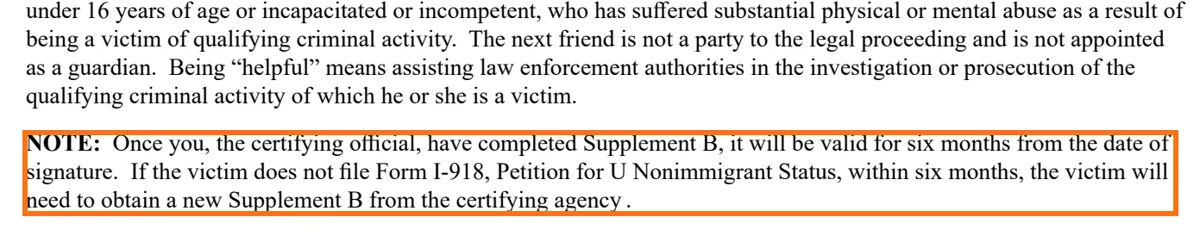
A signed Supplement B is good for six months from the date of signature. USCIS must receive your I-918 within that window. If it arrives later, the certification has expired, and you have to go back to the agency for a new one. That is why the rest of the petition, your statement, the evidence of harm and any waiver, should be nearly finished before the signed form comes back.
There is no USCIS fee. The fee schedule dated October 26, 2026 lists $0 for Form I-918, $0 for Supplement A (family members) and $0 for Supplement B. USCIS also charges no fee for the first work permit application tied to a bona fide determination. Agencies do not charge a USCIS fee to sign either; if anyone asks you to pay a "filing fee" for Supplement B, ask them where it comes from.
How to request a certification in Dallas
Each agency sets its own process. Start by finding the case number, the name of the detective or prosecutor if you know it, and every date you met or spoke with them.
Dallas County District Attorney’s Office
The DA’s Office publishes a written U visa certification policy and a request form, in English and Spanish, on its Victim Services page. The form is emailed to the office and asks for the victim’s details, the case number, the charge, the defendant, the date of the crime, and the attorney’s contact and mailing address.
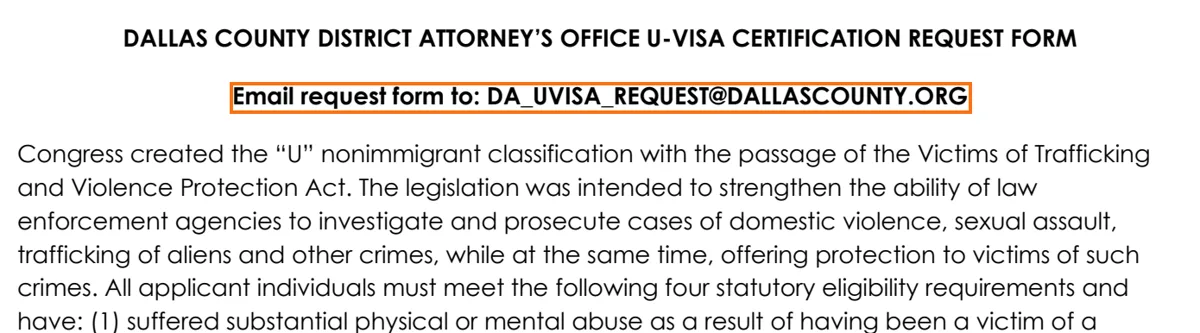
Under that policy, the office certifies when its records, case files, and prosecutor and advocate notes confirm that you have helped, are helping, or are likely to help. It counts as helpful things like staying in touch with its advocates and prosecutors, giving information, adding to police reports or statements, and testifying when reasonably asked. It decides case by case, may withdraw a certification if a victim stops cooperating, and certifies only once per eligible victim. Read the current policy on the DA’s Victim Services page before you send a request.
Dallas Police Department and other police agencies
We could not find a current U visa certification procedure published on an official Dallas Police Department page. Ask the department directly who reviews U visa certification requests and how it wants to receive them, and do the same with suburban police or sheriff’s offices. Under the federal rule, the head of an agency can designate a supervisor to sign, so the person who took your report may not be the one who decides.
What a strong request includes
- A short cover letter naming the case number, the offense and the qualifying crime it falls under.
- A summary of every step you took to help: the report, interviews, line-ups, court dates, calls with an advocate.
- Copies of the police report and any court records you have.
- The Supplement B form, with the victim information completed, for the official to review and finish.
- A mailing address for the signed original, since USCIS does not accept a photocopied signature page.
Need a police or DA certification for your U visa?
Tell us which agency handled the crime and how you helped. In a free, confidential 20-minute consultation we will tell you which certifier to ask first and what your request should include.
If the agency refuses, or does not answer
A refusal is not a USCIS decision, and USCIS cannot order an agency to sign. But a first "no" or silence is not always the end:
- Ask what was missing. Many refusals come from an agency that could not match the request to its records. A clearer request with the case number and dates may get a different answer.
- Ask another certifier with a real role. If the police department says no, the prosecutor who handled the case, or the judge who heard it, may sign. Protective services or a labor agency may fit when they investigated.
- Follow up in writing. Keep copies and dates of every request and reply. They help if you later need to show your efforts.
- Check whether the agency’s policy offers a review. Some agencies have one. The federal rules do not create an appeal.
- Look at other paths. Abuse by a citizen or permanent-resident spouse or parent may fit the VAWA self-petition, which needs no certification. Trafficking victims should be screened for the T visa.
Keep the timing in mind. If you are in removal proceedings, you still file the U petition with USCIS, and ICE’s lawyers may agree, as a matter of discretion, to a joint motion to end the court case while USCIS decides it. Our guide to prosecutorial discretion in immigration court explains how those requests work.
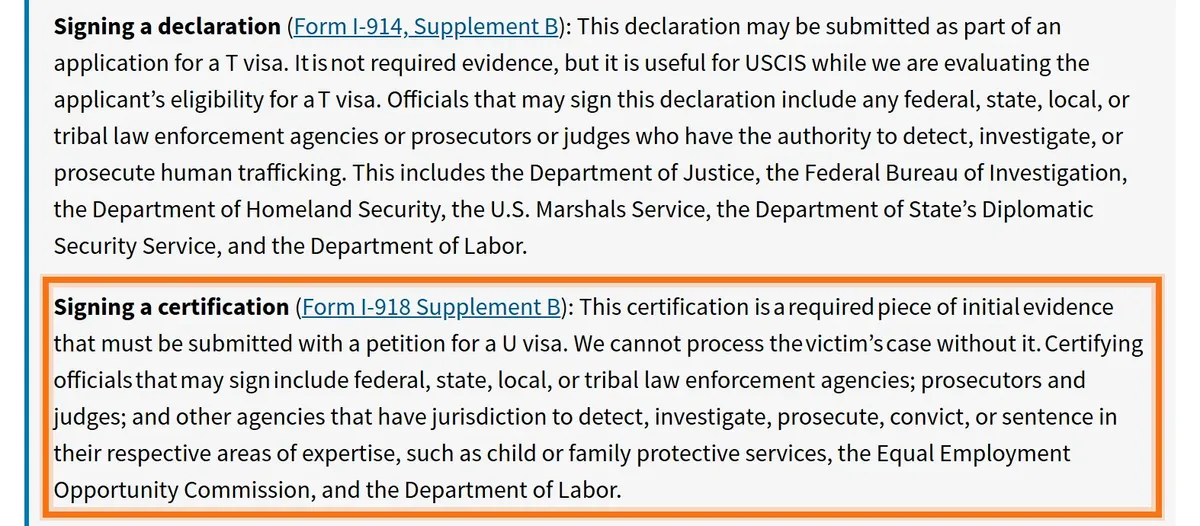
U visa certification vs. the T visa declaration
Both crime victims and trafficking victims can ask law enforcement for a form called Supplement B, which causes confusion. They are different forms with different weight:
| Question | U visa (Form I-918 Supplement B) | T visa (Form I-914 Supplement B) |
|---|---|---|
| Required? | Yes. USCIS cannot process the petition without it | No. Useful evidence, but not required |
| What it is called | Certification | Declaration |
| What the official confirms | Victim of a qualifying crime, and helpful | Complied with reasonable requests for help with the trafficking case |
| USCIS fee (October 26, 2026 schedule) | $0 | $0 |
| If no agency will sign | The U petition cannot succeed | You can prove cooperation with other evidence |
How to read this table: if an agency will not sign and the facts involve forced labor or commercial sex, the T visa may still be open, because its declaration is optional. Our T visa guide explains who qualifies.
After the signature: the bona fide review and the wait
Once the petition is filed with the signed Supplement B, your statement and biometrics, USCIS first reviews whether it is bona fide. If it is, and you are in the United States, USCIS can grant a work permit and deferred action, valid for four years and renewable while you wait. If not, USCIS considers you for its waiting list, which can also bring a work permit and deferred action.
Only 10,000 principal U visas can be granted each fiscal year. USCIS reported that it reached the fiscal year 2026 cap on September 5, 2026, and that when the new year began on October 1, 2026, it resumed approvals starting with petitions filed on or before August 31, 2017. Check current processing times for the bona fide review, and keep your address current with USCIS throughout.
How Atlas Immigration Law helps
Any immigration lawyer who represents you can request a certification for you, and so can you. What a lawyer adds is the work around the request: matching the crime to a qualifying category, choosing the right certifier, presenting your cooperation clearly, timing the signature so the six-month window is not wasted, and filing the full I-918 with your statement, evidence of harm and any waiver. Our U visa services page describes the representation we provide, with compassionate, confidential handling.
The firm is led by founder and managing attorney Jordan Weinberg, licensed in Texas and a member of AILA and the Dallas Bar Association. You get a free 20-minute consultation, a flat fee quoted in writing and billed by milestone, a dedicated paralegal reachable by call, email or text, same-business-day responses, and a client portal for secure uploads during a long wait. Our office is at 1920 McKinney Ave in Dallas, and we work with clients in all 50 states. Call (945) 219-5599.
Frequently asked questions
Which attorney can request the law enforcement certification for my U visa case?
Any immigration attorney who represents you can request Form I-918 Supplement B from the police, prosecutor, judge or other agency that handled the crime, and you can also ask on your own. In Dallas, Atlas Immigration Law prepares certification requests as part of its U visa cases. The agency decides whether to sign.
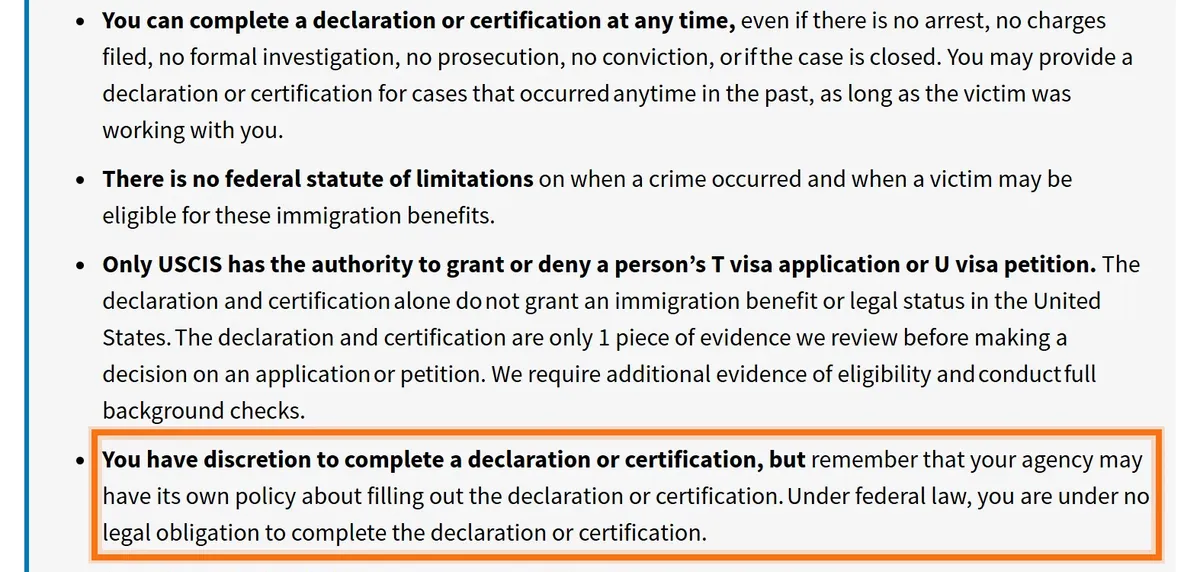
Is the police department required to sign Supplement B?
No. USCIS tells certifying agencies that, under federal law, they are under no legal obligation to complete the certification, and that their agency may have its own policy. Without a signed Supplement B, though, a U visa petition cannot be approved.
How long is a signed U visa certification valid?
Six months from the date the official signs it. USCIS must receive your Form I-918 within that time. If it arrives later, the certification has expired and you need a new one from the agency.
Does Supplement B cost anything?
No USCIS fee applies. The fee schedule dated October 26, 2026 lists $0 for Form I-918, Supplement A and Supplement B. Attorney fees are separate.
Can I get a certification if nobody was arrested or the case was closed?
Yes, it is possible. USCIS tells certifiers they can sign even with no arrest, charges, prosecution or conviction, or after a case is closed, and there is no federal time limit on when the crime happened. The agency still decides whether to sign.
How do I ask the Dallas County District Attorney’s Office for a U visa certification?
The DA’s Office posts its U visa policy and a request form on its Victim Services page at dallascounty.org. The completed form is emailed to the address printed on it. The office certifies when its records confirm your cooperation and certifies only once per eligible victim.
Does a T visa need Supplement B too?
No. For the T visa, the law enforcement declaration on Form I-914 Supplement B is useful but not required evidence. For the U visa, Form I-918 Supplement B is required.
This guide is part of our humanitarian immigration services — the service page covers eligibility, fees, and how we handle these cases.
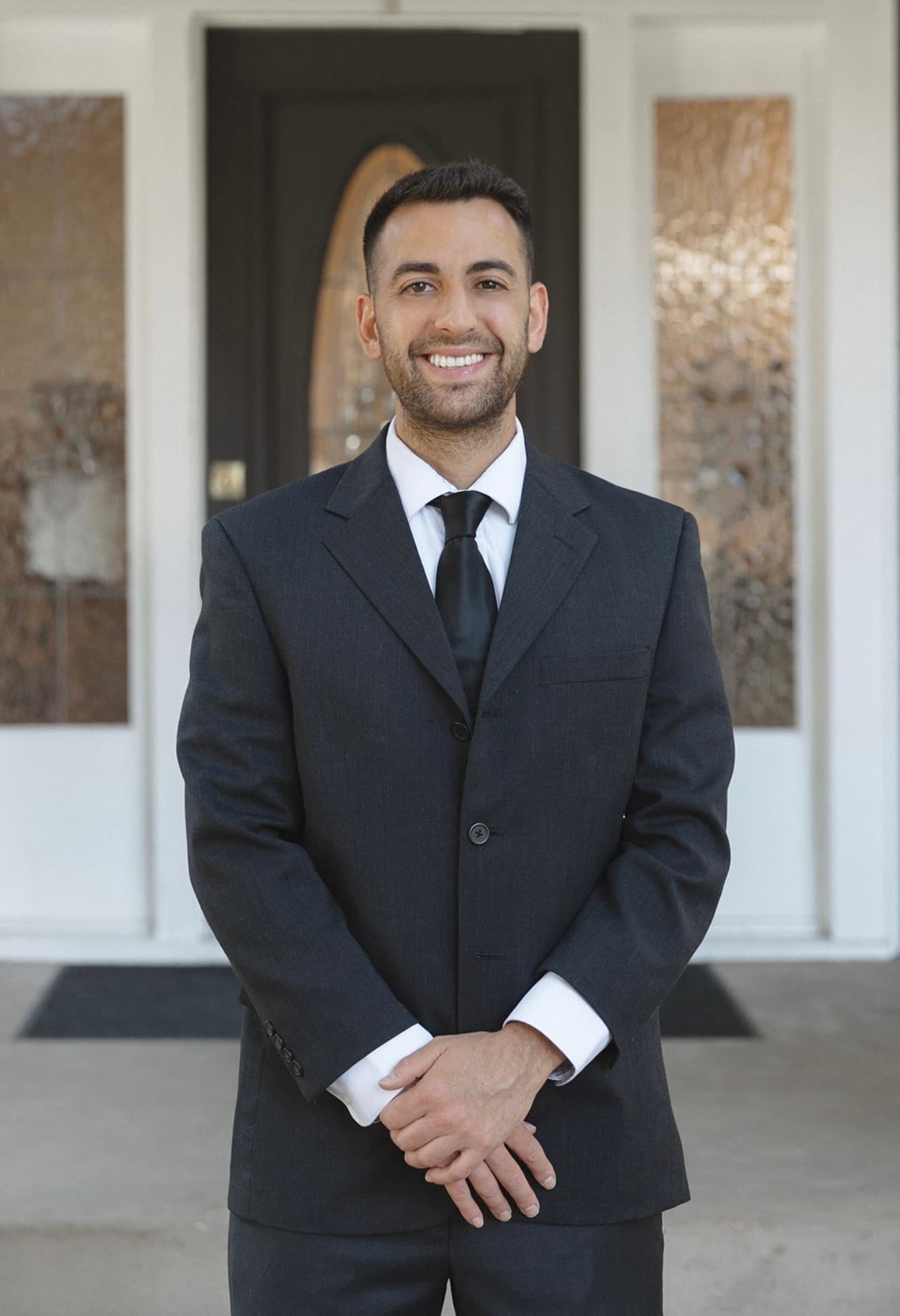
Founder & Managing Attorney, Atlas Immigration Law
Member of the American Immigration Lawyers Association (AILA) and the Dallas Bar Association. Licensed to practice in Texas; fluent in English and Spanish.
Legally reviewed by a licensed immigration attorney
Talk to an immigration attorney about your case
Free consultation on request, flat fees, and a dedicated paralegal who knows your case — serving clients in all 50 states.
This guide is general information, not legal advice, and reading it does not create an attorney-client relationship. Immigration law and procedures change, and how they apply depends on your specific facts — consult a licensed immigration attorney about your situation.