
To sponsor a relative for a green card, you sign Form I-864 and show household income of at least 125% of the federal poverty guidelines: $27,050 for a household of 2 in Texas in 2026. If your income, your household’s income, and your assets do not reach the line, you need a joint sponsor who meets it alone. This guide walks Dallas families through the numbers and the choices.
Key takeaways
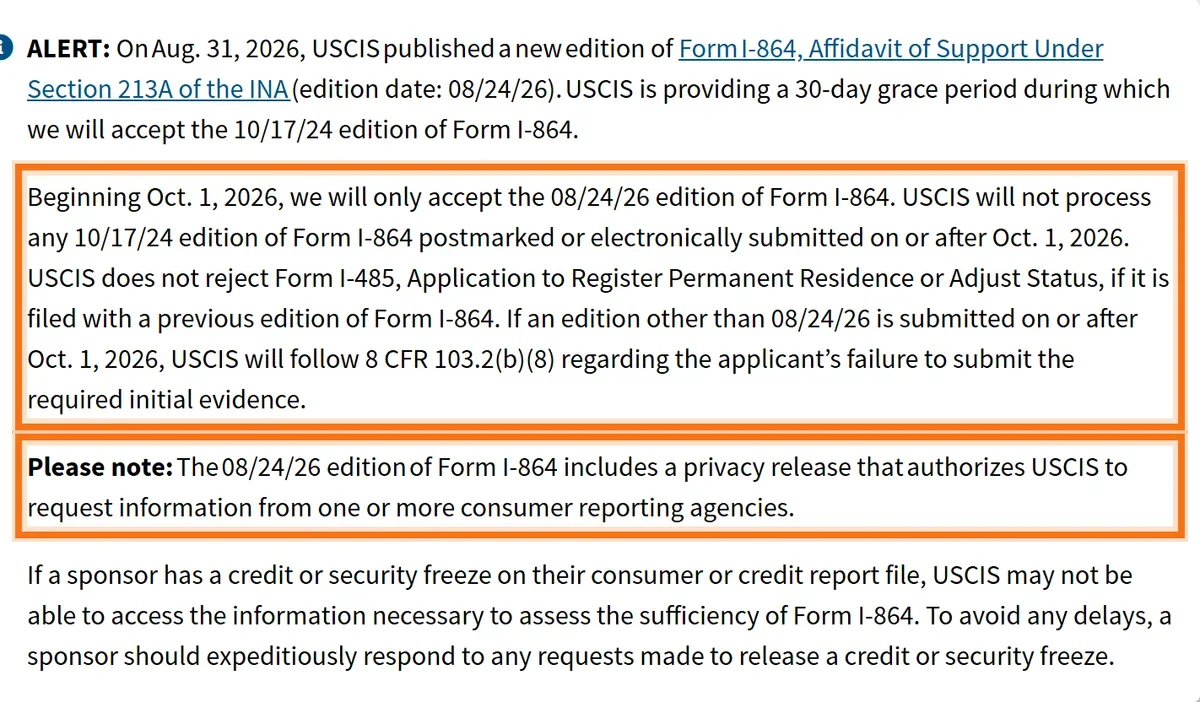
The petitioner always signs an I-864, even with no income. The 2026 line for most sponsors is $27,050 for a household of 2 and $41,250 for 4 (48 states, effective March 1, 2026). A joint sponsor cannot top up your income; they must reach 125% for their own household alone, and a family can have at most two. Since October 1, 2026, USCIS accepts only the 08/24/26 edition, which lets it check the sponsor’s credit report. The obligation survives divorce and usually lasts until the immigrant becomes a citizen or is credited with 40 quarters of work.
What Form I-864 is, and who has to file one
Form I-864, Affidavit of Support Under Section 213A of the INA, is a contract between the sponsor and the U.S. government. It exists so the immigrant is not refused as likely to become a public charge. USCIS charges no fee for it. The rules are in 8 CFR 213a.2 and on the USCIS Affidavit of Support page. These immigrants need one:
- Immediate relatives of U.S. citizens: spouses, unmarried children under 21, and parents.
- Family preference immigrants: adult and married children of citizens, spouses and unmarried children of permanent residents, and brothers and sisters of citizens.
- K-1 fiancés and K-2 children, at the green card stage after the wedding (not with the fiancé petition).
- Some employment-based immigrants, when a citizen or permanent resident relative filed the petition or owns 5% or more of the company that did.
The person who filed the I-130 must be a sponsor. That stays true if you are retired, a student, or between jobs: you file your own I-864 showing what you have, and a joint sponsor files a second one. A sponsor must be at least 18, a U.S. citizen or permanent resident, and domiciled in the United States. If you live abroad, you must prove the stay is temporary or that you will move back no later than your relative does.
How much income a Dallas sponsor needs in 2026
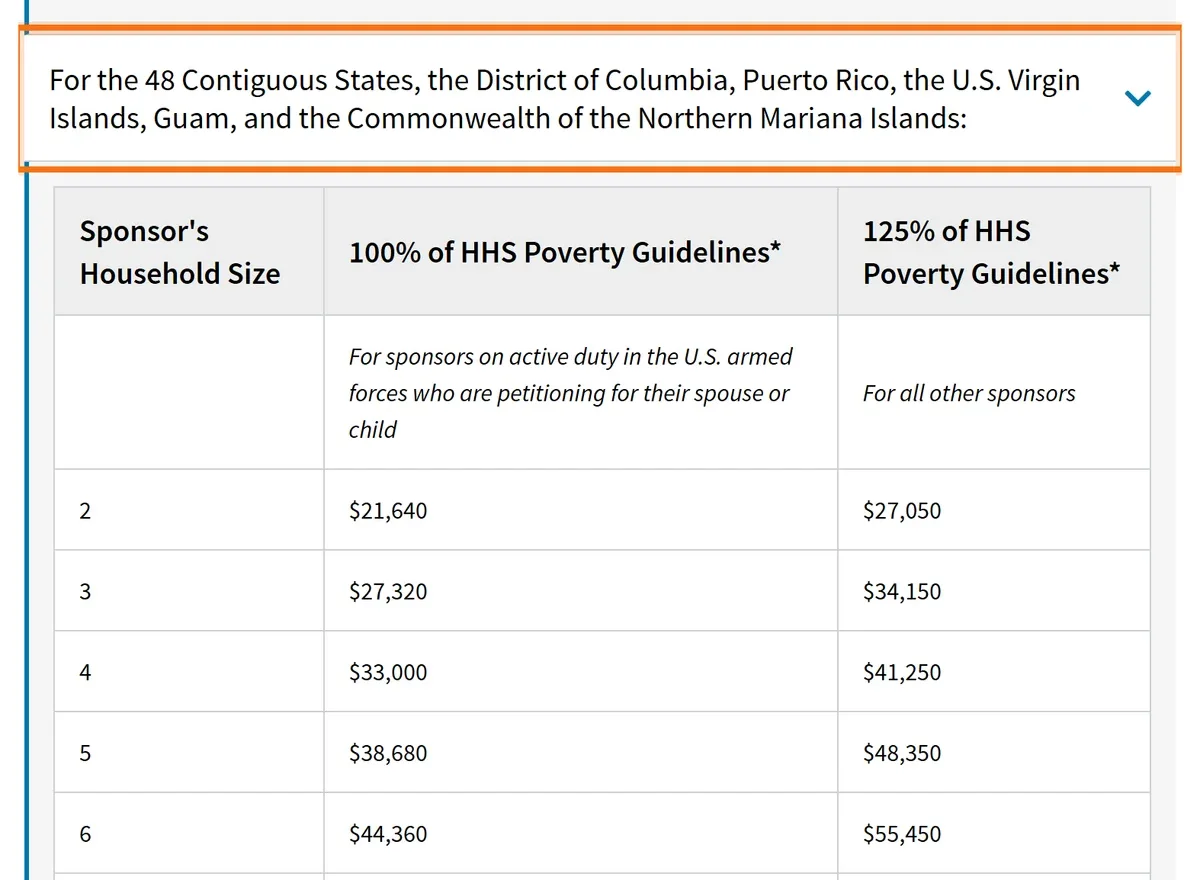
USCIS publishes the figures on Form I-864P. The current guidelines took effect on March 1, 2026 and stay in force until the next annual update. Texas uses the table for the 48 contiguous states; Alaska and Hawaii have higher lines. We read the page on November 12, 2026.
| Household size | 125% (most sponsors) | 100% (active-duty military sponsoring a spouse or child) |
|---|---|---|
| 2 | $27,050 | $21,640 |
| 3 | $34,150 | $27,320 |
| 4 | $41,250 | $33,000 |
| 5 | $48,350 | $38,680 |
| 6 | $55,450 | $44,360 |
| 7 | $62,550 | $50,040 |
| 8 | $69,650 | $55,720 |
| Each additional person | +$7,100 | +$5,680 |
How to read this table: find your household size after counting the people in the next section, then compare the 125% column with your current yearly income. The 100% column is only for a petitioner on active duty in the U.S. armed forces or Coast Guard who sponsors a spouse or child; joint sponsors never use it.
How to count your household size
Household size is where many wrong answers start, because it is not the number of people in your home. Under the I-864 instructions, count each of these once, wherever they live:
- You, the sponsor.
- Your spouse.
- Your dependent children under 21.
- Anyone else you claimed as a dependent on your most recent federal tax return.
- Every immigrant you are sponsoring on this affidavit.
- Every immigrant you sponsored before on an I-864 or I-864EZ whose obligation has not ended.
Two examples. A single Dallas resident with no children who sponsors a spouse has a household of 2 and needs $27,050. A married sponsor with two children who brings a parent has a household of 5 and needs $48,350. You may also add a parent, sibling, or adult child who lives with you, but only if you want to count their income, and adding them raises the line too.
What income counts, and the tax documents that prove it
The officer looks at two things: the total income line of your most recent federal tax return, and what you can reasonably expect to earn this year. The regulation gives the current year’s income the most weight, so a new, better job can carry a case that last year’s return would not.
- Required: an IRS transcript or a copy of your federal return for the most recent tax year. With a copy, add every W-2, 1099, and schedule.
- Optional but useful: returns for the three most recent years, pay stubs for the last six months, and an employer letter stating your salary.
- Self-employed: the Schedule C, D, E, or F from your return. What counts is the income the return reports, not your gross sales.
- Did not file: a written explanation of why you were not required to. Living abroad does not excuse a citizen or resident from filing. If you owed a return and never filed it, the affidavit is not sufficient until you do.
- Does not count: means-tested public benefits, and income from anything illegal.
The immigrant’s own income can count only if the immigrant is your spouse or lives with you, the income is lawful, and it will continue from the same source after the green card. A U.S. job that has not started yet does not count. USCIS does not want state returns, and it wants a foreign return only when you had no duty to file a U.S. one.
If your income falls short: household members, assets, or a joint sponsor
| Option | Who it is | What they sign | The limit to know |
|---|---|---|---|
| Household member | Your spouse, or a relative who lives with you or is your tax dependent, age 18 or older | Form I-864A, filed with your I-864 | Their income is added to yours, and they become liable with you. Their tax return must be for the same year as yours. |
| Assets | You, a household member who signs an I-864A, or the immigrant | Part 7 of your I-864, with proof of ownership and value | Must equal 5 times the shortfall; 3 times for a U.S. citizen’s spouse or child 18 or older. |
| Joint sponsor | Any U.S. citizen, national, or permanent resident, 18 or older, living in the U.S. | Their own separate Form I-864 | Must reach 125% for their own household alone. Your income and theirs cannot be combined. |
How to read this table: work down it in order. A spouse’s paycheck on an I-864A is the simplest fix, assets come next, and a joint sponsor is the answer when the first two still leave a gap. Rows 1 and 2 can be used together; a joint sponsor stands apart.
How the asset math works. Subtract your household income from the 125% line, then multiply. Say a U.S. citizen with a household of 2 earns $21,050, which is $6,000 short of $27,050. Sponsoring a spouse, the citizen needs assets worth $18,000 (3 times). A permanent resident sponsoring a spouse, or a citizen sponsoring a parent, needs $30,000 (5 times).
Only assets that can be turned into cash within one year without serious loss count: savings, stocks, bonds, and the net value of real estate. For a home, USCIS wants proof of ownership, a recent appraisal by a licensed appraiser, and the balance of every loan against it. A car counts only if you own more than one and leave one out.
Do we need a joint sponsor? The rules that decide it
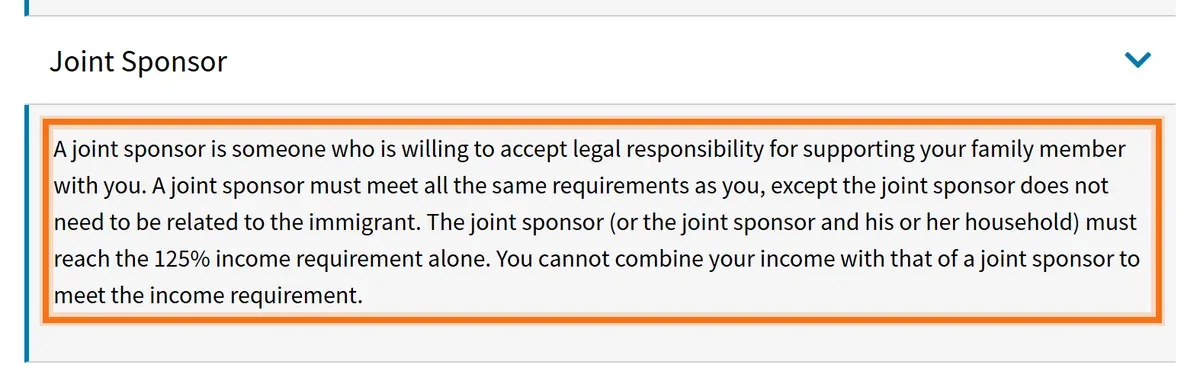
You need a joint sponsor when your household income and assets, counted as above, still do not reach the line. The joint sponsor does not have to be related to anyone in the case. A friend, an in-law, or a coworker who is a citizen or permanent resident can do it.
- Their household grows. The joint sponsor counts their own family plus every immigrant they sponsor. A couple with one child who backs your spouse has a household of 4 and needs $41,250.
- Their documents are the same as yours: the I-864, the tax return or transcript, and proof of citizenship or residence (passport, birth or naturalization certificate, or both sides of the green card).
- At most two joint sponsors per family. With a spouse and children immigrating together, one joint sponsor can cover some of them and a second the rest.
- They are fully liable. Each joint sponsor can be sued for the whole obligation, even if nobody goes after you first.
- One exception: if the officer finds in the decision that your own income was enough, the joint sponsor is not bound.
A sponsor can back out only in writing and only early: before the visa is issued in a consular case, or before the decision in an adjustment case. Ask your joint sponsor to read the contract in Part 8 of the form before signing, not after.
Not sure your income clears the line?
Bring last year’s tax return and a recent pay stub to a free 20-minute consultation. We can go through your household count and the 2026 figure with you, and talk about whether a household member, assets, or a joint sponsor fits.
Step by step: from tax return to a finished affidavit
- 1. Count the household using the list above, and write down who each person is.
- 2. Find your line in the I-864P table for that household size.
- 3. Pull your IRS transcript for the most recent tax year and note the total income. Add up your current pay.
- 4. Compare. If you clear the line on current income and last year’s return supports it, the hard part is done.
- 5. If short, add a household member on Form I-864A, then assets, then look for a joint sponsor.
- 6. Download the current edition (08/24/26) on the day you fill it in, and sign it. USCIS rejects an unsigned I-864.
- 7. File it where the case is. In the U.S., it goes in with the I-485. Abroad, you follow the National Visa Center’s instructions.
For an adjustment case, the interview is usually at the USCIS Dallas Field Office in Irving, and it helps to bring a fresh pay stub or employer letter. If more than a year passes between filing and the interview, the officer may ask for updated income evidence. For a consular case, the State Department charges a $120 Affidavit of Support review fee under 22 CFR 22.1 when the form is reviewed in the United States; our NVC stage guide covers that upload.
I-864, I-864EZ, I-864A, I-864W, or I-134: which form is yours
| Form | Who uses it | USCIS fee |
|---|---|---|
| I-864 | Every petitioning sponsor who cannot use the EZ, every joint sponsor, and every substitute sponsor | $0 |
| I-864EZ | A petitioner sponsoring only one person, qualifying on their own salary or pension shown on W-2s | $0 |
| I-864A | A household member lending income or assets to the sponsor | $0 |
| I-864W | Formerly, immigrants exempt from the affidavit. USCIS has archived this page; adjustment applicants now claim the exemption in Part 3 of Form I-485 | Not applicable |
| I-865 | A sponsor reporting a new address after the immigrant has the green card | $0 |
| I-134 | A different form, the Declaration of Financial Support, for temporary stays. It is not an I-864 and does not create the same contract | $0 |
How to read this table: most families need the I-864, plus an I-864A if a spouse’s income is counted. The EZ works only when all three of its conditions are true. People who are exempt include an immigrant already credited with 40 quarters of work (a spouse’s work during the marriage can count), a child who becomes a citizen on admission, and widow(er) or VAWA self-petitioners.
K-1 couples can meet two of these. At the fiancé visa stage, the consulate decides what financial evidence it wants from the U.S. citizen; the State Department’s fiancé visa page lists it. The binding I-864 comes later, with the green card application after the wedding. Our guide to the K-1 fiancé visa versus the CR-1 spouse visa compares the two paths.
How long the obligation lasts, and why divorce does not end it
The obligation starts the day your relative becomes a permanent resident. From then on you promise to keep them at 125% of the poverty line and to repay any means-tested public benefits they receive. The immigrant can sue to enforce it, and so can a benefits agency after a written demand and 45 days. Under 8 CFR 213a.2(e), it ends only when the sponsored immigrant:
- becomes a U.S. citizen;
- has worked, or can be credited with, 40 qualifying quarters (usually about 10 years);
- gives up permanent residence and leaves the United States;
- receives a new grant of adjustment of status in removal proceedings; or
- dies. It also ends when the sponsor dies, though amounts already owed remain a debt of the estate.
Divorce is not on the list
USCIS says it in one line: divorce does not end the sponsorship obligation. A sponsor who divorces two years after the green card is still bound until one of the events above happens. Joint sponsors and household members who signed an I-864A carry the same duty.
One duty continues the whole time: if you move, file Form I-865 within 30 days. USCIS lists fines of $250 to $2,000 for failing to report, and $2,000 to $5,000 if you knew the immigrant had received means-tested benefits.
What gets an I-864 sent back with a request for evidence
Each item below is a requirement in the form instructions or the regulation, so a missing one is what an officer asks for:
- An old edition. Anything other than 08/24/26, submitted on or after October 1, 2026, is treated as missing initial evidence.
- No tax return or transcript, or a copy without the W-2s and 1099s.
- Household size miscounted: a spouse, a dependent, or an earlier sponsored immigrant left out.
- Income under the line with no I-864A, assets, or joint sponsor.
- A joint sponsor without proof of citizenship or residence, or one whose own household pushes them under 125%.
- Assets listed without proof of ownership, value, and liens.
- A sponsor living abroad with no evidence of U.S. domicile.
- A credit freeze that keeps USCIS from the report. Lift it when asked.
If a request for evidence has already arrived, the deadline on it is firm. Our guide to responding to a USCIS RFE or NOID explains how to answer once and completely.
How Atlas Immigration Law helps
Financial sponsorship is part of the family immigration cases we handle from our Dallas office. We count the household, test the income against the current I-864P, work out with you whether a household member, assets, or a joint sponsor is the right fix, and prepare the affidavit and the financial documents so they agree with the tax returns and the rest of the file.
The affidavit is prepared inside your green card case, whether that is a marriage-based green card, a green card for parents, or consular processing abroad.
The practice is led by Jordan Weinberg, founder and managing attorney, licensed in Texas and a member of AILA and the Dallas Bar Association. You get a flat fee quoted in writing at the consultation and billed by milestone, a dedicated paralegal reachable by call, email, or text, same-business-day responses, and a client portal, in English or Spanish. We are at 1920 McKinney Ave in Dallas and work with families in all 50 states. Call (945) 219-5599. More on choosing help is in our Dallas family immigration lawyer guide.
Frequently asked questions
How much income do I need to sponsor my spouse in 2026?
With no children or other dependents, your household is 2 and you need $27,050 a year in Texas and the other 47 contiguous states, under the I-864P guidelines effective March 1, 2026. Each extra person in the household adds $7,100. Active-duty military sponsoring a spouse or child need $21,640 for a household of 2.
Can my joint sponsor and I combine our incomes?
No. USCIS says the joint sponsor, with their own household, must reach the 125% line alone. You can combine income only with members of your own household who sign Form I-864A.
Who can be a joint sponsor?
Any U.S. citizen, U.S. national, or permanent resident who is at least 18, lives in the United States, and meets the income line for their own household plus the immigrants they sponsor. They do not need to be related to you or to the immigrant. A family group can have no more than two joint sponsors.
I have no income. Do I still file an I-864?
Yes. The person who filed the I-130 must always sign an I-864, even with zero income. You file yours with your tax return or an explanation of why you did not have to file, and a joint sponsor files a second I-864 that meets the requirement.
Does divorce end my obligation under the affidavit of support?
No. The obligation ends only when the sponsored immigrant becomes a U.S. citizen, is credited with 40 quarters of work, gives up permanent residence and leaves the U.S., gets a new grant of adjustment in removal proceedings, or dies, or when the sponsor dies.
Can I use my house or savings instead of income?
Yes, to cover a shortfall. The net value of assets must be 5 times the gap between your household income and the 125% line, or 3 times if you are a U.S. citizen sponsoring your spouse or a child 18 or older. A home needs a recent licensed appraisal and proof of every loan against it.
Is there a fee to file Form I-864?
USCIS charges $0 for Forms I-864, I-864A, I-864EZ, and I-865 on its fee schedule dated October 26, 2026. In a consular case, the State Department charges a $120 Affidavit of Support review fee under 22 CFR 22.1 when the form is reviewed in the United States.
Does the new I-864 edition let USCIS check my credit?
Yes. The 08/24/26 edition, the only one USCIS accepts since October 1, 2026, includes a release that authorizes USCIS to request information from consumer reporting agencies. If you have a credit or security freeze, USCIS says to respond promptly to any request to lift it.
This guide is part of our family immigration services — the service page covers eligibility, fees, and how we handle these cases.

Founder & Managing Attorney, Atlas Immigration Law
Member of the American Immigration Lawyers Association (AILA) and the Dallas Bar Association. Licensed to practice in Texas; fluent in English and Spanish.
Legally reviewed by a licensed immigration attorney
Talk to an immigration attorney about your case
Free consultation on request, flat fees, and a dedicated paralegal who knows your case — serving clients in all 50 states.
This guide is general information, not legal advice, and reading it does not create an attorney-client relationship. Immigration law and procedures change, and how they apply depends on your specific facts — consult a licensed immigration attorney about your situation.