
A U.S. citizen can bring a partner from abroad two ways. With the K-1 fiancé visa you apply as fiancés, marry in the U.S. within 90 days, and then file for the green card: about $2,380 in government fees. With the CR-1 spouse visa you marry first, and your spouse arrives as a permanent resident: about $1,355. For Dallas couples the choice comes down to speed, cost, and where the wedding will be.
Key takeaways
Only U.S. citizens can use the K-1; green card holders marry first and file a spouse petition. The K-1 needs an in-person meeting in the last 2 years and a wedding within 90 days of arrival, then a second case for the green card. A CR-1 or IR-1 spouse can work from the day of arrival; a K-1 fiancé usually waits for a work permit. On the USCIS figures we track, the fiancé petition is now much faster than the spouse petition. If your partner is already in the U.S. after a lawful entry, a third path may beat both.
K-1 vs. CR-1, side by side
A note on names first. CR-1 is the visa for a spouse married less than 2 years on the day of arrival; IR-1 is the same visa for a couple married 2 years or more. The process is identical, so this guide says CR-1 for both unless the difference matters.
| Question | K-1 fiancé visa | CR-1 / IR-1 spouse visa |
|---|---|---|
| Who can file | A U.S. citizen only | A U.S. citizen (a green card holder files the same form in the F2A category) |
| Are you married when you file? | No. You must both be free to marry | Yes. A legal marriage comes first |
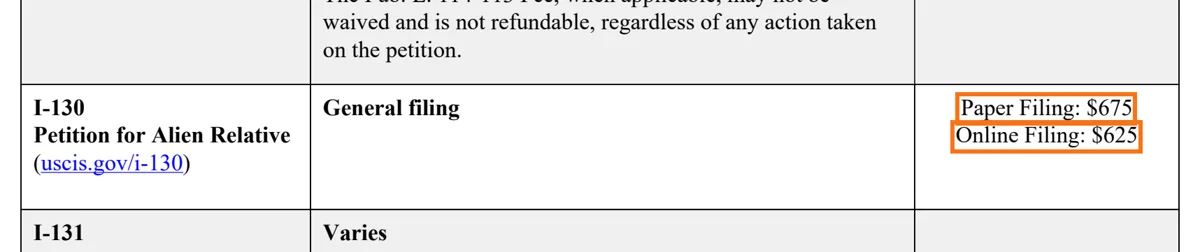
| Petition and USCIS fee | Form I-129F, $675 | Form I-130, $675 on paper or $625 online |
| Must you have met in person? | Yes, at least once in the 2 years before filing, unless a waiver is granted | No fixed rule, but you must prove the marriage is real |
| Where the wedding happens | In the U.S., within 90 days of arrival | Anywhere it is legally valid, before you file |
| Status on arrival | K-1 nonimmigrant, valid 90 days, one entry | Lawful permanent resident |
| Green card | A second case after the wedding: Form I-485 | Mailed after arrival once the $235 USCIS Immigrant Fee is paid |
| When your partner can work | After a work permit is approved | From the day of arrival |
| Affidavit of Support (I-864) | Filed with the I-485 | Filed at the National Visa Center stage |
| Partner’s children | K-2 visas on the same petition, unmarried and under 21 | A separate I-130 for each child |
How to read this table: the K-1 moves the wedding and the green card paperwork to the U.S., after arrival. The CR-1 puts everything before arrival, so your spouse lands with nothing left to file. Neither is "better"; they trade time apart against cost and convenience.
What each path costs in government fees in 2026
USCIS fees below come from the fee schedule dated October 26, 2026. The State Department fees are the amounts in its fee regulation, 22 CFR 22.1, which we read on November 12, 2026. Its own visa fees page is the place to confirm before you pay.
| Fee | K-1 fiancé visa | CR-1 / IR-1 spouse visa |
|---|---|---|
| USCIS petition | I-129F: $675 | I-130: $675 paper, $625 online |
| State Department visa fee | K visa: $265 | Immigrant visa: $325 |
| Affidavit of Support review (State Department) | None at the visa stage | $120 |
| Green card step | I-485: $1,440 paper, $1,390 online | USCIS Immigrant Fee: $235 |
| Form I-864 (USCIS) | $0 | $0 |
| Required total | $2,380 ($2,330 with an online I-485) | $1,355 ($1,305 with an online I-130) |
| Work permit while the I-485 is pending (optional) | $260 | Not needed |
| Travel permit while the I-485 is pending (optional) | $630 paper, $580 online | Not needed |
| Removing conditions later, if the card is conditional | I-751: $750 paper, $700 online | I-751: $750 paper, $700 online |
How to read this table: the K-1 costs about $1,025 more in required government fees, and about $1,900 more if your fiancé also files for the work and travel permits. Both paths add a medical exam paid to the doctor, translations, travel, and legal fees, which are not in the table.
Which is faster right now
For years the two petitions took about the same time. Today they do not. Our processing times page, which uses USCIS’s published figures, showed this when we read it on November 12, 2026 (USCIS data for October 2026):
- Form I-129F (fiancé petition): 9 to 13 months.
- Form I-130 (spouse of a U.S. citizen, filed alone): 37 to 53 months.
- Form I-485 after a K-1 wedding: 14 to 43 months across offices, and about 13.5 months for family cases at the USCIS Dallas Field Office.
The top of each range is the time within which USCIS finished 80% of recent cases. Both paths then add the consulate’s own wait for an interview, which varies by country. The difference that matters: on a K-1, the long I-485 wait happens while you are together in Texas. On a CR-1, the whole wait is spent apart. Our guide on how long the I-130 takes explains the spouse petition backlog. These numbers move, so check them the week you decide.
Arrival day: work, travel, and status
A CR-1 or IR-1 spouse is a permanent resident from the moment of admission. They can take a job right away and travel in and out of the country, and the green card arrives by mail.
A K-1 fiancé arrives on a single-entry visa. Until the green card case moves, three things are different:
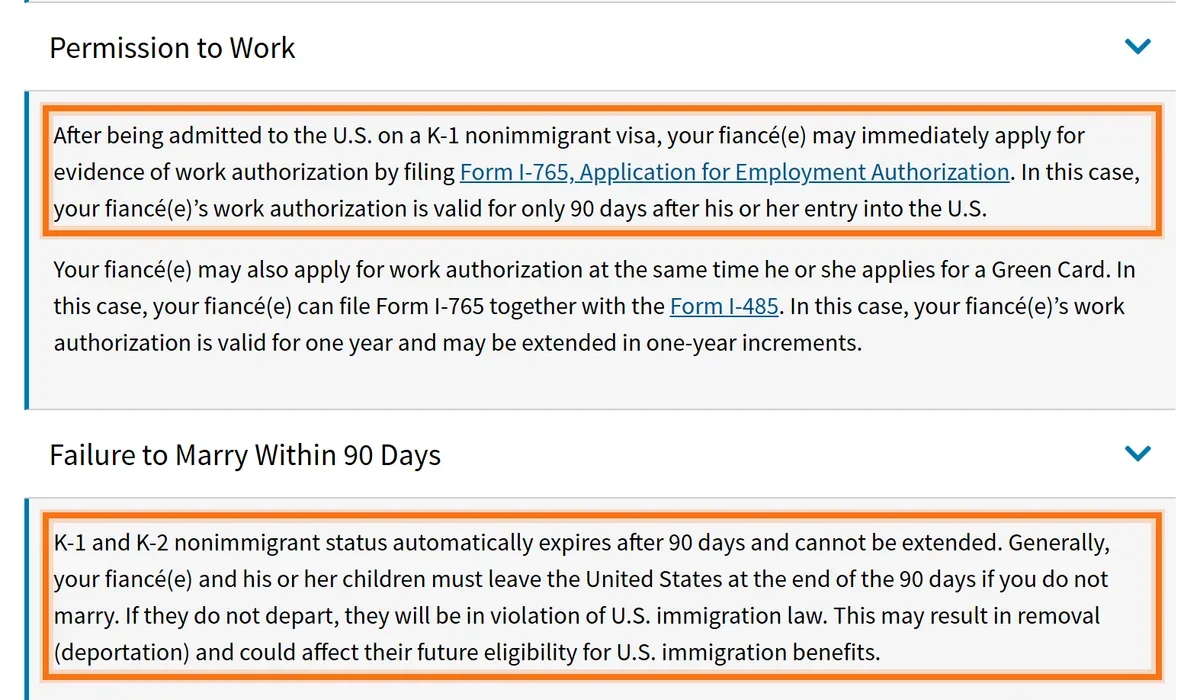
- Work. A work permit tied to K-1 status expires 90 days after entry, so most couples skip it and file Form I-765 with the I-485 after the wedding. Plan for months on one income.
- Travel. The K-1 visa cannot be used to enter twice. A trip abroad before the travel permit or the green card arrives can end the case.
- Paperwork. The I-485, the medical record, and your Form I-864 affidavit of support are all still ahead, followed by an interview, usually at the USCIS Dallas Field Office in Irving for couples living in North Texas.
Conditional residence works the same on both paths. If you have been married less than 2 years on the day your spouse becomes a resident, the card is valid for 2 years and you file Form I-751 together in the 90 days before it expires. K-1 couples nearly always get a conditional card. A spouse-visa couple who passes the second anniversary before arrival gets a 10-year card.
What happens if a K-1 couple does not marry within 90 days
K-1 status and K-2 status expire automatically after 90 days and cannot be extended. If there is no wedding, USCIS says your fiancé and any children generally must leave. Staying is a violation that can lead to removal and can hurt later applications.
- Married late, to the same person: you can still file Form I-130 as spouses, but it is a new petition with its own fee and wait.
- Engagement ended: a K-1 fiancé generally cannot get a green card through anyone or anything else from inside the U.S. USCIS lists narrow exceptions, such as U or T status for crime or trafficking victims.
- A new relationship: marrying a different U.S. citizen does not fix it. The fiancé would have to leave and start over abroad.
Dallas couples should also plan the calendar. The Dallas County Clerk issues marriage licenses at the Records Building, 500 Elm Street. Texas has a 72-hour waiting period after the license is issued, and the license expires if no ceremony is held before the 90th day. Do not leave the license for week twelve.
Not sure which path fits the two of you?
Tell us where your partner lives, whether you have met in person, and when you want to be together. In a free 20-minute consultation we can compare the K-1, the spouse visa, and adjustment in the U.S. for your facts.
Children: K-2 visas vs. separate petitions
On a K-1, your fiancé’s unmarried children under 21 ride on the same I-129F as K-2 children, as long as you list them. Each child pays the visa fee and later files their own I-485 ($1,440 on paper at 14 or older; $950 under 14 when filed with the parent). They can travel with the parent or later, never before.
On the spouse path there are no riders. You file a separate I-130 for each child as your stepchild, and each pays the visa fee and the immigrant fee. One rule decides some families’ whole plan: USCIS treats a child as your stepchild only if you married the parent before the child turned 18. A fiancé with a 19-year-old may be able to bring that child as a K-2, while marrying first would leave the child without a stepchild petition. Check this before you set a wedding date.
The third option: your partner is already in the U.S.
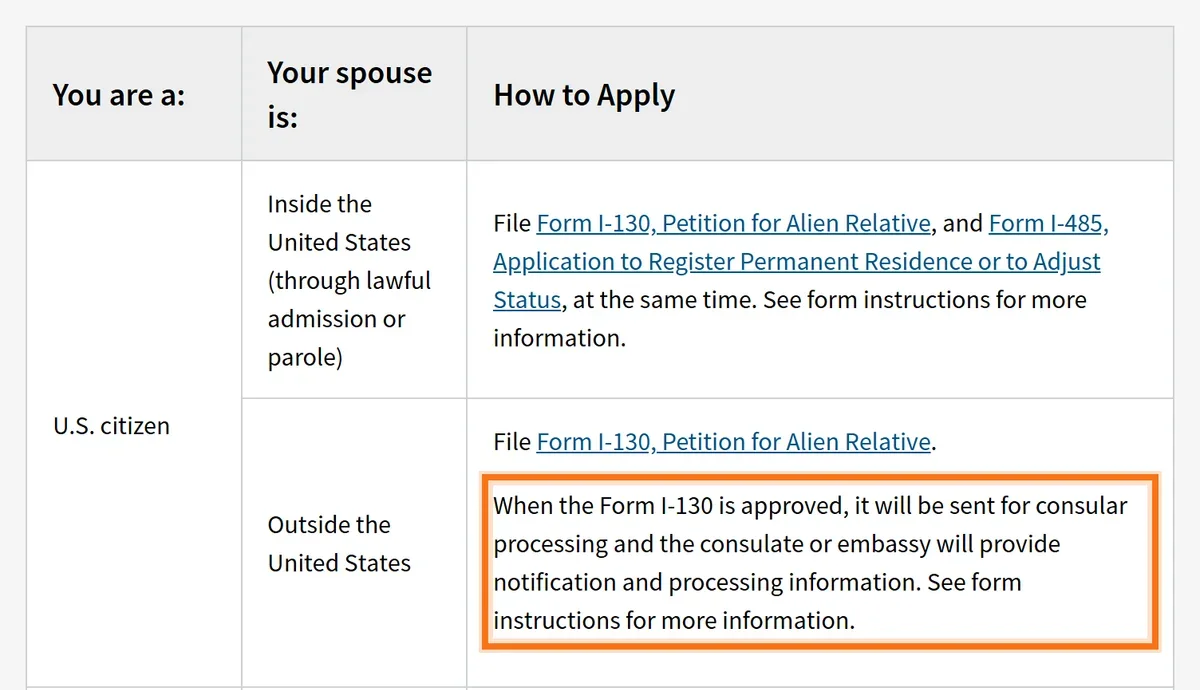
If your partner is in the United States after a lawful admission or parole, for example on a student or work visa, neither visa may be needed. USCIS says a U.S. citizen’s spouse in that position can file the I-130 and the I-485 at the same time and stay here while the case is decided. That is adjustment of status, and at the Dallas Field Office it is currently far quicker than an I-130 filed alone.
Do not plan an entry around this
Adjustment is for people whose plans changed after they arrived. Someone who enters on a visitor visa or visa waiver already intending to marry and stay can be found to have misrepresented the purpose of the trip, which can sink the green card and follow them for years. Whether a past entry is a problem depends on the facts and timing. Get advice before filing, and never arrange a trip to use this path.
Our guides to the marriage-based green card process and to what to check before filing an I-485 in Dallas cover that route in full.
Which path fits you? A decision guide for Dallas couples
| Your situation | Usually fits | Why |
|---|---|---|
| You hold a green card, not citizenship | Spouse petition (F2A) | The K-1 is for U.S. citizens only |
| You are already married, or want the wedding abroad with family | CR-1 / IR-1 | USCIS does not issue a K-1 to couples who are married or will marry outside the U.S. |
| You have not met in person in the last 2 years | Meet first, then decide | The K-1 requires the meeting; a trip to meet can also be the trip to marry |
| Being together soonest matters most | K-1, on current figures | The fiancé petition is 9 to 13 months against 37 to 53 for the spouse petition |
| Your partner must work right after arriving | CR-1 / IR-1 | A permanent resident can work on day one |
| Lowest government cost | CR-1 / IR-1 | $1,355 against $2,380 |
| Your partner has a child aged 18 to 20 | K-1, after advice | K-2 covers children under 21; a stepchild petition needs a marriage before 18 |
| Your partner is in the U.S. after a lawful entry | Marry and adjust status | I-130 and I-485 filed together, no consulate |
| A past overstay, visa refusal, or arrest on either side | Review before choosing | Either path can need a waiver, and the timing differs |
How to read this table: find every row that describes you, not just one. When two rows point in different directions, such as "together soonest" and "must work right away," that conflict is the real decision, and it is the one worth talking through with a lawyer.
USCIS also has a K-3 visa for a citizen’s spouse waiting on an I-130, with no fee for the extra I-129F. USCIS itself says the State Department rarely issues it, so we do not treat it as a plan. If history is the worry, our immigration waivers guide explains what can be forgiven. Green card holders should read sponsoring a spouse as a green card holder.
Each path, step by step
K-1 fiancé visa
- 1. You file Form I-129F with proof of the meeting and the plan to marry.
- 2. USCIS approves it and sends it through the National Visa Center to the consulate where your fiancé lives.
- 3. Your fiancé applies for the visa, has the medical exam, and attends the interview.
- 4. Your fiancé enters within the visa’s validity, up to 6 months.
- 5. You marry within 90 days.
- 6. Your spouse files the I-485 with your I-864, and you attend the interview together.
The evidence list is in our K-1 fiancé visa requirements checklist, and the full process is in the K-1 guide for Dallas and Fort Worth couples.
CR-1 / IR-1 spouse visa
- 1. You marry, and get the civil marriage certificate.
- 2. You file Form I-130 with proof the marriage is real.
- 3. After approval, the case goes to the National Visa Center: fees, the DS-260 visa application, your I-864, and civil documents.
- 4. Your spouse has the medical exam and the consular interview.
- 5. You pay the $235 USCIS Immigrant Fee, and your spouse enters as a permanent resident.
Step 3 is covered in our guide to the NVC stage after I-130 approval, and steps 4 and 5 in consular processing, step by step.
How Atlas Immigration Law helps
Choosing the route is the first thing we do in a family case: a K-1 fiancé visa or a spouse visa after marriage, adjustment inside the United States or consular processing abroad. We look at where each of you lives, your timing, any children, and both immigration histories, then prepare the path you choose: the K-1 fiancé visa, the spouse visa, or another family immigration case.
The practice is led by Jordan Weinberg, founder and managing attorney, licensed in Texas and a member of AILA and the Dallas Bar Association. You get a flat fee quoted in writing at the consultation and billed by milestone, a dedicated paralegal reachable by call, email, or text, same-business-day responses, and a client portal, in English or Spanish. We are at 1920 McKinney Ave in Dallas and work with couples in all 50 states. Call (945) 219-5599.
Frequently asked questions
Is it better to marry first or apply for a fiancé visa?
It depends on what matters most. The spouse visa (CR-1) costs less in government fees, about $1,355 against $2,380, and your spouse can work on arrival. The K-1 fiancé petition is currently processed much faster, 9 to 13 months against 37 to 53 for the spouse petition on the USCIS figures we track, but it needs a second green card case after the wedding.
What is the difference between a CR-1 and an IR-1 visa?
Only the length of the marriage. A spouse married less than 2 years on the day of admission gets a CR-1 and a 2-year conditional green card, and the couple files Form I-751 in the 90 days before it expires. A spouse married 2 years or more gets an IR-1 and a 10-year card.
Can a green card holder file for a K-1 fiancé visa?
No. USCIS lists U.S. citizenship as the first K-1 requirement. A permanent resident marries first and files Form I-130 for the spouse in the F2A category.
How much does a K-1 visa cost compared with a CR-1 in 2026?
In required government fees, the K-1 path is $2,380: $675 for Form I-129F, $265 for the K visa, and $1,440 for a paper Form I-485. The CR-1 path is $1,355: $675 for a paper Form I-130, $325 for the immigrant visa, $120 for the Affidavit of Support review, and the $235 USCIS Immigrant Fee. Medical exams and legal fees are extra.
Can my fiancé work right after arriving on a K-1?
Not in practice. A work permit based on K-1 status is valid only 90 days after entry, so most couples file the work permit with the green card application after the wedding and wait for it. A spouse who arrives on a CR-1 or IR-1 visa is a permanent resident and can work immediately.
What if we do not marry within 90 days on a K-1?
K-1 status expires after 90 days and cannot be extended, and your fiancé is generally required to leave. If you marry each other after day 90, you can file a new Form I-130. A K-1 fiancé generally cannot get a green card on any other basis from inside the United States.
Can we marry in the U.S. on a tourist visa instead?
A spouse of a U.S. citizen who is in the U.S. after a lawful admission can often apply for a green card here. But entering as a visitor while already intending to marry and stay can be treated as misrepresentation. Get advice on your facts before filing, and do not plan a trip around this route.
Do my partner’s children come with them?
On a K-1, unmarried children under 21 listed on the I-129F can come as K-2 children. On the spouse path, you file a separate Form I-130 for each child, and a stepchild qualifies only if you married the parent before the child turned 18.
This guide is part of our family immigration services — the service page covers eligibility, fees, and how we handle these cases.

Founder & Managing Attorney, Atlas Immigration Law
Member of the American Immigration Lawyers Association (AILA) and the Dallas Bar Association. Licensed to practice in Texas; fluent in English and Spanish.
Legally reviewed by a licensed immigration attorney
Talk to an immigration attorney about your case
Free consultation on request, flat fees, and a dedicated paralegal who knows your case — serving clients in all 50 states.
This guide is general information, not legal advice, and reading it does not create an attorney-client relationship. Immigration law and procedures change, and how they apply depends on your specific facts — consult a licensed immigration attorney about your situation.