
For most Dallas employers, the person you are hiring picks the visa. A Canadian or Mexican professional in a listed occupation can usually start fastest on a TN. Someone who has worked a full year for your company abroad fits an L-1. A candidate with national or international acclaim fits an O-1. Almost everyone else with a specialty degree needs an H-1B, which means the March lottery and an October 1 start.
Key takeaways
Only the H-1B has an annual cap and a lottery; L-1, O-1 and TN petitions can be filed in any month. H-1B, L-1 and O-1 allow a green card case to run alongside; the TN requires a temporary stay. Required USCIS fees in 2026 run from $810 to $3,595 per petition, depending on visa and headcount. Decide the green card path on the day you choose the visa, not three years later.
Start with the person, not the visa
Hiring managers often ask for "an H-1B" because it is the visa they know, but it is the only one with a lottery in front of it. Four facts about the candidate settle most cases: citizenship, current status and location, time with your company abroad, and a record of awards, publications or press. Two facts about the job finish it: whether it needs a degree in a specific field, and how soon you need the person.
H-1B, L-1A, L-1B, O-1 and TN side by side
| H-1B | L-1A | L-1B | O-1 | TN | |
|---|---|---|---|---|---|
| Who qualifies | Job needs a bachelor’s degree in a specific specialty; worker holds it or the equivalent | Executive or manager with one continuous year at your company abroad in the last three | Employee with specialized knowledge of your company; same one-year rule | Extraordinary ability shown by sustained national or international acclaim | Canadian or Mexican citizen in a profession on the USMCA list |
| Annual cap or lottery | Yes: 65,000 plus 20,000 for U.S. master’s degrees; universities and certain related organizations are exempt | No | No | No | No |
| Earliest start | October 1 after a March registration, unless cap-exempt or a transfer | After approval; any month | After approval; any month | After approval; any month | Canadians: at the border with an employer letter; Mexicans: after a TN visa |
| Stay limit | Up to 3 years, then 3 more; 6 in total, longer only with green card steps | Up to 3 years (1 for a new office), 2-year extensions, 7 in total | Same steps, 5 in total | Up to 3 years, then extensions of up to 1 year at a time | Up to 3 years per grant; no total limit while the job continues |
| Green card case alongside | Allowed | Allowed | Allowed | Allowed | Risky: the stay must remain temporary |
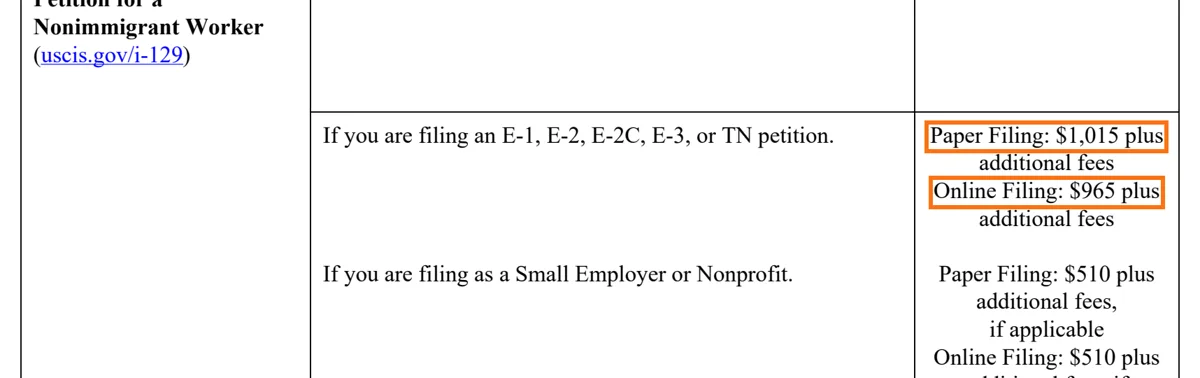
| Required USCIS fees, 26+ employees | $3,595 (incl. $215 registration) | $2,485 | $2,485 | $1,655 | $1,615 if filed with USCIS |
| Required USCIS fees, 25 or fewer | $2,225 | $1,495 | $1,495 | $830 | $810 if filed with USCIS |
| Usual green card path | PERM, then I-140 (EB-2 or EB-3) | EB-1C, no PERM | PERM, then I-140 | EB-1A or EB-2 NIW, or PERM | Often a switch to H-1B first, then PERM |
How to read this table: start with the "who qualifies" row; if the candidate fails it, the rest of that column does not matter. Fee rows add the required lines and leave out premium processing; our employer cost guide breaks down each one. The green card row comes from the regulations: a labor certification or immigrant petition is not a reason to deny an H-1B, L-1 or O-1 (8 CFR 214.2(h)(16), (l)(16), (o)(13)), while a TN stay must have a "reasonable, finite end" (8 CFR 214.6(b)).
When the H-1B is the right choice
The H-1B fits the widest range of professional jobs: software, engineering, finance, healthcare, architecture and more, as long as the role normally requires a degree in a specific field. Its weak point is the calendar. A cap-subject employer registers the candidate in March, files the petition from April 1 if selected, and the job starts October 1 at the earliest. Since February 27, 2026, selection is weighted by the wage level you offer, so the salary now changes the odds. Our H-1B cap registration guide covers the March 2027 season.
Two kinds of hires skip the lottery. A worker who already holds H-1B status with another employer has already been counted against the cap, so you file a transfer petition and the worker can usually start once it is properly filed. And universities and certain related nonprofit and research organizations are cap-exempt employers that can file in any month.
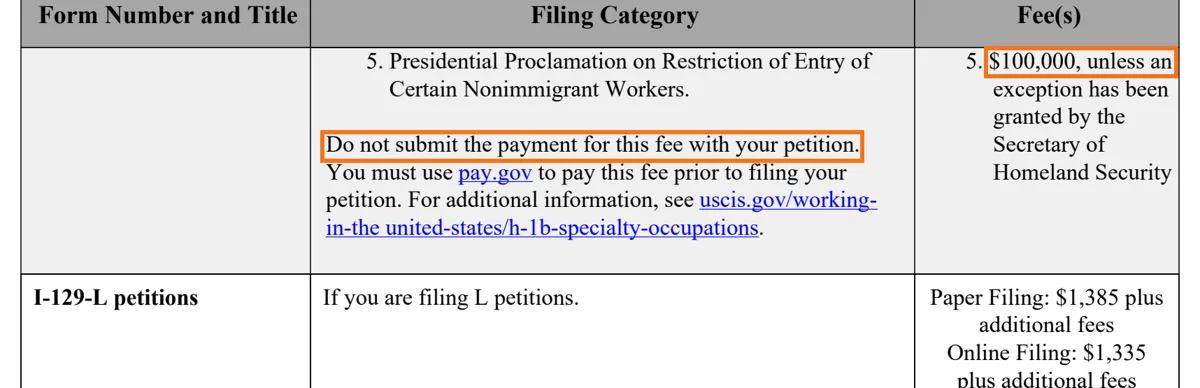
A September 19, 2025 proclamation requires a $100,000 payment for certain new H-1B petitions for workers outside the U.S. without a valid H-1B visa. On June 8, 2026 a federal court in Massachusetts vacated the USCIS guidance putting it into effect (State of California v. Mullin), and on July 24, 2026 the First Circuit denied the government’s request to pause that order. USCIS says it is complying while DHS considers next steps, and still plans to collect the payment if the order is lifted.
DHS has also proposed a separate $103,265 fee for cap-subject petitions (91 FR 54817); it is not final. For a candidate who lives abroad, both items are reasons to check the L-1, O-1 and TN columns before defaulting to the H-1B. Our Dallas H-1B attorney guide tracks the status.
When an L-1 beats the H-1B
If your company has an office abroad, the L-1 is often the cleaner route. The employee needs one continuous year with a related company outside the U.S. in the three years before the transfer, and the U.S. company must be its parent, branch, subsidiary or affiliate. There is no lottery, no degree requirement and no Labor Condition Application with the Department of Labor.
The L-1A is for executives and managers; the L-1B is for staff with specialized knowledge of your products, processes or systems, which the petition must show is not common in the industry. Our L-1A vs L-1B guide covers the definitions, blanket petitions and new offices. One limit to plan around: the L-1 works only inside your corporate group and does not move with the employee to another company.
When the O-1 fits
The O-1A is for people at the top of science, education, business or athletics; the O-1B covers the arts, film and television. The petition needs at least three types of evidence, such as major awards, press about the person, high pay or judging others’ work, plus a written advisory opinion from a peer group or expert.
The O-1 has no lottery and no degree requirement, and a green card case can run alongside it. The trade-off is evidence: the file takes the candidate’s help and time, and USCIS asks petitioners to file at least 45 days before the start date. Our O-1 visa guide lists the criteria, and EB-1A vs EB-2 NIW vs O-1 shows how the same record can support a green card.
When a TN is the fastest route
For Canadian and Mexican citizens, the TN is usually the quickest path. The job must match a profession on the USMCA list, such as Engineer, Computer Systems Analyst or Accountant, and the candidate must hold the credential the list requires. Canadians can apply to a Customs and Border Protection officer at a designated port of entry or preclearance station with your employer letter; Mexicans first get a TN visa at a U.S. consulate.
Two limits matter. A TN worker may not start with a new employer until USCIS approves that employer’s petition, so hiring someone who is already on a TN elsewhere takes planning. And TN status rests on a temporary stay, which can clash with a green card case. Our TN visa guide covers the profession list, the employer letter and renewals.
How we pick the route for a Dallas hire, step by step
This is the order we work through for a Dallas-Fort Worth employer, and it works the same for a team in any state. Each step can end the search early: the first visa that fits well, with a backup, beats a perfect plan that starts in a year.
- Step 1. Citizenship. Canada or Mexico: check the TN list first. Australia: the E-3, granted two years at a time with no lottery. Chile or Singapore: the H-1B1, with 6,800 numbers set aside each year. A treaty-country citizen joining a company owned by the same nationality: ask about the E-2 employee route.
- Step 2. Current status and location. Already in H-1B: a transfer, no lottery. On F-1 OPT or STEM OPT: the remaining OPT time can cover a lottery attempt; see our guide to hiring F-1 students on OPT. Abroad: check the $100,000 status and consular timing.
- Step 3. Time with your company abroad. One continuous year with a related company in the last three years opens the L-1. Decide L-1A or L-1B from the actual duties, not the title.
- Step 4. The candidate’s record. Count awards, articles about the person, publications, judging, high pay and key roles. Three strong types of evidence point to an O-1.
- Step 5. The job itself. Confirm the role needs a degree in a specific field for an H-1B, or matches a USMCA profession for a TN. Set the wage level early, because it now drives H-1B lottery odds.
- Step 6. Start date and length of need. Map the first realistic start date for each open route. Add premium processing where a date cannot slip.
- Step 7. The green card goal. If you expect to keep the person, choose the visa that lets the green card case run alongside it, and name the green card route now.
- Step 8. Budget and headcount. Price the government fees for your employer size and the legal fee for each route, then write it all on one page: first visa, backup, green card path, key dates.
Comparing visas for a new hire or a key employee?
Request a free 20-minute consultation. We look at the candidate and the job, tell you which routes are open and which green card path follows, and quote a flat fee in writing before any work starts.
Common hiring situations and where to start
| Candidate | First visa to check | Backup | Why |
|---|---|---|---|
| Canadian software engineer with a computer science degree | TN | H-1B | Engineer and Computer Systems Analyst are on the USMCA list; no lottery, and Canadians can apply at the border |
| Recent U.S. graduate on STEM OPT already working for you | H-1B registration in March | O-1 if the record supports it | The 24-month STEM OPT extension can leave time for another lottery attempt |
| Manager at your subsidiary abroad for two years | L-1A | H-1B | No lottery, the spouse can work in L-2S status, and the EB-1C green card skips PERM |
| Engineer at your foreign affiliate who knows your in-house systems | L-1B | H-1B | No lottery or degree test, but the specialized-knowledge proof must be strong |
| Researcher or founder with awards, publications and press | O-1A | H-1B, or an EB-2 NIW green card | No lottery, and the same evidence can support a self-petitioned green card |
| Worker already on H-1B with another employer | H-1B transfer | None needed | Already counted against the cap; work can usually start once the petition is filed |
How to read this table: find the row closest to your candidate, then check the "first visa" against the comparison table above. If no row fits, the candidate probably needs the H-1B lottery, and the time to plan for it is before March.
Choosing the work visa and the green card path together
For a key employee, the work visa is the first step of a longer plan. The H-1B lasts six years in total, and time beyond that requires a green card case that is far enough along. That is why employers who expect to keep an H-1B worker often start PERM labor certification in year two or three, not year five.
The L-1A has the shortest road: a manager or executive may qualify for the EB-1C multinational manager green card, which needs no PERM. An L-1B usually goes through PERM. An O-1 worker’s evidence may support an EB-1A or a national interest waiver, which the worker can file without an employer. A TN worker is the hardest case, because a green card filing can make it harder to show the temporary stay a TN renewal requires; many move to an H-1B before that filing.
Family members belong in the plan too. L-2S spouses may work. Certain H-4 spouses can apply for a work permit, but only once the H-1B worker has started the green card process. O-3 and TD family members may study but not work. For a relocating employee with a working spouse, that difference can decide whether the offer is accepted.
Timing: what premium processing can and cannot fix
Every route on this page except a Canadian TN at the border runs through Form I-129, and USCIS offers premium processing for it. For $2,965, USCIS takes action within 15 business days: an approval, a denial, or a request for evidence. It buys speed, not approval, and it cannot move the H-1B lottery or the October 1 start date.
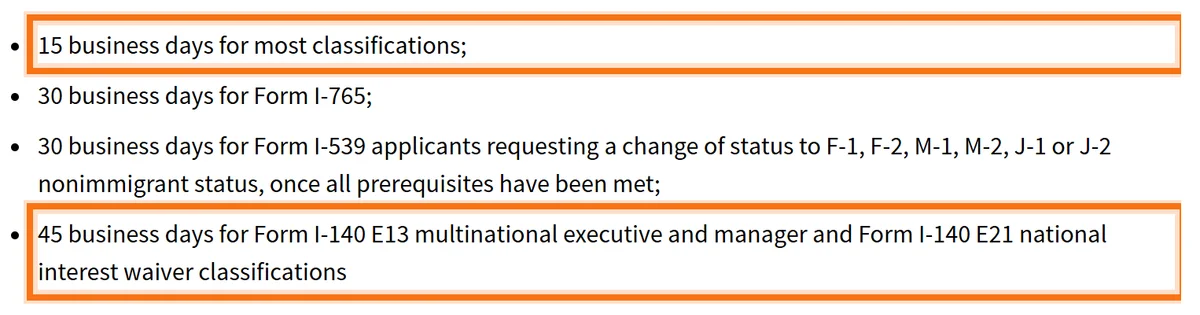
For a worker abroad, approval is not the finish line: most still need a U.S. consulate visa appointment (Canadian TN applicants need no TN visa). Check current processing times before promising a start date, and see our premium processing guide for when the fee pays off.
How Atlas Immigration Law helps
We handle employer work visas for companies in Dallas-Fort Worth and in all 50 states: H-1B, L-1, O-1, TN and E-2 petitions, and the green card cases that follow, including PERM and I-140 petitions. Comparing these options for a new hire, or mapping the visa and green card plan for a company’s key foreign employees, is the work we do at the consultation.
Every case is a flat fee quoted in writing at the consultation and billed by milestone, with no hourly billing, so you can compare routes on cost as well as timing. Each client has a dedicated paralegal reachable by call, email or text, same-business-day responses from our team, and case tracking in the Atlas Vision client portal.
Founder and managing attorney Jordan Weinberg is licensed in Texas and is a member of AILA and the Dallas Bar Association. Our office is at 1920 McKinney Ave in Dallas, and we work in English and Spanish. To compare the options for your hire, request a free 20-minute consultation or call (945) 219-5599.
Frequently asked questions
Which work visa is fastest for a new hire?
For a Canadian in a USMCA profession, usually the TN, because the candidate can apply at the border with your employer letter. Otherwise, an L-1 or O-1 petition with premium processing gets USCIS action within 15 business days. A cap-subject H-1B is the slowest, with an October 1 start after a March lottery.
Can we hire someone on an L-1 if they never worked for us abroad?
No. The L-1 requires one continuous year of work for a parent, branch, subsidiary or affiliate of the U.S. employer outside the United States within the three years before the transfer. Some companies employ a candidate abroad first and transfer them after that year.
Is the O-1 harder to get than an H-1B?
It asks for different proof. The H-1B needs a degree-level job and a lottery selection; the O-1 needs evidence of sustained national or international acclaim, with at least three types of evidence and an advisory opinion. For a candidate with a strong record, the O-1 avoids the lottery entirely.
Can a TN worker apply for a green card?
It is possible, but TN status requires a temporary stay, and a pending green card case can make that harder to show at the next renewal or border entry. Many employers move the worker to H-1B status before filing, since the H-1B allows a green card case alongside it.
What if our candidate is not selected in the H-1B lottery?
Check the routes without a cap: TN for Canadian and Mexican citizens, E-3 for Australians, L-1 if the person works for your company abroad, and O-1 if the record supports it. Otherwise, register again the next March, while any remaining OPT time keeps the person working.
How much does each work visa cost an employer in 2026?
Required USCIS fees on the schedule dated October 26, 2026, paper filing, for an employer with more than 25 employees: $3,595 for a cap-subject H-1B including registration, $2,485 for an L-1, $1,655 for an O-1 and $1,615 for a TN filed with USCIS. Small employers pay less. Legal fees are separate.
This guide is part of our work visa services for employers — the service page covers eligibility, fees, and how we handle these cases.

Founder & Managing Attorney, Atlas Immigration Law
Member of the American Immigration Lawyers Association (AILA) and the Dallas Bar Association. Licensed to practice in Texas; fluent in English and Spanish.
Legally reviewed by a licensed immigration attorney
Talk to an immigration attorney about your case
Free consultation on request, flat fees, and a dedicated paralegal who knows your case — serving clients in all 50 states.
This guide is general information, not legal advice, and reading it does not create an attorney-client relationship. Immigration law and procedures change, and how they apply depends on your specific facts — consult a licensed immigration attorney about your situation.