
The U.S. company that filed the L-1B answers a specialized knowledge RFE, usually through its immigration attorney, and Atlas Immigration Law prepares these responses for employers in Plano, Dallas, Frisco, Irving and across the country. The notice asks you to prove that your employee’s knowledge of your products or processes is special or advanced compared with other workers, that the U.S. job needs it, and that the person spent a qualifying year abroad. You have until the date on the notice, at most 12 weeks.
Key takeaways
USCIS says merely stating that knowledge is different does not prove it: the officer wants a comparison with other workers, backed by records. The knowledge does not have to be proprietary or unique, and the employee does not have to be a manager or the best paid. An L-1B who will work mainly at a client’s site must stay under your control and deliver your product or service, not labor for hire. The employee must have qualified on the filing date; a response can document facts, it cannot create them. Answer once, completely, before the deadline.
What an L-1B specialized knowledge RFE is really asking
The regulation at 8 CFR 214.2(l)(1)(ii)(D) defines specialized knowledge two ways. Special knowledge is knowledge of the company’s product, service, research, equipment, techniques, management or other interests and its application in international markets. Advanced knowledge is an advanced level of knowledge or expertise in the company’s own processes and procedures. Your employee can have either one, or both.
The USCIS Policy Manual (Volume 2, Part L, Chapter 4) says the petitioner must show three things: the employee has specialized knowledge, the U.S. position involves that knowledge, and the employee has at least one continuous year of qualifying employment abroad within the preceding three years. An RFE means the officer was not convinced on one or more of these. Read the notice line by line and sort each paragraph under one of them before you collect a single document.
If you are still deciding whether the transfer should be L-1A or L-1B at all, our guide to L-1A vs L-1B intracompany transfers covers that choice. An RFE that questions whether the U.S. and foreign companies are related is a different problem, covered in our guide to the L-1 qualifying relationship RFE.
The comparison USCIS wants: other employees and the industry
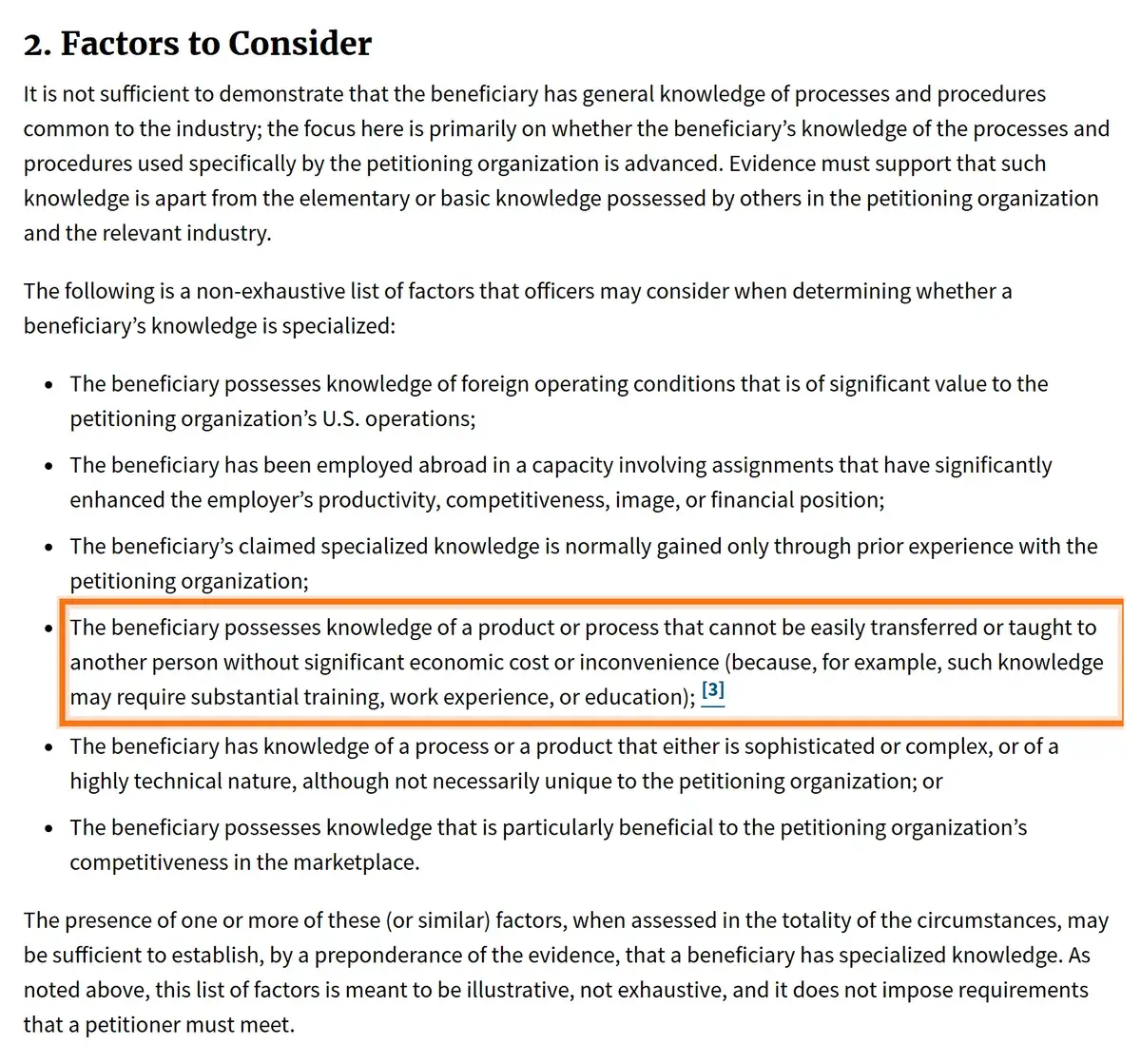
Specialized knowledge is a comparison, and the Policy Manual puts the burden of making it on you. For special knowledge, you compare your employee with similarly employed workers in your industry. For advanced knowledge, you compare the employee with other workers in your own operations and show the knowledge is greatly developed or further along. Either way, general knowledge of how your industry works is not enough. A software engineer who knows a common programming language well has industry knowledge; the engineer who configured your proprietary platform for clients abroad for three years may have specialized knowledge.
- It does not have to be proprietary or unique. USCIS says you do not have to prove you are the only company where the knowledge could be learned.
- It does not have to be narrowly held. Several employees can share the same specialized knowledge. But if many people in your U.S. office already have it, expect the officer to ask why you need one more, and answer with workload, project and timeline facts.
- It is not a labor market test. You do not have to show that no U.S. worker is available. The question is whether the knowledge is so common in the industry that it is not special.
- It cannot be easily taught. Knowledge that is commonly held, lacks complexity or can be passed on quickly is not specialized. Showing how long and how costly it would be to train someone else is often the strongest proof, although USCIS does not require it if the case is otherwise made.
The Policy Manual also lists factors officers may weigh: knowledge of foreign operating conditions that is valuable to the U.S. operation, assignments abroad that significantly improved productivity or competitiveness, knowledge normally gained only inside the company, knowledge that is complex or highly technical, and knowledge that is particularly beneficial to your competitiveness. One or more of these, in the totality of the circumstances, can be enough.
Wage and job title: considered, but not deciding on their own
Many RFEs point to the employee’s salary or title. USCIS guidance is clear that an L-1B employee does not need to be a manager, officer or supervisor, and does not need to earn more than peers. Rank and pay are factors, not requirements. The Policy Manual notes there can be valid business reasons for a pay difference, such as a young company that cannot yet pay more.
Where pay does matter is the comparison inside your U.S. office. If many U.S. employees share the claimed knowledge and the L-1B will be paid substantially less than them, USCIS says that may suggest the knowledge is not specialized. Officers look at total compensation, which can include guaranteed bonuses and housing, food or transportation allowances agreed before filing. If your offer is lower, explain why with skills, experience and the pay of the whole comparable group, and prove the value of any allowances.
The one continuous year abroad within three years
The employee must have worked full time, physically outside the United States, for the foreign company or another qualifying organization for one continuous year within the three years before the initial L-1 petition was filed, in a managerial, executive or specialized knowledge role. The work abroad does not have to be the same job as the U.S. role, but it has to be qualifying.
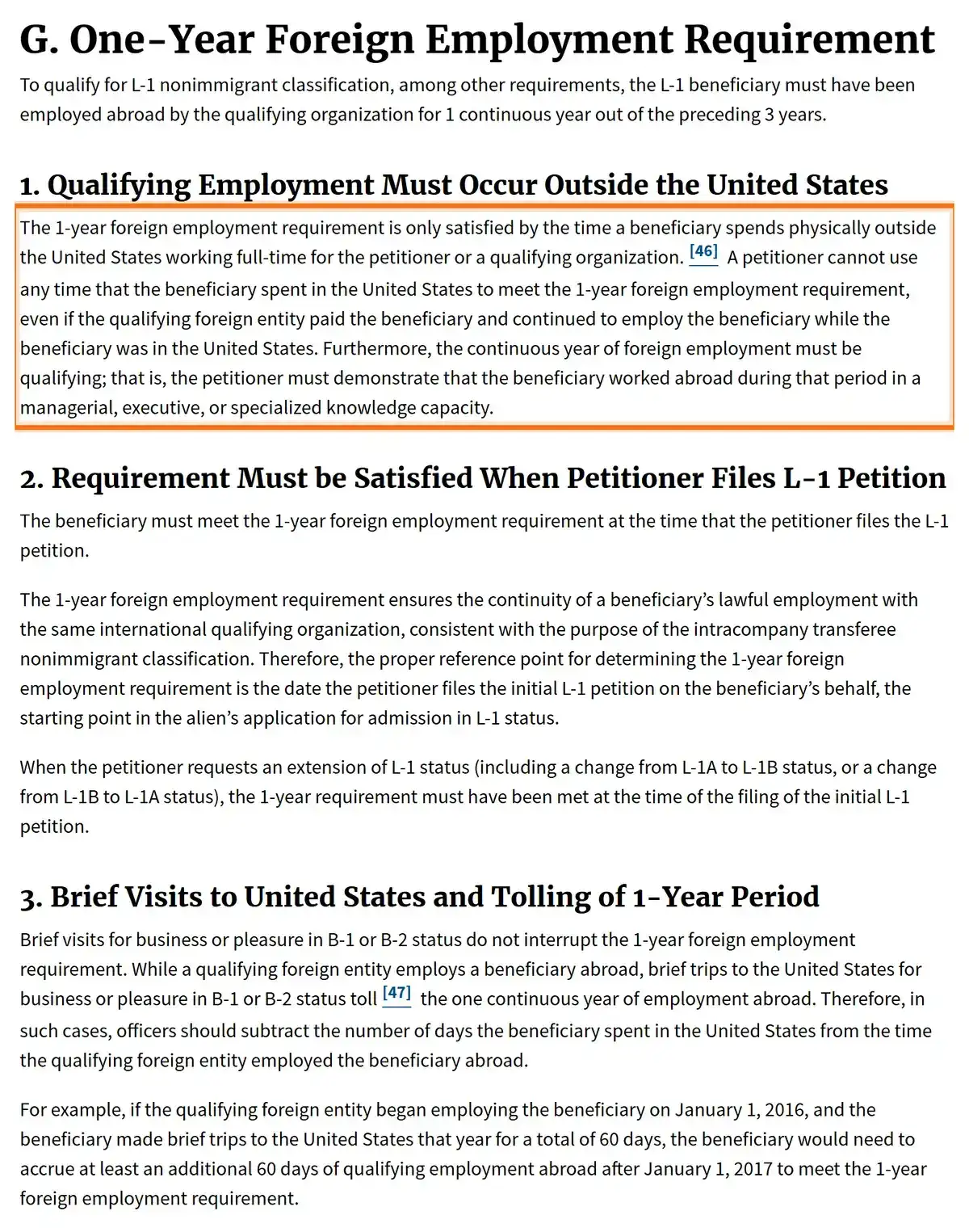
- Short business or vacation trips to the U.S. do not break the year, but USCIS subtracts those days. An employee with 60 days of U.S. visits needs 60 more days abroad.
- Time working in the U.S. for a related company in an employment-based status such as H-1B does not count toward the year, but it shifts the three-year look-back period.
- Time in the U.S. in L-2 or F-1 status, or working for an unrelated employer, interrupts the year and does not shift the look-back period.
- A break longer than two years with the company inside the three years means the requirement cannot be met.
For this point, send payroll records, foreign tax or social insurance filings, an employment verification letter with exact dates and hours, and a travel log with entry and exit dates. A response cannot add days the employee did not work.
Working at a client site: the L-1 Visa Reform Act rule
This point catches IT services, engineering and consulting companies, including many with offices in Plano, Frisco, Irving and Dallas. Under INA 214(c)(2)(F), added by the L-1 Visa Reform Act of 2004, an L-1B is barred if the employee will be stationed primarily at the worksite of an unaffiliated company and will be principally controlled and supervised by that company. A client-site placement is still allowed when two conditions are met.
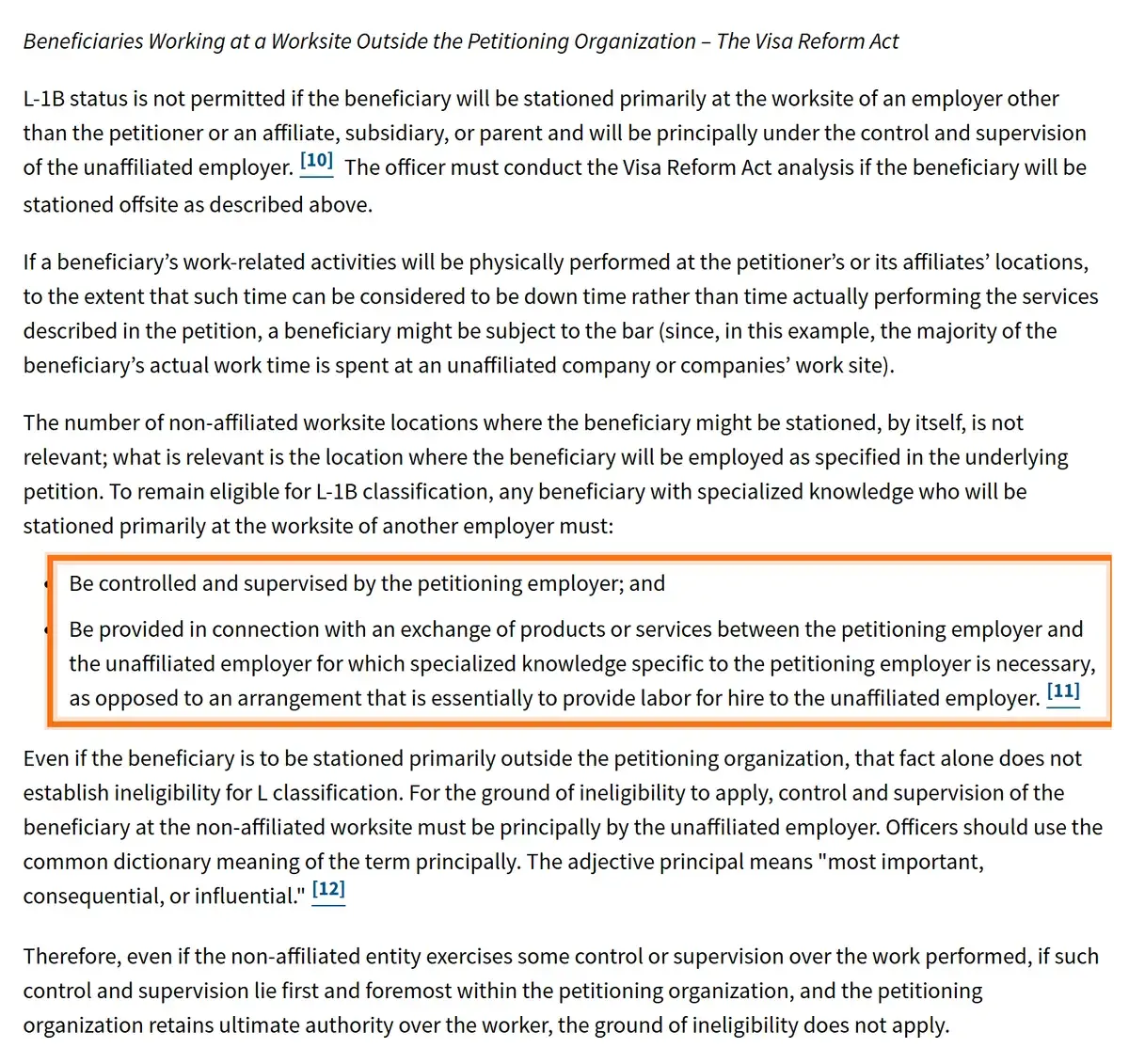
The client may give feedback, set goals and even direct specific tasks. What matters is that the final authority over the employee’s daily work stays with your company. Send the statement of work or services agreement, the supervision chain inside your company, how work is assigned and reviewed, who approves leave and evaluations, and why the project needs knowledge of your product or method. If the honest answer is that any qualified contractor could do the work, the L-1B is the wrong category.
Which evidence answers each RFE point
USCIS says a detailed, specific and credible statement from the company can be persuasive, but in an RFE the officer has already found the statement was not enough. This table matches each point an L-1B specialized knowledge RFE typically raises to the evidence the Policy Manual names, and to the mistake we see most often in responses that fall short.
| RFE point | Evidence that answers it | Common mistake |
|---|---|---|
| Knowledge is not special or advanced | Detailed letter from a senior official naming the specific product, tool or process; how and when the employee learned it; patents, licenses or contracts tied to their work | Describing the employee as "highly skilled" or "an expert" without naming what they know that others do not |
| Knowledge is common in the industry | Comparison with similarly employed industry workers; internal training curricula and manuals; explanation of what is company-specific | Relying on degrees and general certifications that anyone in the field could hold |
| Knowledge is common inside the company | Org chart showing who holds the knowledge; headcount comparison; why the U.S. office needs this person now | Ignoring that many U.S. staff already do similar work |
| Knowledge could be easily taught | In-house training records, months of training required, cost and disruption of training someone new, time-sensitive project deadlines | Claiming a long ramp-up with no records to prove it |
| U.S. job does not need the knowledge | Duty-by-duty description of the U.S. role, with the share of time spent on each duty and the knowledge each requires | A generic job description copied from a posting |
| Pay is lower than U.S. peers | Payroll for the comparable group, total compensation including guaranteed bonuses and allowances, business reason for any gap | Leaving out allowances or not explaining the difference |
| One year abroad not shown | Foreign payroll, tax or social insurance records, verification letter with dates and hours, entry and exit log | Counting time the employee spent working in the U.S. |
| Client-site placement | Statement of work, supervision and reporting chain, who assigns and reviews work, why company-specific knowledge is needed | A contract that reads like staff augmentation |
How to read this table: find each paragraph of your RFE in the left column, then send every type of record in the middle column that you actually have. The right column is the gap the officer will look for next. Foreign-language records need complete English translations with the translator’s certification, and every name, date and number should match across exhibits.
Got an L-1B specialized knowledge RFE?
Send us the notice and the petition as filed. In a free 20-minute consultation we sort each RFE point, tell you which records answer it and where the gaps are, and quote a flat fee in writing for the response.
The response deadline and how to plan the work
Under 8 CFR 103.2(b)(8)(iv), an RFE gives at most 12 weeks and USCIS grants no extensions. Use the due date printed on the notice; USCIS must receive the response by that date. Our guide to answering an RFE or NOID before the deadline explains how to find the real date and what happens to a late or partial response.
Even a full 12 weeks goes fast: records from a foreign office, translations and manager interviews fill it quickly. A plan that works for most HR teams:
- Week 1: map the notice. Sort every paragraph under specialized knowledge, the U.S. position, the year abroad or offsite placement. Name one owner inside the company for each.
- Weeks 1 to 3: collect records abroad. Foreign payroll, training records and project files take the longest, especially with time zones and translations.
- Weeks 2 to 5: write the comparison. The employee’s manager and a senior official explain, in plain detail, what the employee knows, how it differs from peers and the industry, and what it would cost to train someone else.
- Weeks 5 to 7: assemble and check. One response, notice on top, an index, each exhibit tied to the RFE point it answers.
- Before the due date: send it once. Under 8 CFR 103.2(b)(11), all requested materials go in together with the notice, and sending only part of them is treated as a request for a decision on the record. Leave time for courier delivery.
If you filed with premium processing, USCIS must act within 15 business days, but an RFE stops that clock and a new 15-business-day period starts when USCIS receives your response. See our premium processing guide.
If the L-1B is denied: refile, motion, appeal or another route
A denial notice explains the reasons. Under 8 CFR 103.2(b)(12), USCIS denies a petition when the response does not show eligibility on the filing date, so the first question is whether the problem was missing proof or missing facts.
- New petition. If the facts were there but the proof was thin, a new, better-documented I-129 is often the most direct path. It is also the only path when the facts changed after filing, for example when the employee has now completed the year abroad. New USCIS fees apply; the current amounts are in our L-1 visa guide for Dallas employers.
- Motion to reopen or reconsider. A motion to reopen presents new facts with evidence; a motion to reconsider argues the decision misapplied the law or policy on the record as it stood. Both are filed on Form I-290B within 30 days of the decision (33 days if it was mailed).
- Appeal. Under 8 CFR 214.2(l)(10), a denied L petition may be appealed on Form I-290B within the same 30-day window. An appeal must point to a specific error of law or fact.
- Blanket L. If your company has an approved blanket petition, an L-1B employee applying under it must be a specialized knowledge professional, a member of the professions. The rules also bar using both the individual and blanket procedures for the same person unless a consular officer first denies the blanket application, so the blanket is generally not a fallback after an individual denial. See the L-1 blanket petition guide.
- Another category. USCIS says qualifying for H-1B or O-1 does not bar an L-1B, and the reverse is also true. A different visa may fit the person better.
If your U.S. office has been doing business for less than a year, an L-1B is filed as a new office petition, which adds proof of premises and the ability to pay the employee; see the L-1 new office investment guide. And if the person will later lead a team or function, an L-1A role can open the EB-1C multinational manager green card; L-1B workers usually pursue EB-2 or EB-3 instead. L-1B time in the U.S. is limited to five years in total.
How Atlas Immigration Law helps employers in Plano, Dallas and North Texas
Our L-1 practice covers L-1A, L-1B, blanket and new-office petitions, and when USCIS issues a Request for Evidence, we respond thoroughly and on time. For a specialized knowledge RFE, we read the notice against the petition as filed, interview the employee’s managers to pin down exactly what the person knows, build the comparison with peers and the industry, and tie every exhibit to the RFE point it answers. See our L-1 visa attorney in Dallas page for the full service.
The firm is led by founder and managing attorney Jordan Weinberg, licensed in Texas and a member of AILA and the Dallas Bar Association. We work on flat fees agreed upfront, HR teams and employees share documents through the Atlas Vision Portal, and every case has a dedicated paralegal you can reach by call, email or text. We are based at 1920 McKinney Ave in Dallas and represent employers nationwide, because immigration law is federal. Book a free 20-minute consultation or call (945) 219-5599.
Frequently asked questions
Who can respond to an L-1B specialized knowledge request for evidence for a Plano employer?
The petitioner, the U.S. company that filed the L-1B, responds, usually through its immigration attorney. Atlas Immigration Law, based in Dallas, prepares these responses for employers in Plano and nationwide: we sort each RFE point, build the comparison with other workers, and assemble the records by the date on the notice.
What does USCIS mean by specialized knowledge for an L-1B?
Under 8 CFR 214.2(l)(1)(ii)(D), it is either special knowledge of the company’s product, service, research, equipment, techniques, management or other interests and its application in international markets, or an advanced level of knowledge or expertise in the company’s processes and procedures.
Does the knowledge have to be proprietary or unique to our company?
No. USCIS says specialized knowledge need not be proprietary or unique, and you do not have to prove you are the only company where it could be learned. It must not be commonly held in the industry, lacking in complexity, or easy to teach to someone else.
Does an L-1B employee have to earn more than coworkers?
No. USCIS says an L-1B does not need a higher rank or higher pay than peers. Pay is one factor. If many U.S. employees share the same knowledge and the L-1B will earn substantially less, explain the business reason and include total compensation.
Can an L-1B employee work at a client’s office?
Yes, if your company keeps control and supervision of the employee and the placement is part of delivering your product or service that needs your company-specific knowledge. It is barred if the client principally controls the employee or the arrangement is essentially labor for hire.
Do business trips to the U.S. break the one year abroad?
Brief B-1 or B-2 visits do not break the continuous year, but USCIS subtracts those days, so the employee needs that many extra days abroad. Time working in the U.S. never counts toward the year.
How long do we have to respond to an L-1B RFE?
Use the due date printed on the notice. Under 8 CFR 103.2(b)(8)(iv), an RFE allows at most 12 weeks and USCIS grants no extensions. USCIS must receive the complete response by the deadline.
What can we do if the L-1B is denied after the RFE?
You can file a new, better-documented petition, file a motion to reopen or reconsider, or appeal on Form I-290B within 30 days of the decision (33 days if it was mailed). The right choice depends on whether the denial came from missing proof or missing facts.
This guide is part of our work visa services for employers — the service page covers eligibility, fees, and how we handle these cases.

Founder & Managing Attorney, Atlas Immigration Law
Member of the American Immigration Lawyers Association (AILA) and the Dallas Bar Association. Licensed to practice in Texas; fluent in English and Spanish.
Legally reviewed by a licensed immigration attorney
Talk to an immigration attorney about your case
Free consultation on request, flat fees, and a dedicated paralegal who knows your case — serving clients in all 50 states.
This guide is general information, not legal advice, and reading it does not create an attorney-client relationship. Immigration law and procedures change, and how they apply depends on your specific facts — consult a licensed immigration attorney about your situation.