Your company qualifies for an L-1 blanket petition if the group is in commercial trade or services, its U.S. office has done business for at least a year, it has three or more related branches, subsidiaries or affiliates, and it meets one size test: 10 L approvals in the past 12 months, $25 million in combined U.S. sales, or 1,000 U.S. employees. After USCIS approves the blanket once, each transfer skips the USCIS petition: the employee applies at a U.S. consulate with Form I-129S, which has a $0 USCIS filing fee. For Dallas-Fort Worth companies with offices abroad, each transfer goes straight to a consulate appointment instead of waiting on a separate USCIS petition.
Key takeaways
The blanket approves your corporate group, not people: each employee is still screened, by a consular officer instead of USCIS. It is faster per transfer because there is no individual I-129 to wait on, but only for employees whose case is clearly approvable. L-1B transferees must be specialized knowledge professionals, so specialists who are not members of a profession still need an individual petition. The approval lasts three years, then can be extended indefinitely with a report of every admission. A restructuring or a new subsidiary means an amended petition.
Does your company qualify for a blanket L petition?
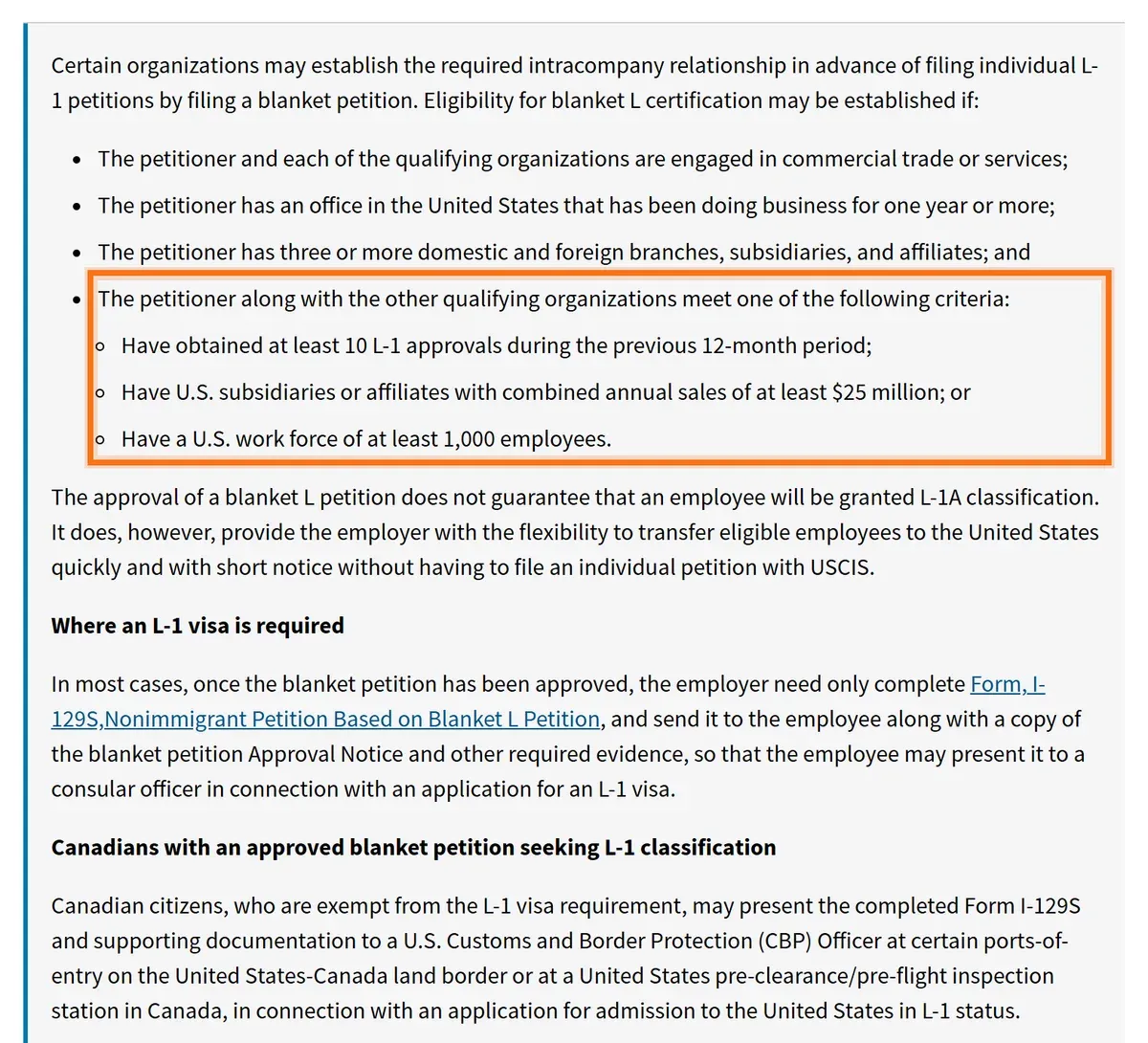
The test is in 8 CFR 214.2(l)(4), and USCIS repeats it word for word on its L-1A and L-1B pages. Your group must meet all four of these conditions:
- Commercial trade or services. The petitioner and every entity named in the blanket must be engaged in commercial trade or services.
- A U.S. office doing business for one year or more. "Doing business" means the regular, systematic and continuous provision of goods or services, not just an agent or an address. A brand-new U.S. office cannot use a blanket; it files a new-office L-1 instead.
- Three or more domestic and foreign branches, subsidiaries or affiliates. Each must meet one of the parent, branch, subsidiary or affiliate definitions, the same ownership and control tests USCIS applies to an individual petition.
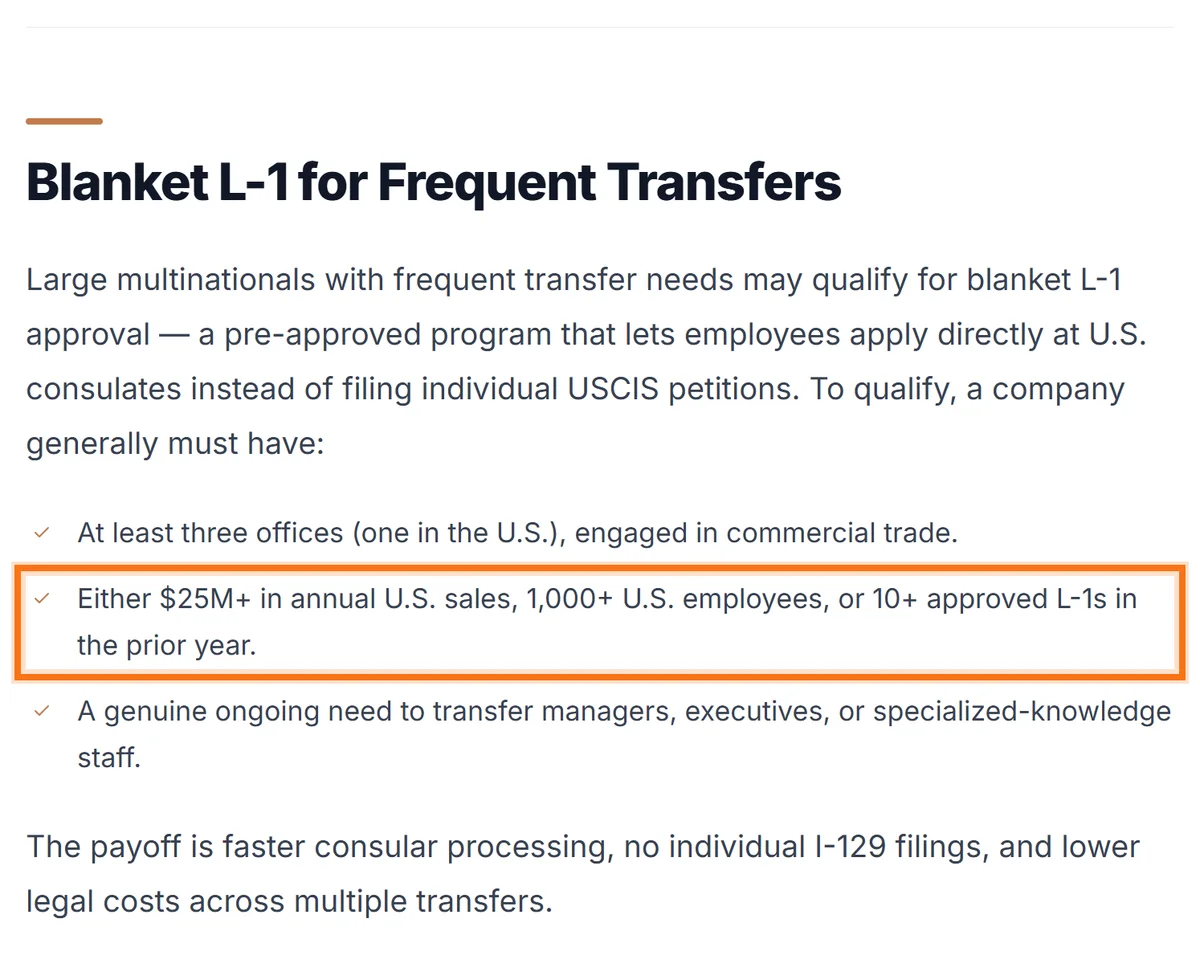
- One size threshold, counted for the petitioner together with the other qualifying organizations: at least 10 L approvals for managers, executives or specialized knowledge professionals in the previous 12 months; or U.S. subsidiaries or affiliates with combined annual sales of at least $25 million; or a U.S. work force of at least 1,000 employees.
The size tests are alternatives, so a group with a Dallas company selling $25 million a year can qualify without ever having filed an L-1. The harder part is the paper trail of ownership: if your structure has holding companies, joint ventures or recent changes, read our guide to the qualifying relationship RFE before you file, because the same proof decides the blanket.
When you apply, include every branch, subsidiary and affiliate that plans to transfer people under the blanket. USCIS can approve a blanket in whole or in part, so an entity whose relationship is unclear can drop out while the rest are approved.
Which employees a blanket covers, and which it does not
A blanket covers the same two L-1 roles as an individual petition, with one narrowing. Managers and executives qualify as they would under an individual L-1A. Specialized-knowledge staff qualify only if they are specialized knowledge professionals: people with specialized knowledge who are also members of the professions as defined in section 101(a)(32) of the Immigration and Nationality Act.
- L-1A managers and executives: covered. See L-1A vs L-1B for how USCIS separates a manager from a senior specialist.
- L-1B specialized knowledge professionals: covered. The Form I-129 instructions add that the person need not have worked in a "professional capacity" abroad to meet the one-year rule; the professional test applies to the U.S. job.
- L-1B specialists who are not members of a profession: not covered. File an individual L-1B petition.
- Employees who already used up their L time: not covered. The five-year limit for specialized knowledge and seven-year limit for managers and executives apply under a blanket too, along with the rule requiring a year outside the United States before a new L or H stay.
The one-year rule does not get shorter under a blanket. The consular or USCIS officer checks that the employee’s immediate prior year of continuous employment abroad was with an organization named in the blanket and in a managerial, executive or specialized-knowledge-professional position. Make sure the year abroad is complete and documented before the visa appointment.
How one transfer works under an approved blanket
Once USCIS approves the blanket, each move is handled with a short certificate instead of a full petition. For an employee who needs a visa:
- 1. The company completes Form I-129S, Nonimmigrant Petition Based on Blanket L Petition, in an original and three copies, and attaches a copy of the blanket approval notice (Form I-797) to each.
- 2. The company keeps one copy and sends the original and two copies to the employee, with the evidence of the job and the year abroad.
- 3. The employee applies for the L-1 visa at a U.S. consulate within six months of the date on the I-129S.
- 4. The consular officer decides whether the U.S. job is with an organization named in the blanket, whether it is a manager, executive or specialized knowledge professional position, and whether the year abroad qualifies. The visa is annotated "Blanket L-1"; a spouse and children receive "Blanket L-2".
- 5. At the border, the officer stamps the I-129S with a validity period of up to three years.
Canadian citizens do not need an L-1 visa. They present the I-129S and approval notice to a CBP officer at a Class A port of entry on the U.S.-Canada land border or at a U.S. pre-clearance or pre-flight station in Canada. For a visa-exempt employee, the company may instead file the I-129S with the USCIS service center that approved the blanket. An employee already in the United States in another status, such as H-1B, also goes through that USCIS office to change to blanket L-1.
Is a blanket faster than individual L-1 petitions?
Per transfer, yes, usually. With an individual petition, the employee cannot apply for the visa until USCIS approves the I-129; under a blanket, that step is gone and the employee goes straight to the consulate. USCIS describes the benefit as the flexibility to transfer eligible employees quickly and with short notice.
There are three limits on the speed. First, consular officers may grant blanket L classification only in clearly approvable cases. A borderline L-1B, a short or patchy year abroad, or a job title that does not match the duties is exactly what gets refused. Second, a consular refusal under the blanket is final: the company then files an individual petition, which must name the consulate, the date and the reason for the refusal. You lose the time spent at the consulate. Third, your company may not use both routes for the same person at once, unless a consular officer has first denied the blanket application.
So run two lanes: clear-cut managers and specialized knowledge professionals go through the blanket, and the harder cases go to USCIS as individual petitions, where the evidence can be reviewed on paper and premium processing is available. Check current USCIS timelines on our processing times page and see the premium processing guide for how the faster USCIS track works.
Blanket L vs individual L-1 petition: side by side
| Question | Individual L-1 petition | Blanket L petition |
|---|---|---|
| What USCIS approves | One employee, one job, one company relationship | Your group of qualifying organizations, once; employees later |
| Who can use it | Any qualifying organization, including a new U.S. office | Groups that meet the four tests and one size threshold; U.S. office in business 1+ year |
| Specialized knowledge staff | Any L-1B with specialized knowledge | Only specialized knowledge professionals |
| Filing for each transfer | Form I-129 with USCIS, then a visa application | Form I-129S taken straight to the consulate (or CBP for Canadians) |
| Who decides the employee’s case | USCIS | The consular officer, or USCIS/CBP for visa-exempt employees |
| If the employee is refused | RFE, appeal or refiling with USCIS | Consular refusal is final; file an individual petition |
| USCIS fees per transfer | $1,385 paper or $1,335 online, plus $600 Asylum Program Fee and $500 fraud fee for initial approvals | I-129S filing fee $0; $500 fraud fee paid through the employee at the consulate |
| Length of the approval | Up to 3 years (1 year for a new office) | Group approval 3 years, then indefinite; each employee up to 3 years on the I-129S |
How to read this table: the middle column is what you do for every transfer without a blanket; the right column is what you do once you have one. The blanket moves the employee review from USCIS to the consulate, which saves a filing and a wait, and in exchange it narrows who qualifies and removes the second chance if the officer says no.
Not sure your group qualifies for a blanket L?
Send us your ownership chart, U.S. sales or headcount, and the transfers you expect next year. We will tell you whether a blanket fits, which entities to include, and which employees should still go through individual petitions, with a flat fee in writing.
What a blanket L costs in government fees
The blanket petition is itself an L petition on Form I-129. Under the USCIS fee schedule (Form G-1055, edition 11/19/26), the L petition fee is $1,385 on paper or $1,335 online, or $695 for a small employer or nonprofit, plus the Asylum Program Fee of $600 for a regular petitioner ($300 for a small employer, $0 for a nonprofit). Premium processing on Form I-907 is $2,965 and is listed for L-1, including Blanket L-1.
- Form I-129S: $0 USCIS filing fee, plus additional fees if they apply.
- Fraud Prevention and Detection Fee, $500: under a blanket, the State Department collects it from the company through the employee who applies for the L-1 visa at a U.S. embassy or consulate. For visa-exempt employees, USCIS or CBP collects it. It cannot be waived or refunded.
- Public Law 114-113 fee, $4,500: applies to L-1 filings by companies with 50 or more U.S. employees when more than half of them are in H-1B, L-1A or L-1B status, for petitions filed on or before September 30, 2027.
Compare that with an individual initial petition: $1,385 + $600 + $500 is $2,485 in USCIS fees per transfer before premium processing. With several transfers a year, the I-129 fees saved outweigh the blanket’s one-time filing fee. For the full employer fee picture, see business immigration costs for employers.
The HR decision: blanket, individual petitions, or both
For an HR team, the blanket is a program decision, not a case decision. Five questions settle it:
- How many transfers, on how much notice? One or two a year rarely justify the upkeep; a steady flow of managers and engineers, often on short notice, does.
- Who are the transferees? If most are managers, executives or specialized knowledge professionals, the blanket fits. Specialists who are not members of a profession will need individual L-1B petitions anyway.
- How clean is your structure? Every entity in the blanket must keep a documented qualifying relationship. Frequent acquisitions and disposals mean frequent amendments.
- Where will employees apply? Blanket cases depend on consular officers, and a refusal there sends you back to an individual petition. For a key hire with a borderline record, file individually from the start.
- Who keeps the records? The extension after three years requires a report of every admission. Someone must track names, roles, entities and entry and departure dates from day one.
If an L-1 is only one of the options for a hire, compare it with H-1B, O-1 and TN in choosing a work visa for a new hire. For managers and executives who will stay, the L-1A also leads toward the EB-1C multinational executive green card.
When the blanket expires or your company restructures
A blanket is approved for three years. To keep it, the company files a new Form I-129 with a copy of the earlier approval notice and a report of admissions for those three years: each person admitted under the blanket, the position held, the employing entity, and the dates of first admission and final departure. The company also states whether it still meets the blanket criteria and documents any changes in its relationships. If approved, the blanket is extended indefinitely.
- If you miss the extension: the blanket is automatically revoked, and the group must use individual petitions until another three years have passed before it can apply for a new blanket.
- Employees already in the U.S.: an employee can be admitted for three years even if the blanket’s first three-year period ends sooner, but the company must then either obtain indefinite validity or file an individual petition to support that person’s stay.
- Extending an employee’s stay: file a new I-129S with a copy of the previous one, plus a petition extension, while the employee is in the United States. Extensions run in increments of up to two years, to the five- or seven-year total.
- Moving an employee between group companies: allowed without going back to USCIS if the duties stay virtually the same. Different duties need a new I-129S approved by the office that approved the blanket.
- Mergers, acquisitions, new subsidiaries: file an amended petition, with fee, to reflect changes in approved relationships or to add qualifying organizations. An entity sold off or no longer qualifying can be removed by USCIS through a notice of intent to revoke.
- An unused blanket: USCIS may revoke it if none of the organizations has used it for three consecutive years.
If the blanket is revoked while L-1 employees are in the United States and they are otherwise still eligible, USCIS extends it only as long as needed to support their stay, and no new employees can enter under it. Deal teams should add the blanket to their diligence list; our guide to immigration in mergers and acquisitions covers what to check before closing.
How Atlas Immigration Law helps with blanket L petitions
Our L-1 visa practice handles L-1A, L-1B, blanket and new-office petitions for multinational companies. For a blanket, we map the corporate group, decide which entities to include and how to prove each relationship, assemble the evidence for the size threshold, and set up the I-129S packet your HR team will reuse for each transfer. We also coordinate the EB-1C green card path for transferred managers when it is time.
Blanket work sits inside our broader business immigration services and work visa practice. We work on flat fees with milestone billing, employees upload documents through our secure client portal, and every case has a dedicated paralegal you can reach by call, email or text. We are based in Dallas, at 1920 McKinney Ave, and represent employers nationwide because immigration law is federal. To find out whether your group qualifies, book a free consultation or call (945) 219-5599.
Frequently asked questions
What are the requirements for an L-1 blanket petition?
The petitioner and each entity must be engaged in commercial trade or services, the U.S. office must have been doing business for one year or more, the group must have three or more domestic and foreign branches, subsidiaries or affiliates, and it must meet one size test: at least 10 L approvals in the previous 12 months, U.S. subsidiaries or affiliates with combined annual sales of at least $25 million, or a U.S. work force of at least 1,000 employees (8 CFR 214.2(l)(4)).
Is a blanket L faster than an individual L-1 petition?
For each transfer, usually yes: the employee skips the USCIS Form I-129 petition and applies for the visa at a U.S. consulate with Form I-129S. The catch is that consular officers may approve only clearly approvable cases, and their refusal is final, so a borderline case can end up slower once the company has to file an individual petition after the refusal.
How long is a blanket L approval valid?
The first approval is valid for three years. The company can then extend it indefinitely by filing a new Form I-129 with the prior approval notice and a report of every admission under the blanket in the preceding three years. If it does not ask for indefinite validity, the blanket is automatically revoked.
Can an L-1B employee use a blanket petition?
Only if the employee is a specialized knowledge professional: someone with specialized knowledge who is also a member of the professions. Specialized-knowledge employees who are not professionals need an individual L-1B petition. The person does not have to have worked in a professional capacity abroad.
What is Form I-129S and how much does it cost?
Form I-129S, Nonimmigrant Petition Based on Blanket L Petition, is the certificate the company completes for each employee transferred under an approved blanket. It has a $0 USCIS filing fee; the $500 Fraud Prevention and Detection Fee is collected through the employee at the consulate.
How do Canadian employees use a blanket L?
Canadian citizens do not need an L-1 visa. They present the completed Form I-129S and the blanket approval notice to a CBP officer at a Class A port of entry on the U.S.-Canada land border or at a U.S. pre-clearance or pre-flight station in Canada. The company may instead file it with the USCIS service center that approved the blanket.
What happens if the consulate denies an employee under the blanket?
The consular officer’s decision on a blanket application is final. The company may then file an individual L-1 petition with USCIS, stating the reason for the refusal, the consulate that made it and the date.
Do we need to amend the blanket after an acquisition or reorganization?
Yes. An amended petition, with fee, must be filed to reflect changes in approved relationships or to add new qualifying organizations to the blanket. Employees can move between listed companies without a new filing only if their duties stay virtually the same.
This guide is part of our work visa services for employers — the service page covers eligibility, fees, and how we handle these cases.

Founder & Managing Attorney, Atlas Immigration Law
Member of the American Immigration Lawyers Association (AILA) and the Dallas Bar Association. Licensed to practice in Texas; fluent in English and Spanish.
Legally reviewed by a licensed immigration attorney
Talk to an immigration attorney about your case
Free consultation on request, flat fees, and a dedicated paralegal who knows your case — serving clients in all 50 states.
This guide is general information, not legal advice, and reading it does not create an attorney-client relationship. Immigration law and procedures change, and how they apply depends on your specific facts — consult a licensed immigration attorney about your situation.