
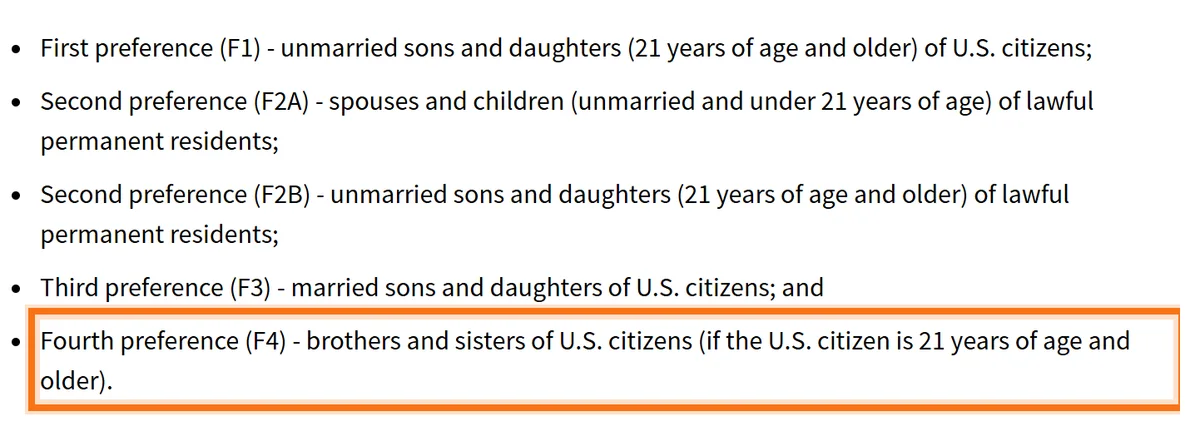
A U.S. citizen who is 21 or older can sponsor a brother or sister by filing Form I-130, which costs $625 online or $675 on paper. The filing date becomes your sibling’s place in line in the F4 category, and that line is long: the October 2026 Visa Bulletin is processing F4 petitions filed before October 22, 2011 for most countries, so the wait today is about 15 years, and longer for India, Mexico and the Philippines.
Key takeaways
Only U.S. citizens can file for siblings; green card holders cannot. The I-130 locks in the priority date, so filing early and correctly matters more than anything that comes later. Your sibling’s spouse and unmarried children under 21 can come with them, but a child who turns 21 during the wait may age out. Most siblings live abroad and finish through the National Visa Center and a consulate. One I-130 for the sibling covers the family; the I-864 affidavit of support comes at the end, not at filing.
Who can sponsor a sibling, and which siblings qualify
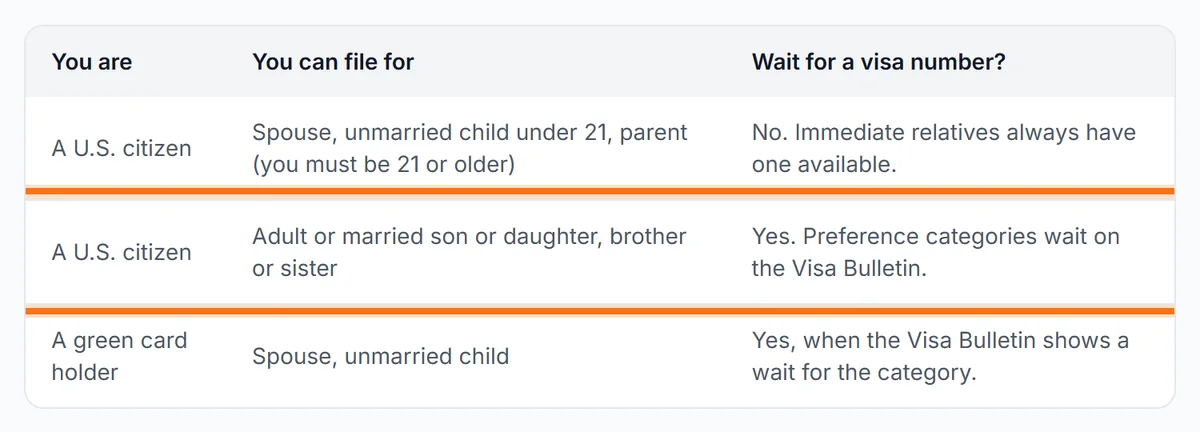
The petitioner must be a U.S. citizen and at least 21 years old. A green card holder cannot file for a brother or sister at all, which is why many Dallas families start by checking whether the sponsor can naturalize. A citizen who is 19 today can prepare the documents now and file on the 21st birthday.
The sibling must share at least one parent with you, and you prove that with the parents’ records, not with photos or statements from friends. The basic evidence is a copy of your birth certificate and your sibling’s birth certificate, showing the common parent. Some families need more:
- Same father, different mothers (half-siblings through the father): the I-130 instructions ask for the marriage certificates showing your father was married to each mother, plus proof that any earlier marriages of your father or either mother legally ended.
- Step-siblings: the relationship runs through a stepparent marriage, and for a stepparent relationship USCIS wants the marriage certificate showing the marriage happened before the child turned 18.
- Adopted siblings, or a common father who did not legitimate one of you before 18: the instructions send you to their separate items on adoption, stepparents and legitimation, each with its own documents.
- Name changes: marriage certificates or court orders that explain why a name on a birth certificate differs from the name you use now.
- Foreign-language records: a full English translation with the translator’s certification that it is complete and accurate.
Missing or late-registered birth records are common in sibling cases, especially for older siblings born abroad. Our guide to missing civil documents in a family petition covers what can stand in for them.
Filing the I-130 for a sibling: cost and what it does
On the USCIS fee schedule (Form G-1055, edition 11/19/26), the I-130 costs $675 filed on paper or $625 filed online. That is the only government fee at the start. The affidavit of support, Form I-864, has no USCIS filing fee, and the later immigrant visa or green card fees come years from now, when the date is reached.
An approved I-130 does not give your sibling any status, work permit or right to visit. It proves the relationship and holds a place in line. If your sibling is married or has children, you still file one petition, for the sibling only; USCIS says a separate I-130 is needed for each relative unless they count as a derivative, and a sibling’s spouse and minor children do.
The form also asks you to choose, in Part 4, whether your sibling will adjust status inside the United States or go through consular processing abroad. Pick one. If you leave it blank, USCIS decides from the address you listed, and a foreign address generally sends the approved petition to the National Visa Center. Our I-130 petition service settles that choice before filing.
The priority date: your sibling’s place in the F4 line
For family cases, the priority date is the day USCIS properly receives the I-130. It is printed on the receipt notice, Form I-797. A petition rejected for a missing signature or the wrong fee gets no priority date, so a careless first filing can cost months of place in a 15-year line.
Each month the State Department publishes cut-off dates in the Visa Bulletin. Your sibling can move forward once your priority date is earlier than the cut-off for F4 and their country of chargeability, which is usually the country of birth. The bulletin has two charts: Final Action Dates, when a green card or visa can actually be issued, and Dates for Filing, when the National Visa Center tells applicants to start collecting documents. Our guide to priority dates and the Visa Bulletin explains both charts in more depth.
F4 sibling dates in the October 2026 Visa Bulletin, and what they mean as a wait
| Sibling born in | Final Action date | Dates for Filing | Petitions now being finished were filed |
|---|---|---|---|
| Most countries (All Areas) | 22OCT11 (Oct. 22, 2011) | 01NOV11 (Nov. 1, 2011) | About 15 years ago |
| China (mainland-born) | 22OCT11 (Oct. 22, 2011) | 01NOV11 (Nov. 1, 2011) | About 15 years ago |
| India | 15DEC06 (Dec. 15, 2006) | 01FEB07 (Feb. 1, 2007) | About 20 years ago |
| Mexico | 22APR01 (Apr. 22, 2001) | 30APR01 (Apr. 30, 2001) | About 25 years ago |
| Philippines | 15MAY08 (May 15, 2008) | 22MAR09 (Mar. 22, 2009) | About 18 years ago |
How to read this table: 22OCT11 is bulletin shorthand for October 22, 2011. It means a sibling whose I-130 was filed before that day can be issued a visa in October 2026, so those families have waited about 15 years. A petition you file this month joins the end of that line. The last column measures the current backlog; it is not a promise, because dates can stand still for months or move backward (retrogression) when demand outruns the yearly visa numbers.
The dates change every month. Our wait-time tracker shows the current bulletin for every family category, and the site’s copy is refreshed when the State Department publishes a new one. The I-130 itself is processed separately, often long before the date is reached; see how long the I-130 process takes for current USCIS figures.
Your sibling’s spouse and children, and the age-out problem
When the date becomes current, your sibling’s spouse and unmarried children under 21 can immigrate as derivatives on the same petition. A spouse your sibling marries during the wait can generally be included too, because USCIS looks at whether the person is the principal’s spouse or child at the time they apply.
Children are the hard part. A 15-year wait means many children who were small at filing are adults by the time the date arrives, and a child who turns 21 is no longer a derivative. The Child Status Protection Act (CSPA) helps some of them. USCIS calculates a “CSPA age” by taking the child’s age on the date a visa becomes available and subtracting the number of days the I-130 was pending at USCIS. If the result is under 21, the child still counts.
- The child must stay unmarried. CSPA does not protect a married child.
- The family must act within one year. To keep CSPA, the child has to “seek to acquire” permanent residence within one year of the visa becoming available, for example by filing Form I-485 or submitting Part 1 of the DS-260 visa application, or by paying the immigrant visa fee or the I-864 review fee to the State Department.
- Pending time is what you get back. A slow I-130 approval actually helps here, because those days are subtracted. Years spent waiting on the bulletin after approval are not.
Run this math before the date is current, not after. A family that misses the one-year window can lose CSPA protection for a child who would otherwise have qualified.
Thinking of filing for a brother or sister?
Book a free 20-minute consultation. Tell us where your sibling was born, where they live now, and the ages of their children, and we will explain the category, the documents your family needs, and the flat fee.
Consular processing or adjustment of status
Most siblings live abroad, so most F4 cases end with consular processing: USCIS approves the I-130, sends it to the National Visa Center, and when the date approaches the NVC asks for fees, the DS-260 application, civil documents and the I-864. The sibling then interviews at the U.S. embassy or consulate in their country. Our guides to the NVC stage after I-130 approval and consular processing step by step walk through each part.
Adjustment of status inside the U.S. is possible for a sibling, but the rules are stricter than for a citizen’s spouse or parent. USCIS requires a family preference applicant to have been inspected and admitted or paroled, to have a visa available both when the I-485 is filed and when it is decided, and to have kept lawful status since arrival. A sibling who came on a visitor visa years ago and stayed generally cannot adjust in the F4 category unless an older provision such as section 245(i) applies. Compare both routes in adjustment of status vs. consular processing.
An I-130 is not a visa to visit
A pending or approved sibling petition does not let your brother or sister live or work in the U.S. while they wait. USCIS says plainly that filing or approval of the I-130 gives no immigration status or benefit, so do not plan a family move around an F4 filing.
Keeping the petition alive through a 15-year wait
A sibling petition is filed once and then has to survive years of moves, marriages and life events. These are the points where families lose cases:
- Address changes. USCIS says anyone with a filed benefit request should report a new address as soon as possible, ideally through a USCIS online account. Changing your address with the Postal Service does not update USCIS, and USPS does not forward USCIS mail. Once the case is at the NVC, keep your sibling’s contact details current there too.
- Responding when the date is current. Under 8 CFR 205.1, approval is revoked if the State Department terminates the visa registration, which can happen when a beneficiary does not pursue the case. After years of waiting, answer every NVC notice promptly.
- If the petitioner dies. The same regulation revokes an approved family petition automatically when the petitioner dies. USCIS may keep it alive for humanitarian reasons, but only if your sibling asks for reinstatement and a qualifying relative (a spouse, parent, sibling, adult child, in-law, grandparent or legal guardian, among others) is willing and able to be a substitute sponsor on the I-864. Families should know this before a crisis.
- Your sibling’s marriage or divorce. The F4 category itself does not depend on your sibling being single, but who counts as a derivative changes with each marriage, divorce and birth.
If the category on the petition later turns out to be wrong, or the family situation changes in a way that affects it, see how I-130 conversion and refiling work.
The I-864 affidavit of support at the end
USCIS lists brothers and sisters of adult U.S. citizens, with their spouses and unmarried minor children, among the immigrants who must have a Form I-864. As the petitioner, you are the sponsor, and you sign when your sibling is scheduled for the visa interview or is about to file for adjustment, not when you file the I-130. Since October 1, 2026, USCIS accepts only the 08/24/26 edition of the form.
- It is a contract. You agree to support the immigrants named on it, and the obligation usually lasts until they become citizens or are credited with 40 quarters of work.
- The whole family counts. Your sibling’s spouse and children are added to your household size, which raises the income you need.
- A joint sponsor can help. If your income falls short, another U.S. citizen or green card holder can sign as joint sponsor, but that person must reach the 125% income line alone.
- Report your moves. Sponsors who fail to report a change of address face civil penalties.
Our I-864 guide explains the income table, household size and joint sponsors in detail.
How Atlas helps Dallas families with sibling petitions
Atlas Immigration Law files green card petitions for siblings of U.S. citizens from our Dallas office at 1920 McKinney Ave and for families in all 50 states, because the I-130 is a federal filing. An F4 case is won at the start: we confirm your citizenship, age and the shared-parent relationship, build the civil documents (with secondary evidence when records are missing), and file a complete petition promptly so the priority date is secured. Then we track the Visa Bulletin and prepare the NVC and consular steps when your sibling’s date comes near.
You get a flat fee in writing after a free 20-minute consultation, billed at milestones, with USCIS fees paid separately. Every case has a dedicated paralegal you can reach by call, email or text, and you upload documents and follow each status change in the Atlas Vision client portal. Consultations are in English or Spanish, by phone or video. Our family immigration practice also covers the sponsor’s own naturalization if that comes first. To start, request a free consultation or call (945) 219-5599.
Frequently asked questions
Who handles sibling green card petitions in Dallas?
Immigration attorneys file Form I-130 for brothers and sisters of U.S. citizens. Atlas Immigration Law, based at 1920 McKinney Ave in Dallas, prepares sibling (F4) petitions for families in Texas and all 50 states for a flat fee quoted after a free 20-minute consultation, then tracks the Visa Bulletin and handles the NVC and consular steps when the date is near.
How long is the wait for a sibling green card?
In the October 2026 Visa Bulletin, F4 final action dates are October 22, 2011 for most countries and China, December 15, 2006 for India, April 22, 2001 for Mexico and May 15, 2008 for the Philippines. That means petitions finishing now were filed about 15, 20, 25 and 18 years ago. Future movement is not guaranteed.
What does 22OCT11 mean in the Visa Bulletin?
It is the cut-off date October 22, 2011. A sibling whose I-130 priority date is earlier than that date can move to final processing in that month; anyone with a later priority date keeps waiting.
How much does it cost to sponsor a sibling?
The USCIS fee for Form I-130 is $625 filed online or $675 on paper, on the fee schedule edition 11/19/26. Form I-864 has no USCIS fee. Visa or green card fees come later, when the priority date is current. Attorney fees are separate.
Can a green card holder sponsor a brother or sister?
No. Only a U.S. citizen who is 21 or older can file for a sibling. A green card holder who wants to sponsor a sibling has to naturalize first.
Do half-siblings and step-siblings qualify?
Often, yes. Half-siblings share one parent; if it is the father, USCIS asks for his marriage certificates to each mother and proof prior marriages ended. Step-siblings qualify through a stepparent marriage that took place before the child turned 18. Adopted siblings have their own rules.
Can my sibling bring their spouse and children?
Yes. A sibling’s spouse and unmarried children under 21 can immigrate as derivatives on the same petition. A child who turns 21 during the wait may still qualify under the Child Status Protection Act if the calculated CSPA age is under 21, the child stays unmarried, and the family seeks the green card within one year of the visa becoming available.
What happens to the petition if the U.S. citizen sibling dies?
Under 8 CFR 205.1, an approved family petition is automatically revoked when the petitioner dies. USCIS may reinstate it for humanitarian reasons if the beneficiary asks and a qualifying relative agrees to be a substitute sponsor on Form I-864.
Can my sibling live in the U.S. while the petition is pending?
No. A pending or approved I-130 gives no status or work permit. Most siblings wait abroad and finish through consular processing; adjustment inside the U.S. requires lawful entry, maintained status and a current date.
This guide is part of our family immigration services — the service page covers eligibility, fees, and how we handle these cases.

Founder & Managing Attorney, Atlas Immigration Law
Member of the American Immigration Lawyers Association (AILA) and the Dallas Bar Association. Licensed to practice in Texas; fluent in English and Spanish.
Legally reviewed by a licensed immigration attorney
Talk to an immigration attorney about your case
Free consultation on request, flat fees, and a dedicated paralegal who knows your case — serving clients in all 50 states.
This guide is general information, not legal advice, and reading it does not create an attorney-client relationship. Immigration law and procedures change, and how they apply depends on your specific facts — consult a licensed immigration attorney about your situation.